

Yoon Suk Yeol’s Failed Self-Coup and the Evolution of Korean Constitutional Democracy
[Professor Jongcheol Kim’s Constitution for the Citizens] Overcoming Yoon’s self-coup is the evolutionary process of the Korean-style democratic republic. Institutions and culture that reproduce the resilience of democracy, such as the autonomy and independence of the National Assembly, the Constitutional Court and the ordinary courts, and the rise of a new generation that embodies the victory of the people, are becoming a new driving force that will continue the momentum of Korean democratization.
- “한국 입헌민주주의는 진화중이다” translation of a Korean column originally published on January 29, 2025, titled “한국 입헌민주주의는 진화중이다” .
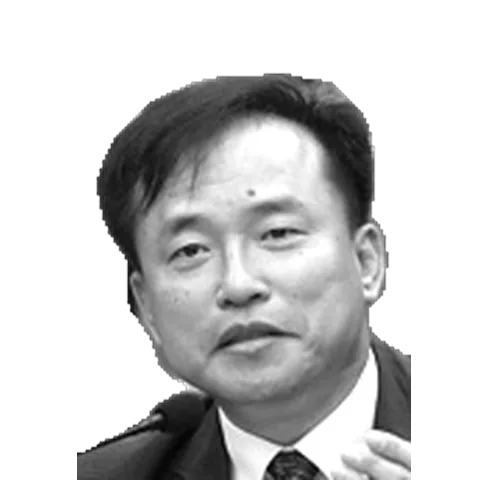
- Author Professor Jongcheol Kim is a constitutional law scholar at Yonsei University School of Law. After graduating from Seoul National University College of Law for his LL.B. and LL.M., he obtained his Ph.D. in law at the London School of Economics and Political Science, UK. He has served as President of the Korean Public Law Association, Vice Chair of the National Constitutional Advisory Committee, a member of the Prosecutorial Reform Committee at the Supreme Prosecutor’s Office and other advisory positions in public and private sectors. He views his role as a constitutional scholar as contributing to civic constitutional education, political reform, and judicial reform rooted in the principles of a democratic republic.
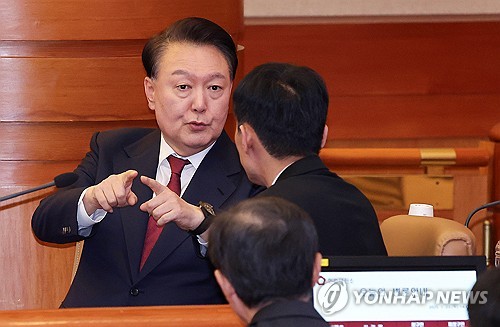
Yoon Suk Yeol’s indictment on January 26 2025 as a new milestone in South Korean history
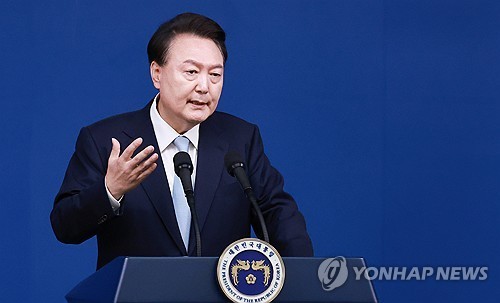
President Yoon Suk Yeol, who has become a “notorious” figure in South Korea’s 21st century history, has made another record. He became the first sitting president in the country’s history to have an arrest warrant and detention warrant executed against him, and the first to be indicted.
Now South Korea’s democratization is moving toward to its summit by remembering that the president, a symbol of “living power,” can be criminally prosecuted even while in office. Article 84 of the Constitution, allowing criminal prosecution of sitting presidents only for insurrection and treason, had been thought to be dead and buried but is now revived. We should have recognized it when Yoon Suk Yeol appeared in the presidential debate and showed the public the Chinese character of the Crown(王) written on his palm, but was it too late? In any case, the fact that we elected a delusional man who thought he was a “king” to rule the “democratic republic” in the 21st century may be enough to show the imperfections of Korean democracy.
But can this rebellious declaration of martial law be seen as a setback for South Korean democracy? Attempting to answer this question may be futile. The impeachment process is still underway and the criminal case is still ongoing despite Yoon’s detention and indictment, so it’s hard to say. Still, there is a motive for this haste. It is not too early to reflect on the causes of this situation and to consider the best response. Above all, it is necessary to ponder what we, the people of the democratic republic, should do in this ‘constitutional moment’ at the historical crossroads between constitutional crisis and constitutional restoration. It is not important whether diagnoses and predictions are right or wrong, but rather that we cannot neglect constant reflection to fulfill our minimum obligations as members of history and community through constitutional practice.
In my last column, ”내란, 보수의 퇴행과 한국 정치의 재편성,” I examined the current state of political polarization and confirmed that conservative regression has deepened the roots of the far right in Korean society to the point where it cannot be ignored. It is now up to Korean democracy to prevent the right-wing extremists, who have demonstrated the ruthlessness and violence to throw away even the Constitution of the Democratic Republic as if it were an old and dirty shoe, from intruding into our daily lives and to reorganize Korean politics around the defenders of the Constitution.
Subduing an Insurgency, Another Evolution of the Korean Democratic Republic
On the other hand, it is worth noting that South Korea’s constitutional democracy, which has grown through many ups and downs over the past three and a half centuries since 1948, is poised to take another step forward through this self-coup. There are many signs that South Korea’s proud history of evolving from a divided country that survived a civil war and two subsequent military coups into a leading democratic republic and a major player in the global market economy is being revisited in the wake of the anachronistic self- coup by the sitting president. We need to have the wisdom and foresight to recognize the possibility that the resilience of democracy to turn crises into opportunities and forge a new transition is once again on display in Korea’s constitutional history.
This article examines the resilience of South Korea’s constitutional democracy from the perspective of the evolution of the Korean democratic republic. The Korean democratic republic is a unique democratic republic that has been built over a period of more than 110 years, since the Shanghai Interim Government adopted democratic republic as the national form of government for the first time in Korean history in 1911, and just under 40 years since the current constitutional system was established by the June 1987 uprising. There are many features of this constitutional system, but in this column, we will focus on three that are directly relevant to analyzing the implications of Yoon’s self-coup on December 3, 2024.
A Checked and Balanced Presidency - A Presidential System Harmonized with Parliamentarism
First, the Korean democratic republic has a tradition of adopting a checked and balanced presidential system as its power structure, which is premised on cooperation with the parliament. There is no vice president, but the Prime Minister, who is appointed with the consent of the National Assembly, is the second in executive power. The executive power is not vested in a single president, but there are several constitutional institutions that form a government headed by the president, but which share executive power with the president. These are the Prime Minister and State Councilors, the State Council, which is a national deliberative body, and the administrative departments. The President’s official acts, including those related to the military, must be documented and countersigned by the Prime Minister and the relevant State Councilors, and important state affairs must be deliberated by the State Council.
The National Assembly, on the other hand, has the constitutional authority not only to establish the organization and scope of the government by law, but also to control the president’s major powers, such as the power to command the military, pardon, and appoint public officials, all of which are controlled by legislation passed by the National Assembly. It even has the right to authorize and request the lifting of emergency orders and martial law, which are national emergency powers. In short, it is safe to say that there is very little that a government headed by a president can do without the cooperation of the National Assembly. In this situation, it is often called ‘imperial presidentialism’ because the president has a wide range of powers such as budgeting, submitting bills, vetoing bills, and appointing Supreme Court justices and Constitutional Court judges, but in short, it is an illusion of the system and operation.
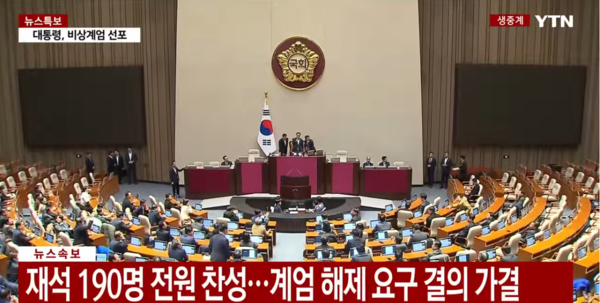
In relation to the December 3 emergency martial law, President Yoon Suk Yeol was impeached for failing to comply with not only the procedures required for the declaration of martial law, such as deliberation by the State Council, countersignature of documents by the prime minister and other State Councilors, and notification to the National Assembly but also the substantive constitutional requirements such as the existence of national emergency. And because the National Assembly has the final say on the maintenance of martial law under the constitutional procedure, the National Assembly was able to vote to lift the restrictions after the blockade of the National Assembly by the martial law forces and police failed due to citizen resistance. This constitutional power structure, which differs fundamentally from the U.S. presidential system in which the president alone exercises ultimate authority over the military and the executive branch, made it possible for the National Assembly and the judiciary to control the rebellion under the guise of martial law.
In short, the vertical and horizontal separation of powers and the system of checks and balances inherent in the unique power structure of the Korean-style democratic republic prevented a self-coup by a delusional leader and his followers. On the one hand, this emergency martial law case confirmed the need for reforms to democratize and decentralize power institutions such as the prosecution, police, and intelligence agencies, which are still easily politicized and corrupted to back up the presidential abuse of power, but on the other hand, it also confirmed the advantages of the checked and balanced power structure of the Constitution.
Autonomy and Independence of the Constitutional Court and the Ordinary courts - the Judiciary as the Second Tier of Power Control
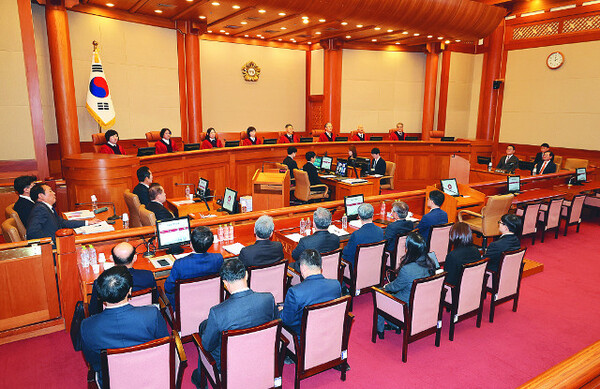
The second feature of the Korean democratic republic is the activation of the Constitutional Court, an independent institution that is established by the constitution and has the authority to review unconstitutional laws, impeachment, dissolution of political parties, competence disputes, and constitutional complaints. Under the circumstances that the old legacies of the authoritarian presidential system and the centralized law enforcement and intelligence agencies tend to make the president easily ignore constitutional barriers, despite the National Assembly’s legislative authority and oversight power over the president’s authority, and the checked and balanced power structure within the executive branch, the existence of the Constitutional Court, with important powers to control constitutional disputes, plays a vital constitutional role in ensuring the overall accountability as well as the stability of the Korean-style democratic republic.
Of course, we should not overlook the ambivalence of the Constitutional Court, which does not necessarily perform a positive function and runs the risk of exacerbating the danger of “juristocracy” through an excessive “judicialization of politics”. However, it cannot be denied that the constitutional court system is at least an important check on power, capable of removing from office those who aspire to become imperial presidents against the backdrop of parliamentary impeachment proceedings. This is a far cry from the negative experience of some countries, such as Hungary, Brazil, and Thailand, where excessive judicialization of politics actually undermines constitutional democracy.
The impeachment adjudication against Yoon Suk Yeol is currently underway, and the unconstitutional and illegal acts in the execution of his duties so far are enough to warrant his removal from office. The unconstitutionality and illegality of the declaration of emergency martial law in clear violation of constitutional procedures and requirements, the issuance of Martial Law Proclamation No. 1 outside the constitutional limits, the occupation of the National Assembly and the National Election Commission, and the arrest orders of key figures are self-evident and supported by objective evidence that cannot be denied by facts witnessed by the entire nation and the world, as well as the president’s own discourses and claims.
In the past 20 years, three presidents have been impeached, but their fates have been mixed. Roh Moo Hyun, who was strongly trusted by the people, was returned to power, while Park Geun Hye, who had completely lost the trust of the people, was removed from office. Now, Yoon Suk Yeol, who is obviously guilty of insurrection and cannot prove himself worthy of upholding the constitution by plotting to divide the country through incitement against his blind followers, will be removed from office. These realities, on the one hand, show the instability of Korean democracy, but on the other hand, they also show that important cases are accumulating to further stabilize Korean democracy. A cherished constitutional practice is accumulating that those in power who grossly violate the constitution and laws cannot remain in office.
Along with the impeachment adjudication, the unconstitutionality and illegality of the declaration of emergency martial law and its execution constitute the crime of insurrection under the criminal law, and it should be noted that in the process of prosecuting the guilt of insurrection, the court issued arrest warrants and detention warrants, holding the president and his followers who tried to become dictators under the guise of martial law accountable through the criminal justice system.
In the process, extreme right-wing forces supporting Yoon Suk Yeol, a suspect in the insurrection, has stormed the courthouse, exposing a new threat to South Korean democracy, but at the same time, accumulating achievements that paradoxically confirm the autonomy of the courts, whose independence from presidential power has been constantly questioned in authoritarian regimes.
The Last Battalion of Korean Democracy - Direct Action by Sovereigns as the Third Tier of Power Control
Finally, a key feature of Korean-style democratic republic is that direct action by the sovereign people is an important pillar of the constitution. This is a dramatic manifestation of what we might call “plaza democracy” as a kind of “monitoring democracy”.
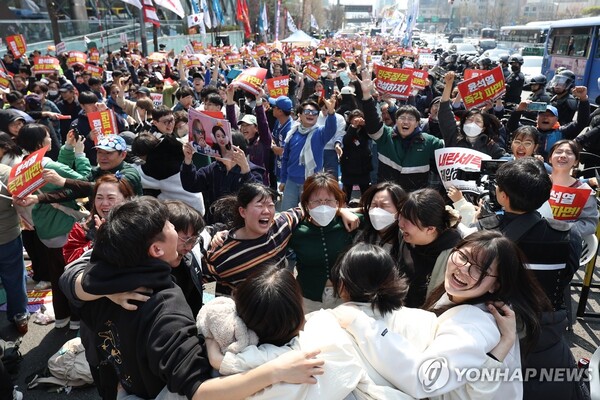
In fact, Korea’s constitutional history is a proud history of “people’s victories” that have consistently defied the dictatorships. From the March 1 Independence Movement (1919), the April 19 Democratic Revolution (1960), the May 18 Gwangju Democratization Movement and Bu-Ma Uprising (1979~1980), the June Uprising (1987), to the Candlelight Revolution (2016~2017), each “constitutional moment” has been marked by the sovereign determination and action of the people. The crushing of the December 3 insurrection, which marked a major milestone with the arrest and indictment of the incumbent President Yoon Seok Yeol, will soon go down in history as another proud constitutional moment, along with his impeachment.
It is also important to note that the social foundations of the constitutional community are being strengthened by the people’s resistance to the December 3 Emergency Martial Law. They were the main force that effectively neutralized Yoon Suk Yeol’s self-coup and are the last battalion of Korean democracy. It is particularly noteworthy that the 2030 generation was at the center of the citizens who gathered daily in front of the National Assembly from December 7 to December 14 to subdue the forces that were obstructing the impeachment of the alleged insurrectionists. It is important to remember that the creativity and dynamism that turned a moment of despair into a moment of hope by “chanting” K-pop with idol cheering sticks instead of candles is remembered, embodied and shared by Korean society.
Finally, a new generation has emerged in twenty-first-century Korea, one that has shed the shell of idol fan clubs and realized the importance of democracy as a strong wall that will guarantee their daily happiness. This generation is manifestly demonstrating the characteristics of a postmodern subject who cannot be bound by the old shackles of modern subjectivism. It is characterized by spontaneity and flexibility that restores and sublimates the centrifugal force of individualization into the centripetal force of solidarity with the minorities in the community. It shows the possibility that citizen empowerment can strengthen the dynamics of community, not drive its dissolution.
Above all, it should not be forgotten that this new entity is based on respect for the constitutional order. It is the birth of a new entity as a champion of order against the mainstream of the old system, which is so obsessed with profit and power that it does not hesitate to break the rules of coexistence, such as the Constitution. While they do not forget the virtues of tolerance, patience and moderation in dealing with the incompetent, irresponsible and unscrupulous usurpers of everyday life, they do not waver for a moment in their determination to bring them to justice in accordance with the procedures prescribed by the Constitution and the law. They are unwavering in their adherence to the principle of “constitutionalism” even in the face of innumerable sophistries and atrocities against the Constitution. Even in the extreme situation of an insurrection, we have not given up the basic principle of solving problems through impeachment, impeachment adjudication, and criminal proceedings. Despite the recklessness of some in the civil service and political sphere who continue to perpetuate their vested interests rather than focusing on quickly resolving the insurgency and restoring the constitution, we are patiently and slowly but resolutely going through the constitutional process to prevent the worst possible consequences of the crisis.
Of course, we cannot neglect the emergence of another 2030 who claims to be an operative of the ultra-right faction that is their counterforce. It is worth noting, however, that they are fundamentally different in their spontaneity and human rights friendliness from those captured and mobilized by the far-right Christian demagogues and far-right YouTubers. Moreover, when they talk about and practice the virtues of coexistence and the importance of the Constitution and the rule of law, the members of the far-right fringe disqualify themselves from being at the center of a democratic republic by appealing to exclusion, hatred and violence, and by denying the Constitution and the rule of law.
The people of South Korea are demonstrating the resilience that is unique to the Korean- style democratic republic, which transforms the instability of the political system into dynamism and the inefficiency of the political process into stability. When the traditional ruling elite of South Korean society succumbed to the temptation of an anachronistic fascist dictatorship and attempted to revolt, a new generation of “good citizens” whose highest values are their daily security, freedom, and happiness took direct action to defend the democratic republican constitutional system based on the separation of powers, checks and balances, and the rule of law.
Once the immediate task of impeaching and criminally punishing the leader of the insurrection, Yoon Suk Yeol, is accomplished, the country will move forward with major reforms of the state and society to ensure that any attempt at authoritarianism that would undermine the constitution cannot be dreamed of again. The early containment and aftermath of the insurrection demonstrate the qualities and capabilities of the Korean people to lead an evolving democratic republic. In my next column, I will discuss the challenges and methodology of reforming the state and society to diagnose the problems of the ‘87 constitutional system and inherit its advantages.
Kim Jong-cheol Professor
Professor Jongcheol Kim is a constitutional law scholar at Yonsei University School of Law. After graduating from Seoul National University College of Law for his LL.B. and LL.M., he obtained his Ph.D. in law at the London School of Economics and Political Science, UK. He has served as President of the Korean Public Law Association, Vice Chair of the National Constitutional Advisory Committee, a member of the Prosecutorial Reform Committee at the Supreme Prosecutor's Office and other advisory positions in public and private sectors. He views his role as a constitutional scholar as contributing to civic constitutional education, political reform, and judicial reform rooted in the principles of a democratic republic.


댓글