

The Transnational Solidarity Network That Helped Gwangju in 1980
This article is dedicated to the memory of the Reverend Pharis Harvey, who passed away in April 2026.
- [Summary]
- An Autonomous Network Breaking Isolation Although Gwangju was completely isolated domestically in May 1980, a transnational solidarity network (including the NACHRK) led by Christian human rights organizations sprang into action, broadcasting the truth of the Gwangju atrocities to the world in real-time.
- Solidarity of Consciences in Action From memorial services attended by prominent U.S. civil rights leaders like Jesse Jackson, to dispatching local fact-finding missions and publishing counterarguments in The New York Times, overseas activists transcended mere information sharing to become powerful players pressuring the new military junta.
- Community Spirit as a Universal Human Value This international pressure proved to be a practical force that saved Kim Dae-jung from execution, secured the release of detainees, and forced the junta to implement appeasement measures. Today, South Korea stands in a position to repay the solidarity and support once extended by the international community.
- About the Author
The Tragedy of Gwangju, Which Came Close to Being Forgotten and Concealed
The tragedy of Gwangju in May 1980 stemmed fundamentally from its “isolation.”
As Gwangju citizens were killed, injured, and dragged away by the martial law forces, the government’s absolute censorship of the press left the vast majority of South Koreans completely unaware of the reality. Cut off from the outside world, the citizens’ ten-day campaign of non-violent civil disobedience was distorted and vilified as a riot instigated by communists and rebel elements.
Ultimately, the tragedy of Gwangju did not stop at physical isolation. It was a painful crucible followed by deliberate attempts at erasure, concealment, and eventually, stigmatization through slander and mockery.
However, looking beyond our borders, Gwangju was by no means entirely alone.
A few years ago, while researching the archives of documents related to the Gwangju Uprising at the East Asian Library of UCLA, I experienced a profound sense of awe. I confirmed that at the very moment the atrocities in Gwangju were being completely suppressed and hidden domestically, news of Gwangju was rapidly spreading across the United States, Japan, and Europe, sparking vibrant and active solidarity movements.
Gwangju Was Not Lonely
This news did not travel through standard media channels. Instead, it was disseminated via an autonomous network woven tightly together by various human rights organizations and grassroots activists operating in different nations. Crucially, the groups and individuals comprising this network were intimately connected, in one way or another, with counterpart organizations and figures active within South Korea at the time.
In essence, a “transnational solidarity” network had coalesced around South Korea’s contemporary political reality and human rights situation. Through this web of connections, the tragic news of Gwangju was systematically broadcasted to the globe.
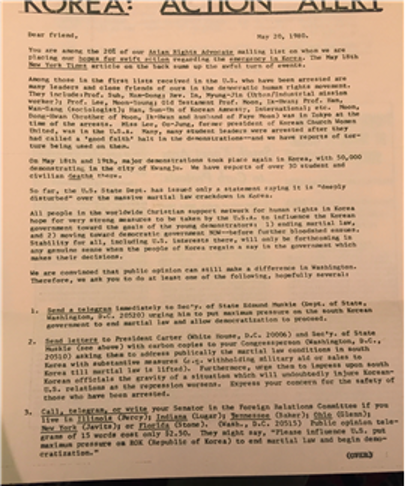
This solidarity network was primarily driven and operated by Christian human rights organizations.
While there were multiple factors behind this, it can be understood first and foremost through the structural nature of religious organizations: they were uniquely equipped to provide the human and financial resources necessary to build and maintain such a network, and Christian humanism served as the moral bedrock for these altruistic endeavors.
Furthermore, the late 1960s and 1970s had seen civil rights and anti-war movements actively led by religious communities across the United States and Europe. It was an era where drawing attention to the human rights abuses perpetrated by authoritarian regimes in the Third World was heavily emphasized as part of a broader “social mission.”
NACHRK Playing a Central Role
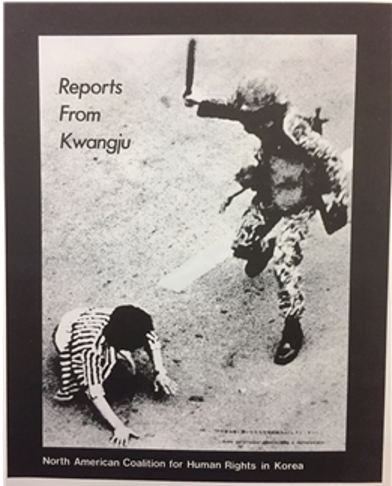
At the epicenter of this solidarity network stood the North American Coalition for Human Rights in Korea (NACHRK), which operated primarily out of New York and Washington, D.C.
Established in 1975 and active until 1995, this organization was formed around Christian activists operating across North America. The Reverend Kim Jae-jun, a prominent human rights activist from the National Council of Churches in Korea (NCCK) who was then active in the U.S., was deeply involved in its founding and operation. The practical executive leadership was spearheaded by the Reverend Pharis Harvey, who had previously served as a missionary in Japan during the 1960s and 70s and had been heavily involved in the campaign to save Kim Dae-jung.
The NACHRK maintained an extraordinarily close relationship with the “Monday Night Group,” an informal organization formed in the late 1960s by foreign missionaries residing in South Korea. The Monday Night Group, in turn, engaged in deep, fluid exchanges with domestic Christian human rights bodies, such as the Human Rights Committee of the NCCK and the Catholic Priests’ Association for Justice (CPAJ).
Through missionaries stationed directly in Gwangju, the Monday Night Group gathered raw updates on the “Gwangju Situation,” transmitting this critical data to the NACHRK via international telegrams or couriers. The NACHRK then compiled and edited these updates, distributing them to a vast web of other human rights organizations across the United States.
Assistance from Japanese Christian Human Rights Organizations
The NACHRK also maintained continuous contact with Japanese Christian human rights organizations. This was partly because its executive director, Reverend Pharis Harvey, had originally operated out of Japan, but it was also largely due to the existing close alliances between South Korean human rights groups and their Japanese counterparts.
Organizations such as the Documentation Action Group Asia (DAGA) operated by the Christian Conference of Asia in Japan, the Emergency Christian Conference on Korean Problems (ECC) under the National Christian Council in Japan, and the Japanese Catholic Council for Justice and Peace worked in tight alignment with the NACHRK.
Prime historical examples of this synergy include the famous “Letters from South Korea” published under the pseudonym “T.K. Sheng” by Professor Chi Myong-kwan, as well as the tireless efforts of Paul Schneiss, a German missionary who personally dispatched journalist Jürgen Hinzpeter to Gwangju. In Europe, the movement was spearheaded by the International Christian Network for Democracy in Korea (ICNDK), headquartered in Germany.
The organizations involved in this solidarity network refused to stop at merely passing along information. The moment they received news of Gwangju, they swarmed South Korean embassies to stage fierce protest rallies, distributed appeals in front of the White House and the U.S. Capitol, and sent powerful messages of solidarity to South Korean civil society and the citizens of Gwangju through prayer vigils and fundraising campaigns.
Protests in Front of the White House and Support for Victims Initiated Immediately
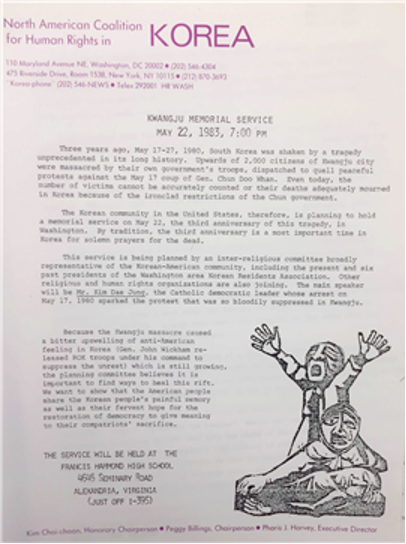
On May 20, 1980, a human rights group in Chicago released the very first English-language flyer containing details of the Gwangju situation. This sparked a wave of active relief and awareness campaigns for the victims of Gwangju across major American cities like New York and Los Angeles, as well as throughout Japan and Germany.
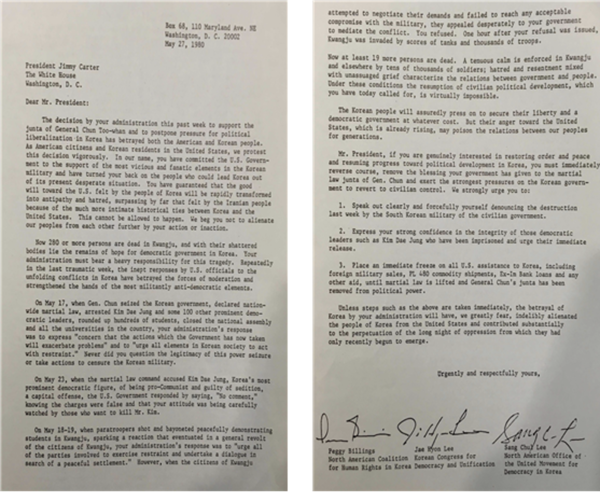
On May 27, 1980—immediately following the bloody suppression that ended the uprising—three prominent human rights organizations, including the NACHRK, released a joint statement. The text fiercely condemned the gross human rights violations committed by Chun Doo-hwan’s military junta and demanded a rigorous diplomatic response from the Jimmy Carter administration, which had consistently championed human rights diplomacy.
On May 29, 1980, a “Memorial Service for the Victims of Gwangju” was held at the historic Riverside Church in Manhattan, New York. Prominent American civil rights leaders, including Jesse Jackson, alongside key politicians, attended the service, successfully elevating the tragedy into a matter of urgent international conscience.
Furthermore, human rights groups from the U.S., Europe, and Japan personally ventured into Seoul and Gwangju to conduct rigorous independent investigations. They submitted detailed field reports to Amnesty International, the United Nations, and the U.S. government, systematically forcing the issue into the international public square.
In June 1980, the NACHRK dispatched two American doctors, Glen Gordon and Young Song Kim, directly to Gwangju to audit the condition of the victims. Their subsequent report was hand-delivered to Bob Rich, then-Director of the Korean Affairs Desk at the U.S. State Department.
In July 1980, two activists from a Quaker human rights organization visited Gwangju and Seoul to compile a report. This was followed in October 1980 by activists from Japan’s ECC, who investigated the martial law forces’ excessive use of force, the human rights abuses inflicted upon political detainees, and the unfolding treason trial of Kim Dae-jung.
Informing the World of the Gwangju Atrocities Through the Media
Human rights organizations also strategically leveraged the press to broadcast Gwangju’s plight and South Korea’s broader human rights situation to a wider audience.
When Ernest Lefever, a far-right Washington columnist, sparked outrage by writing an op-ed in The New York Times (June 18, 1980) claiming that the Gwangju Uprising was a mere riot instigated by leftist students and that South Korea was “not ready” for democracy, Donald Ranard of the Center for International Policy—a think tank embedded within the pro-Korea human rights network—shot back. He published a blistering counter-argument in The New York Times (July 4, 1980), thoroughly dismantling Lefever’s assertions.
Andrew Young, a towering figure of the civil rights movement alongside Dr. Martin Luther King Jr., was commissioned by the NACHRK to pen a poignant column in The Washington Post (September 29, 1980), commemorating the Gwangju Uprising and calling for the immediate release of Kim Dae-jung. Later, in January 1981, when Chun Doo-hwan’s visit to the U.S. was finalized upon the invitation of Ronald Reagan, more than 40 human rights organizations across America co-signed a massive joint protest statement against the visit, publishing it as a full-page advertisement in The New York Times.
As the momentum of the Gwangju Uprising built, the influence of this solidarity network within Washington’s political circles and Congress grew exponentially.
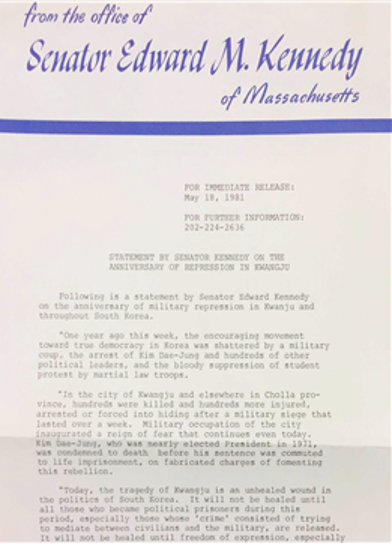
On April 10, 1981, the House Subcommittee on Human Rights and International Organizations called the NACHRK’s Reverend Pharis Harvey to testify as an expert witness, seeking his review of the State Department’s 1980 Country Report on Human Rights Practices for South Korea. Reverend Harvey’s testimony is historically regarded as the first instance where the U.S. Congress officially summoned a member of a Korea-related human rights organization to review and shape foreign policy.
Furthermore, when the Reagan administration attempted to appoint the ultra-conservative columnist Ernest Lefever as Assistant Secretary of State for Human Rights and Humanitarian Affairs, Korea-related human rights groups, spearheaded by the NACHRK, formed a powerful coalition with Latin American human rights organizations to successfully force the withdrawal of his nomination.
Reclaiming Pride and Dignity
It is impossible to quantify with perfect precision exactly how much these multifaceted solidarity campaigns contributed to improving human rights or easing the immediate suffering within South Korea. The Reagan administration’s decision to invite Chun Doo-hwan as a state guest was undeniably a source of immense disappointment at the time.
However, the fact that countless individuals sentenced by military tribunals for their involvement in the “Gwangju Incident” were gradually released starting from late 1980, and that Kim Dae-jung’s death sentence was ultimately commuted, was a direct victory heavily indebted to the zealous, unyielding pressure of this internationally forged solidarity network.
During the fragile dawn of his dictatorship, the “external force” that Chun Doo-hwan feared most was precisely this solidarity network, whose global leverage had grown formidable in the wake of the Gwangju Uprising. Chun’s first major appeasement measures implemented between 1983 and 1984 were, in reality, a concession to the relentless international pressure applied by this very transnational network.
Most importantly, the pride and dignity that Gwangju’s deeply wounded civil society was able to recover through this international blanket of solidarity remains an invaluable, priceless treasure.
Having walked a grueling, triumphant path since the Uprising to achieve astonishing political and economic development, South Korea now stands in a position where it must actively repay the profound solidarity and support the international community once poured into us. Embracing this duty to give back offers a precious opportunity to reaffirm that the awe-inspiring community spirit displayed by Gwangju in May 1980 is, and always will be, a universal value for all of humanity.

댓글