

Korea: Fascism is Coming
[Eun-joo Chang’s Political Philosophy for Citizens] The Far-Right Behind the Coup: Violent Fascism The Far-Right Could Regain Power, Like Trump Beyond a Change in Government, We Must Protect Democracy A New Political Direction for the Grassroots
- “파시즘이 온다” n English translation of a Korean column originally published on Feburary 5, 2025, titled “파시즘이 온다”
By Chang Eun-joo, Professor at Youngsan University
It’s Not Just About a Change in Administration
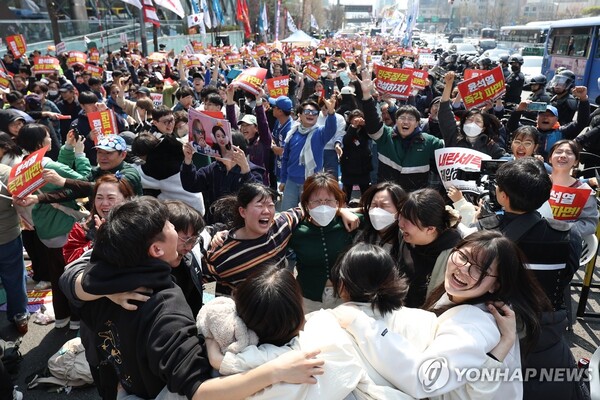
The current developments are almost unbelievable. Numerous polls indicate that nearly 40% of the public supports Yoon Suk-yeol’s declaration of martial law, despite its blatant unconstitutionality and illegality. Similarly, a significant portion of the population believes that Yoon’s impeachment should be overturned, or even subscribes to conspiracy theories about election fraud. In some polls, support for the People Power Party(PPP), which has defended the coup, even surpasses that for the Democratic Party.
Many dismiss these polling results as mere artifacts of oversampling among conservatives and assign them little importance. However, it is difficult to deny the trends these polls reveal. While we may hope that public opinion will soon shift, it is alarming that so many citizens view the insurrection—an attempt to dismantle the democratic constitutional order we have fought to establish and protect—as something positive.
The reasons for these trends are obvious. What should have been recognized as an insurrection attempting to destroy democratic governance has instead been framed as a routine confrontation between progressives and conservatives, degenerating into partisan strife. Behind this narrative lies Yoon Suk-yeol’s attempt to obscure his crimes of insurrection through political agitation, supported by the increasingly far-right orienting People Power Party(PPP).
The PPP is not a marginal group—it is one of the two major political parties that underpin our democracy and enjoys substantial popular support. This makes the situation extraordinarily serious.
The Possibility of Far-Right Rule Returning
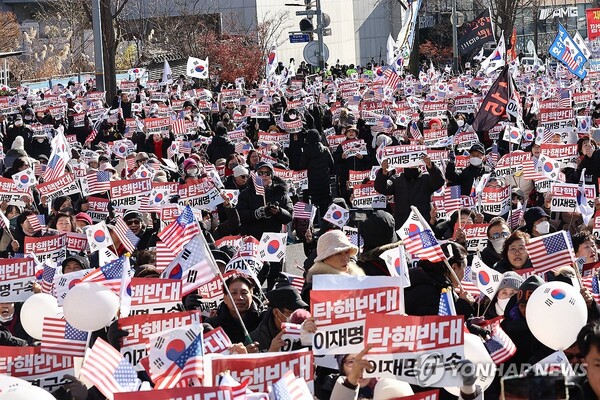
Given the current state of public opinion, we cannot rule out the possibility that the next president will again be a candidate from the People Power Party. It is critical to understand that the coup was not merely the product of Yoon Suk-yeol’s delusions, fueled by alcohol and far-right YouTube channels. As seen during the “1.19 Riot” at the Western District Court, there exists a vast far-right faction capable of and willing to engage in violent fascism. This far-right movement is not limited to elderly members of the “Taegukgi Brigade”; it has also taken root among younger generations and ordinary citizens.
Even if Yoon’s impeachment is upheld and the next president is from the Democratic Party, this does not necessarily mean the coup attempt will have been fully resolved. Just as Donald Trump, who incited the insurrection at the U.S. Capitol, returned to politics with an even stronger support base and personnel network, a similar scenario could unfold in South Korea.
Although Yoon Suk-yeol himself may never return as president, it is entirely possible that far-right forces armed with even more extreme ideologies could rise to power, leading to the complete collapse of our democracy.
South Korea’s Democracy Faces an Existential Crisis
South Korea’s democracy now stands at a grave crossroads. This is no longer a matter of simply changing the administration. Fascism is coming. The infighting within the Democratic Party over the presidential election is disheartening, and Lee Jae-myung’s efforts to shift to the right in pursuit of centrist voters are disappointing. We cannot afford to assume that the impeachment crisis of 2017 will simply repeat itself smoothly.
The democratic and progressive camp in South Korea now faces an urgent, existential challenge: to defend and mature the democratic constitutional order against far-right forces seeking its destruction. More than a mere change in government, what is needed is a fundamental shift in awareness and extraordinary efforts to protect democracy.
The Possibility of Far-Right Rule Returning
Throughout South Korea’s political history, far-right fascist forces have always been part of the mainstream. During the authoritarian regimes of Syngman Rhee, Park Chung-hee, and Chun Doo-hwan, these forces were dominant, and even after democratization, they never truly lost their grip on power. Though progressive forces have temporarily taken over the government at times, the real governing power of society has remained in the hands of these far-right forces, who operate under the guise of “conservatism.” Even under democratic administrations, prosecutors, judges, and high-ranking officials in the executive branch often maintained direct or indirect ties to these forces. Mainstream media, conglomerates, and ultra-conservative Protestant factions have supported them. Many believed that this bloc had transformed into a democratic conservative force, but recent events have shown that this was never the case.
Of course, after democratization, these forces remained constrained within the framework of the democratic constitutional order. This was primarily because the South Korean people strongly desired it. For instance, when these forces attempted to impeach President Roh Moo-hyun, the public thwarted their efforts and punished them politically. Similarly, when President Park Geun-hye engaged in corruption and abuse of power, the overwhelming majority of the population supported her impeachment, driving these forces into political retreat.
However, the current problem lies in the fact that a significant portion of the public now appears swayed by far-right propaganda defending the coup. What has happened to our society in the meantime?
We must first consider the global situation. Worldwide, democracy is in crisis due to the negative consequences of financial capitalism and neoliberal globalization, which have fueled the rise of far-right populism. South Korea’s situation does not appear to be disconnected from this trend. In Western developed nations, far-right populism has gained traction among the working class, who have been marginalized in meritocratic oligarchy where economic and political power is monopolized by a small elite. These individuals, suffering from poverty, economic insecurity, and social alienation, have turned to far-right populist movements. This global trend seems to be manifesting in South Korea as well.
Thomas Piketty, the author of 『Capital in the Twenty-First Century』, has pointed out that center-left parties in Western nations have increasingly catered to the interests of high-income, highly educated middle classes, neglecting the needs of the working class—a phenomenon he calls the “Brahminization” of left-wing politics. Similarly, the Democratic administrations in South Korea, particularly during the COVID-19 pandemic, exposed their weaknesses in addressing public anxiety over skyrocketing housing prices and the struggles of self-employed individuals and the younger generation. These failings ultimately paved the way for Yoon Suk-yeol’s rise.
In the process, many impoverished and marginalized elderly citizens were drawn into ultra-conservative Protestant networks, while many young people, adrift due to an uncertain future, were absorbed by cult-like religious groups such as Shincheonji. Moreover, young men have increasingly been swept up in far-right ideology, amplified by social media algorithms and anti-feminist rhetoric—a trend that reflects broader global phenomena. Unique Factors in South Korea: Economic Uncertainty and Far-Right Narratives
While South Korea does not face severe immigration issues like Western countries, it has its own unique challenges stemming from a rapidly changing global economic environment. The rise of China and intensifying competition in the global market have led to difficulties for South Korean businesses, such as Posco partially suspending factory operations. These economic pressures, while different from the Western context, have created fertile ground for far-right narratives framing China as a political enemy undermining South Korea’s prosperity. This narrative fuels conspiracy theories about “election fraud orchestrated by left-wing forces in collusion with China,” which far-right groups use to incite the public.
Domestically, the specific issues of South Korea’s democratic system—commonly referred to as the “1987 System”—cannot be overlooked. I believe that South Korea’s winner-takes-all, first-past-the-post electoral system, coupled with the so-called “imperial presidency,” has created extreme political polarization, which served as a critical backdrop to the December 3 coup.
This system fosters adversarial politics that view political opponents not as rivals to compete with but as enemies to be eliminated. Within this context, Yoon Suk-yeol sought an extreme solution when confronted with the daunting challenge of leading a government without a parliamentary majority. His supporters, deeply influenced by this adversarial political culture, have uncritically embraced fascist tendencies.
Above all, the issue of South Korea’s “imperial presidency” is severe. While some argue that South Korean presidents actually wield less power than their counterparts in the United States or France and are adequately checked by the National Assembly, I believe this perspective misses the mark. The real problem lies in the very structure of the presidency, which allows the executive branch to be swayed by the arbitrary rule of a single individual. This inherent flaw in the presidential system cannot be overlooked under the guise of “separation of powers.”
The Impact of the Presidential System and the Need to Defend Democracy
The presidential system in South Korea distorts party politics by encouraging the “presidentialization” of political parties. It subordinates all political processes to the goal of acquiring and maintaining presidential power. Phenomena such as the “iron law of oligarchy”(which holds that even the most democratic organizations inevitably come under the control of a small elite due to operational and strategic needs) observed within the Democratic Party or the rise of fervent support groups like the “pro-Lee supporters” can be understood within this context.
What is particularly critical in South Korea’s context is that the presidential system is linked to the winner-takes-all electoral system, which exacerbates adversarial political polarization. In such a polarized political environment—seen not only in the case of Yoon Suk-yeol but also in the U.S.—when a mainstream conservative party is captured by far-right forces, democratic systems can face an existential threat.

Defending Democracy in the Face of Internal and External Threats
Given this situation, we cannot simply be content with electing a new president, as the Democratic Party seems implicitly to suggest. Recent polling trends that reveal unsettling dynamics are not merely issues of overrepresentation in conservative sampling. What we are witnessing is a fundamental vulnerability in South Korea’s democratic system itself. Extraordinary resolve and effort are required to protect democracy from both global economic challenges and internal adversaries who threaten its very foundations.
Learning from Militant Democracy
Karl Loewenstein, a German legal scholar of Jewish descent who fled to the U.S. after witnessing the fall of the Weimar Republic to the Nazis, proposed the concept of “militant democracy.” He argued that in order to defend itself, democracy must reserve the right to suspend democratic principles when dealing with enemies who seek to destroy it, such as far-right fascists. This concept, also known as “defensive democracy,” later found real-world application in Germany through measures like the dissolution of unconstitutional political parties. South Korea also drew upon this idea during the Constitutional Court’s decision to dissolve the Unified Progressive Party. I believe we must cautiously reinterpret this concept in the face of the rise of neo-fascism.
Of course, the concept of militant democracy is susceptible to misuse. In fact, Park Chung-hee’s Yushin martial law and Yoon Suk-yeol’s December 3 martial law both appropriated the logic of defensive democracy, claiming to eradicate enemies of liberal democracy through extraordinary measures. Even in the case of the dissolution of the Unified Progressive Party, the Constitutional Court applied excessively arbitrary standards of “unconstitutionality,” in my opinion.
However, I argue that it is necessary to adopt the principles of militant/defensive democracy in a way that does not fundamentally restrict the democratic rights of specific political groups. If democracy can indeed collapse through democratic means, we need exceptional measures to defend it.
Concrete Steps to Protect Democracy
These efforts should include measures such as monitoring and regulating far-right YouTube channels, punishing the dissemination of intentional “fake news,” and exposing and criticizing public hate speech by far-right figures. However, as these measures might risk being criticized for infringing upon freedom of expression, they must be implemented with restraint and rationality, grounded in a high level of societal consensus about the importance of defending the democratic constitutional order. Moreover, democratic civic education for future generations and citizens is essential.
A Broader Strategy for Inclusive Politics
More fundamentally, we need a new political direction that creates inclusive economic policies and systems to ensure that marginalized and alienated grassroots populations are not co-opted by far-right fascists. Above all, the democratic constitutional system itself must be redesigned and restructured to withstand the challenges posed by fascism.
In this context, the Democratic Party’s current policy direction—such as proposing to repeal the financial investment tax to attract centrist voters or indefinitely delaying discussions on constitutional reform—appears overly complacent. I will discuss these issues in greater detail in my next column.
Chang Eun-joo Professor
Professor Eun-joo Chang is a political philosopher teaching at Youngsan University in South Korea. He focuses on refining philosophical insights to stabilize and mature Korean democracy. After earning a degree in Critical Social Theory at Goethe University in Frankfurt, Germany, he has been working to develop a unique theory to understand Korea’s social dynamics. Recently, he has been involved in democratic citizenship education and has authored works such as The Philosophy of Human Rights, The Movement of Politics, and The Future of Confucian Modernity. His latest works include The Betrayal of Justice and The Republican Roh Moo-hyun.

댓글