

Korea: Is President Yoon entitled to absolute immunity against Insurrection Charges?
[Professor Jongcheol Kim’s Constitution for the Citizens] Yoon’s 12·12 Statement Reaffirms Insurrection Allegations Immunity arguments against insurrection charges contradict South Korea’s Constitution. Reckless immunity theories only fuel constitutional crises.

This text is a translation of a column(내란혐의자가 면책대상이라니!) originally published on December 13.
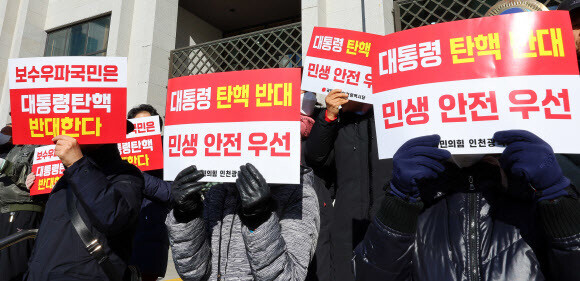
President Yoon Suk-yeol has effectively admitted to leading a self-coup insurrection. His sudden December 12 statement appears to have been intended as a multi-purpose counteroffensive, but instead, it has only exposed his incompetence and recklessness. It also laid bare the fallacy of People Power Party leader Han Dong-hoon’s impractical and unprincipled proposal for an “orderly resignation.” If the People Power Party, after witnessing this statement, continues to elect pro-Yoon leadership and insists on opposing impeachment, it will bear undeniable legal and political responsibility as an accomplice to insurrection.
In recent days, theories and legal precedents have emerged to support the People Power Party’s unwillingness to distance itself from Yoon despite his second statement and political missteps. Yoon himself has boldly claimed that the martial law declaration is an ‘act of government or state’ and therefore not subject to judicial review, asserting that this view is backed by legal precedents and the majority of constitutional scholars. This is a blatant falsehood that seriously damages the reputation of constitutional scholars.
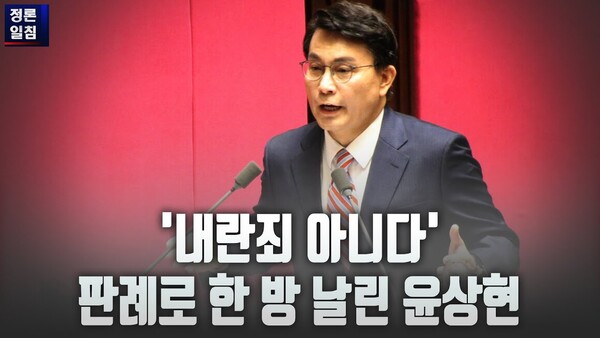
On November 11, during a National Assembly plenary session, Yoon Sang-hyun, a People Power Party lawmaker, raised a question citing a Supreme Court precedent. However, this also distorts and selectively omits the key principles of the Supreme Court’s leading case regarding the rebellion and insurrection tied to the nationwide expansion of martial law during the May 18 Gwangju Uprising(See Supreme Court Decision 96Do3376, April 17, 1997).
Presidential Immunity from Insurrection Charges?
Recently, claims have been spreading online asserting the legitimacy of declaring martial law and arguing that such actions, including insurrection charges, are not punishable offenses especially in the case of the incumbent President. As revealed in the December 12 statement, these assertions may serve as fuel for rallying support against impeachment and defending the current administration under the influence of an accused insurrectionist.
The unconstitutionality and illegality of Yoon Suk-yeol’s martial law declaration, as well as the validity of insurrection charges, were addressed in my previous column (A President Attempting a Self-Coup Must Be Immediately Suspended). This article examines the claim that attempting to prosecute President Yoon for insurrection violates his immunity and breaches the Constitution.
Three Legal Arguments Supporting Presidential Immunity
The argument that President Yoon’s declaration and execution of martial law are absolutely immune from criminal prosecution on the account of insurrection in the Criminal Act relies on three legal allegations:
- Martial law declaration and implementation are “emergency powers granted solely to the president” by the Constitution.
- The assessment of “national crisis,” the prerequisite for invoking these emergency powers, is entirely at the president’s discretion.
- Based on U.S. Supreme Court jurisprudence, the declaration and implementation of martial law fall under “absolute immunity” from criminal liability.
Is Martial Law an Exclusive Presidential Power?
The first premise of presidential immunity—that martial law is an exclusive emergency power of the president—deserves scrutiny and criticism.
Korea’s current Constitution reflects lessons from a history marred by military coups. By institutionalizing emergency powers, including martial law, the Constitution ensures these powers are exercised solely to protect the basic constitutional order. This aim is achieved through specific constitutional safeguards as follows.
First, the Constitution grants the president the authority to declare and execute martial law but imposes limits by requiring these actions to “conform to Acts prescribed by the National Assembly”. Even the declaration of martial law (Article 77 Paragraph 1) and actions such as restricting fundamental rights or implementing special measures regarding executive and judiciary authority (Article 77 Paragraph 3) must adhere to legal frameworks established by the legislature. This underscores the legislature’s primary jurisdiction over martial law governance.
The principle of “statutory reservation” or “vorbehalt des gesetzes” over martial law is reinforced by granting the National Assembly oversight authority. The president must “promptly” notify the Assembly of any martial law declaration and is constitutionally obligated to rescind martial law upon the Assembly’s demand(Article 77 Paragraphs 3 and 4). These provisions clarify the “exceptional” nature of martial law powers. Far from being the president’s exclusive authority, martial law is recognized as a provisional power contingent upon parliamentary oversight.
The presidential immunity argument falsely assumes martial law is an exclusive presidential power and concludes that the assessment of a “national crisis” falls entirely to the president. This claim lacks constitutional validity. Since martial law is clearly not an exclusive presidential power under the Constitution, the argument collapses. For clarity, let us examine this claim further.
Presidential Judgment and Necessary Constitutional Oversight
While the Constitution and martial law statutes grant the president initial discretion to assess a national crisis, this does not equate to absolute authority. Misinterpretation or unconstitutional application of these powers subjects the president to oversight by the National Assembly, judiciary, or Constitutional Court. Even under the doctrine of “acts of government or state”, modern constitutional democracies do not exempt executive actions from judicial review unless the Constitution explicitly permits such exceptional cases. Korean Supreme Court and Constitutional Court precedents affirm that while certain decisions require high political discretion, they are subject to judicial oversight when they affect fundamental rights(See Constitutional Court Decision 93Hun-Ma186, February 29, 1996; Supreme Court Decision 96Do3376, April 17, 1997)
Martial Law: A Unique Context for Criminal Accountability
Unconstitutional or illegal acts by a president do not inherently constitute insurrection. So do other governmental powers. For example, if the National Assembly passes an unconstitutional law, its effect may be nullified by the Constitutional Court, but neither the Assembly nor its members face dissolution or criminal charges. However, martial law involves distinct risks.
Unlike other presidential acts, martial law mobilizes the military—an institution constitutionally mandated to ensure national security, territorial defense, and political neutrality (Article 5 Paragraph 2). This mobilization introduces the potential for criminal violations against national interests. Recognizing these risks, the Constitution limits martial law powers by requiring parliamentary oversight.
The framers of Korea’s Constitution sought to ensure that martial law would never be wielded as an unbridled executive power. Presidents must understand that their martial law declarations and executions are subject to criminal accountability and exercise extreme caution accordingly.
Can U.S. Supreme Court Precedents Be Applied to President Yoon?
The final pillar of the argument for presidential immunity in cases of insurrection rests on the assertion that the president is entitled to immunity. A recent U.S. Supreme Court case, Trump v. United States, 603 U.S. 593 (2024), which upheld former President Trump’s immunity, is frequently cited as a precedent.
In this case, Trump was indicted for spreading false information about election fraud to disrupt the certification and announcement of the 2020 presidential election results. He invoked presidential immunity but initially lost in lower federal courts. However, on July 1, 2024, the Supreme Court ruled 6-3 in his favor, reasoning as follows:
A. Absolute Immunity for Official Acts: Within Presidential Authority, “official acts” falling under the president’s “conclusive and preclusive constitutional authority” (e.g., pardons, commander-in-chief powers) are absolutely immune from criminal prosecution.
B. Presumptive Immunity for Other Official Acts: Official acts not exclusive to presidential authority are presumptively immune unless there is compelling public interest necessitating prosecution.
C. No Immunity for Non-Official Acts: Immunity does not extend to actions unrelated to official duties.
Could this U.S. precedent apply to President Yoon Suk-yeol, who triggered the current martial law controversy? Absolutely not. The fundamental differences between the U.S. and South Korean constitutions, the president’s constitutional role, and the nature of martial law under Korean law render such application untenable.
Explicit Constitutional Provision in South Korea:
Unlike the U.S. Constitution, which has no explicit provision on presidential immunity or non-prosecution, South Korea’s Constitution explicitly addresses this issue. Article 84 states that the president “shall not be charged with a criminal offense while in office, except in cases of insurrection or treason.” While recognizing general immunity during a president’s tenure, the Constitution explicitly allows prosecution for insurrection or treason. This explicit provision negates any reliance on the interpretive precedents of the U.S. Supreme Court regarding presidential immunity.
Structural Differences in Constitutional Powers Between US and Korea:
Even if we hypothetically consider the possibility of immunity through interpretation, absolute immunity cannot be applied to this case. The structural differences between the U.S. and South Korean constitutional frameworks and the president’s roles make direct application impossible.
The U.S. adheres to a strict separation of powers, granting the president exclusive executive authority as the head of a singular executive branch. In contrast, South Korea’s constitutional system moderates the separation of powers through institutions such as the Prime Minister and the statutory framework for administrative organization. In South Korea, executive power is not exclusively vested in the president but shared collectively within the government, including the Prime Minister, cabinet members, and administrative departments.
Martial law declaration and termination, for instance, require deliberation by the State Council (Article 89 Item 5). Additionally, all presidential acts must be documented and co-signed by the Prime Minister and relevant ministers, including military-related actions (Article 82). As previously explained, martial law powers are not exclusive presidential authority but subject to parliamentary oversight and legislative control.
The Nature of Martial Law Under Korean Law:
Even under U.S. precedents, the declaration and implementation of martial law would only qualify as “presumptively immune.” Unconstitutional or illegal martial law actions would likely meet the elements of insurrection, and if proven, would warrant prosecution. South Korea’s Constitution explicitly mandates this accountability, unlike the U.S. system, which relies on judicial interpretation due to constitutional silence on the matter.
Public Demands for Accountability
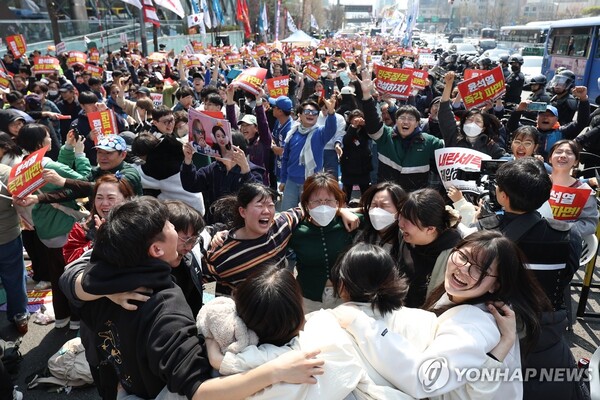
As citizens call for the impeachment of President Yoon and prosecution for insurrection, these events underline the constitutional duty to ensure that martial law powers are exercised within legal bounds. South Korea’s constitutional framework clearly delineates limits on presidential authority, ensuring that no president is above the law.
Postscript: The Responsibility of Scholars in Public Discourse
Academic integrity and the freedom to pursue diverse perspectives must be respected. Political commentary should likewise be afforded considerable latitude. However, when academic freedom and political expression distort the truth or mislead the public, they risk devolving into tools of appeasement (曲學阿世, gukhakase) or deception (惑世誣民, hoksemumin).
Defending an attempted insurrection witnessed globally in real-time through tenuous arguments undermines the foundational principles of a free and democratic basic order and paves the way for a regression to authoritarian rule. This warrants the utmost caution and vigilance.
About the Author:
Professor Jongcheol Kim is a constitutional law scholar at Yonsei University School of Law. After graduating from Seoul National University College of Law for his LL.B. and LL.M., he obtained his Ph.D. in law at the London School of Economics and Political Science. He has served as President of the Korean Public Law Association, Vice Chair of the National Constitutional Advisory Committee, and a member of the Prosecutorial Reform Committee at the Supreme Prosecutor’s Office. He views his role as a constitutional scholar as contributing to civic constitutional education, political reform, and judicial reform rooted in the principles of a democratic republic.


댓글