

Korea: 12.3 Rebellion and a Critical Moment for Democracy
[Woojin Kang’s Democracy for the Invisible] Korean Conservatism: Failure to Internalize the Principles of Democracy More of a “Power-oriented Conservatism” Than “Value-oriented Conservatism” 12.3 Rebellion Witnessed the Emergence of “Monitory Democracy” Among Citizens Can the Current Crisis Be Resolved Within Constitutional Order?
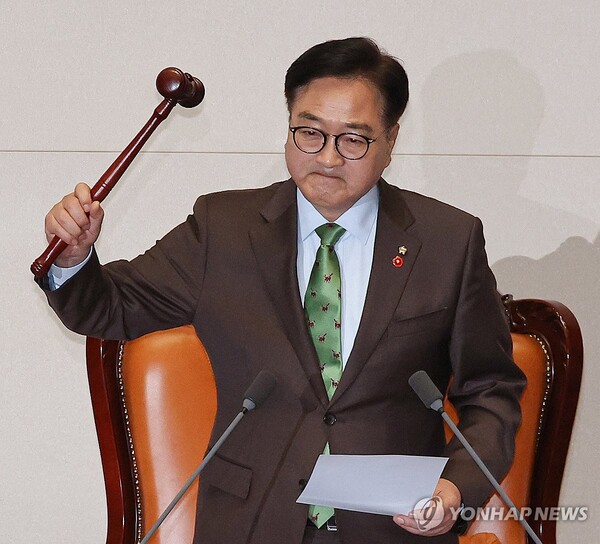
- “12.3 내란과 한국 민주주의의 결정적 순간” tion of a Korean column originally published on January 4, 2025, titled “12.3 내란과 한국 민주주의의 결정적 순간”
By Woojin Kang, Professor of Political Science at Kyungpook National University
The 12.3 coup attempt by President Yoon Suk-yeol was thwarted by civilian resistance, the National Assembly’s resolution to lift martial law, and the impeachment of the President by the legislature. Although the first attempt at rebellion was blocked, the confrontation between the forces of rebellion, their allies, and those defending democracy continues. An unprecedented situation has unfolded, with Acting President Han Duck-Soo impeached for rejecting the National Assembly’s recommendation to appoint constitutional court justices. If the Constitutional Court cannot reach a verdict on the impeachment trial before the retirement of two justices on April 18, 2025, Korea could face severe turmoil.
A Critical Question for Korean Democracy
Korea’s democracy now stands at its third critical juncture, following the June uprising of 1987 and the Candlelight movement protesting against Park Geun-hye–Choi Soon-sil scandal in 2016. This critical juncture poses important questions about the previous understanding and interpretations of Korean democracy.
First, the 12.3 Rebellion fundamentally challenges domestic and international assessments and interpretations of Korea’s democratic achievements. As is widely known, Korea has been one of the few postwar independent nations to institutionalize democracy successfully. Scholars have often considered two peaceful transfers of power a hallmark of democratic consolidation, and Korea has successfully achieved four transfers without major disruptions, the latest being the election of President Yoon.
Many scholars believed that the core rules of democracy—fair and competitive elections as the sole mechanism for power transfer—had become the only game in town in Korea. Furthermore, Korea was thought to have achieved civilian control of the military, one of the most challenging tasks for new democracies, with the dissolution of the Hanahoe faction. It was widely assumed that a scenario reminiscent of the “Spring of Seoul” would never occur again.
Yet, under a government that had overseen four peaceful transfers of power, the “Night of Seoul” arrived. The 12.3 Rebellion compels us to rewrite and reinterpret the history of Korean democracy post-democratization. What has happened to Korea since democratization?
Were We Ever Democrats?
Second, we must question whether Korea’s major political actors have truly been democrats. As mentioned earlier, democratization studies have often focused on institutionalizing electoral regimes when examining democratic consolidation. However, for democracy to consolidate effectively, key actors in society must accept and internalize democratic principles. In other words, citizens—especially major political actors—must prioritize being democrats over being partisans.
A democrat must accept the electoral results, the “tentative equilibrium,” even when they run counter to their partisan interests. They must not resort to violence or illegal methods to influence election outcomes nor align themselves with extremists.
In the United States, the archetype of representative democracy, the January 6, 2021, Capitol insurrection by Trump supporters, illustrated the fragile internalization of democratic norms. Following his loss in the 2020 election, Trump propagated a conspiracy theory blaming election fraud, inciting his supporters to storm the Capitol—a previously unthinkable event.
Similarly, the 12.3 Rebellion revealed the fragile foundation of the belief that Korean conservatism shared and internalized democratic principles. Korea’s conservative forces played a pivotal role in the country’s nation-building as a divided state and its state-led industrialization under authoritarian mobilization. By incorporating parts of the democratization movement through the “three-party merger,” they claimed to have bridged the divide between industrialization and democratization. However, they failed to establish or develop their own coherent ideology.
During the authoritarian regime, the conservative ideology was primarily a negative one based on anti-communism, rather than a proactive compass for Korean society. Efforts for ideological renewal, such as “community liberalism and national advancement” (Professor Park Se-il) and “warm conservatism” (Yoo Seung-min), failed to reconstruct a viable conservative ideology. Korea’s conservatives, despite being a hegemonic force since the country’s founding, have remained “power conservatives,” floating toward power-oriented conservatism rather than “value-oriented conservatism.”
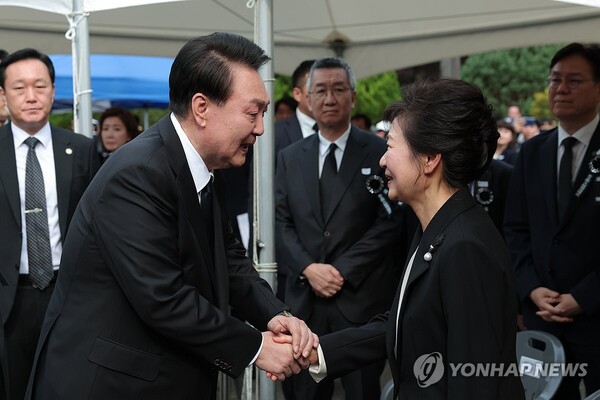
The Naked Face of Power Conservatism
The inherent nature of power conservatism becomes even more apparent when it holds power. Let’s revisit the Lee Myung-bak administration, which marked the return of conservative rule after losing power to the progressives twice. With the 2007 presidential election, Korea achieved two peaceful transfers of power, meeting the minimum definition of democratic consolidation—a feat some scholars dubbed “remarkable democracy.”
Contrary to these accolades, the conservative forces undermined democratic principles during elections to retain power. As the ruling party, they used state institutions, including the National Intelligence Service (NIS), to interfere in the 2012 presidential election. This incident seriously compromised electoral integrity. Ironically, President Yoon, who rose to fame by investigating and prosecuting those involved in this electoral manipulation, later pardoned key culprits of this anti-democratic offense.
A significant segment of Korea’s conservatives went as far as to embrace election fraud conspiracy theories when electoral outcomes were unfavorable. President Yoon justified the 12.3 Rebellion by claiming electoral outcomes were manipulable and instructed the defense minister to investigate the National Election Committee. A former acting president and party leader under the park administration openly endorsed election fraud theories. Prominent ruling party politicians even attended unconstitutional coup-justifying rallies, demonstrating the erosion of democratic norms.
When faced with a crisis threatening the democratic constitutional order they professed to protect, the ruling conservatives prioritized partisan interests over democratic values. They abstained from the first impeachment vote, rendering it invalid, and maintained a party stance against impeachment after prolonged deliberations.
Democracy’s Shrinking Base and Its Partisan Weaponization
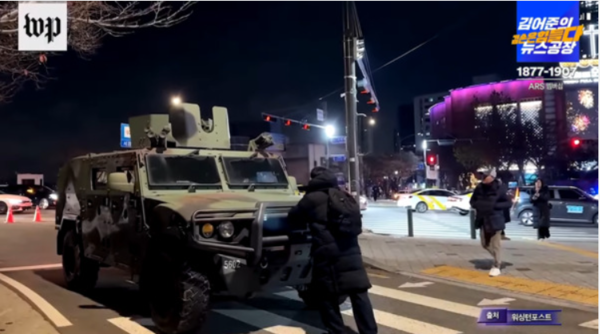
Third, the 12.3 Rebellion revealed both the resilience of Korean democracy and its susceptibility to partisan weaponization. Thousands of citizens flocked to the National Assembly to confront martial law troops, with some risking their lives to block advancing military vehicles physically. One citizen’s action against an armored vehicle evoked the “Tank Man” of Tiananmen Square in 1989. A young female politician symbolically resisted armed troops in the National Assembly, highlighting the people’s defiance.
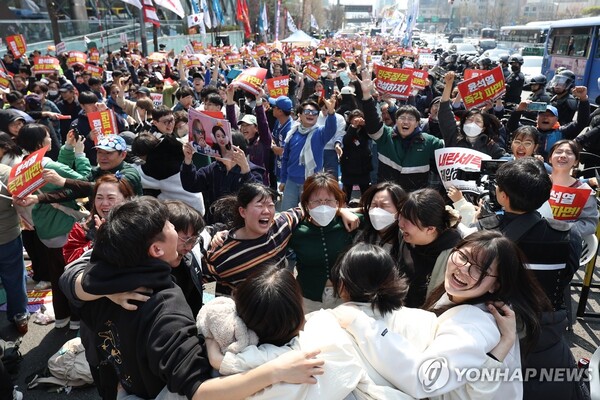
The use of social media platforms like X (formerly Twitter) for real-time protest coordination and pre-ordered meals for participants illustrated Korea’s evolving protest culture. Citizens wielding multicolored cheering sticks became symbols of the new civic movement, embodying the essence of “Monitory Democracy.” Citizen action eventually swayed hesitant lawmakers within the ruling party to join in lifting martial law and impeaching President Yoon in a second vote on December 14, 2024.
Yet, concerns about democracy’s partisan weaponization intensified. Unlike the 2016 impeachment of Park Geun-hye, which saw the ruling party fragmentation and plummeting approval ratings, President Yoon’s approval was 17% just before his impeachment (Gallup Korea). Despite an unprecedented rebellion, many conservative citizens viewed the democratic crisis through a partisan lens.
Although the rebellion was thwarted, a metaphorical civil war persists, with physical clashes deferred but ideological battles continuing between democratic forces and those advocating alternative constitutional orders. Whether this confrontation resolves within the framework of democratic constitutionalism will be a decisive variable for Korea’s democratic future.
The downfall of the “Candlelight Government” after just five years primarily stemmed from its failure to transform the “Candlelight Coalition” into a “democratic reform coalition.” Now is the time to overcome minor differences and partisan divides, uniting the majority who support impeachment into a coalition capable of navigating this crisis and advancing democracy.
About the Author:
Woojin Kang is a professor of political science at Kyungpook National University. He holds a bachelor’s and master’s degree in political science from Korea University and a Ph.D. from Florida State University. He has served as president of the Korean Election Studies Association and vice president of the Korean Party Studies Association. His recent research focuses on how democracy can better represent and improve the lives of ordinary people. His key areas of interest include democratic performance, authoritarian nostalgia, and electoral behavior. His recent books include The Great Root: Park Chung-hee Nostalgia, The Paradox of Korean Democracy: Institutional Trust Deficit, and Park Chung-hee Nostalgia and Korean Democracy.



댓글