

Germany to Overcome Political Crisis on February 23
[Soo-jung Choi’s European Diplomatic Wars] Scholz loses coalition support and faces no-confidence vote Authority to dissolve parliament lies with the President Public favors an FDP-SPD coalition New chancellor must respond to Trump’s policies

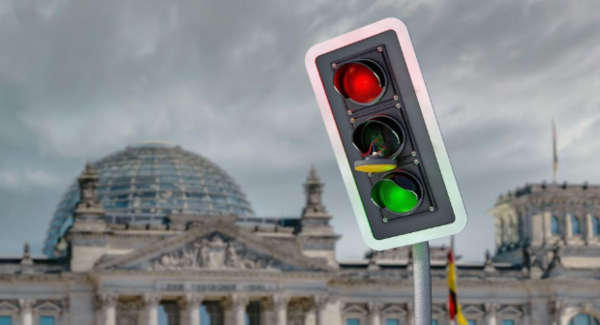
German Chancellor Scholz fails to regain trust
While South Korea was mired in political chaos due to an illegal martial law declaration, German Chancellor Olaf Scholz failed to regain parliamentary confidence on December 16. The no-confidence vote result was 394 votes against him, 207 in support, and 116 abstentions, ultimately withdrawing parliamentary trust from Scholz. Including the 394 votes against and 116 abstentions, 71% of the Bundestag did not support Scholz’s continuation as chancellor. Most votes, excluding those from the Social Democratic Party (SPD), viewed Scholz as unfit to continue leading the government. Scholz subsequently visited Federal President Frank-Walter Steinmeier to request the dissolution of parliament. Consequently, Germany is set to hold early general elections on February 23.
As German politics plunges into turmoil, the world appears concerned about a crisis in German democracy. Naturally, as someone living in Berlin, I too have been watching this situation with unease. Especially while observing South Korea’s declaration of martial law, the parliamentary resolution to lift it, the impeachment motion, and subsequent pro- and anti-impeachment rallies, I cannot deny that the situations in both countries overlap as moments of democratic crisis.
However, from the perspective of parliamentary democracy and constitutional rule of law in Germany, I aim to explore how Germany’s democracy will recover through procedural democracy while preventing abuses of power by the executive and legislative branches.
The Root of the Problem
Two months ago, on November 7, Scholz proposed to the Federal President the dismissal of Christian Lindner, the FDP Finance Minister, which triggered the current crisis. This marked the moment when the “Traffic Light Coalition” (SPD + Greens + FDP) lost its light. The official reason cited was disagreements over the 2025 budget. However, it is interpreted as the culmination of mistrust stemming from severe discord over the 2024 budget, which erupted this year.
According to an in-depth investigation by German public broadcaster ZDF, Lindner had persistently tried to disrupt the coalition by opposing expanded budgets. Despite initially declaring that reallocating 60 billion euros from unused COVID-19 funds to the Climate Fund for the 2024 budget was legal, Lindner ultimately failed to justify this decision. This issue reached the Constitutional Court following objections from the Christian Democratic Union (CDU) and was declared unconstitutional. As a result, the unprecedented situation arose where the Climate Fund for 2024 was stripped of 60 billion euros. This marked the turning point when Scholz’s confidence in Lindner as finance minister shifted to distrust.
Subsequently, Scholz proposed an emergency supplementary budget of 20 billion euros for the Russo-Ukrainian war in 2025, securing support from the Greens. However, Lindner opposed it, escalating the conflict. While there were legal avenues to arrange supplementary budgets, Lindner maintained that he could no longer support budgetary increases through debt. From Scholz’s perspective, Lindner’s inability to defend the 60 billion-euro reallocation in court and failure to secure funds for the one-third-sized war budget highlighted his lack of financial competency. This case illustrates how difficult it is for parties with differing ideologies to achieve common goals.
What Happens When a Coalition Breaks?
A coalition breakdown does not immediately result in the federal government ceasing to function. The two remaining coalition parties can decide whether to continue governing, subject to the chancellor’s decision. However, governing becomes politically challenging, as gaining cooperation from the Bundestag, which holds legislative and budgetary authority, becomes difficult.
A chancellor has two options: dissolve parliament to push forward with a favorable coalition or secure parliamentary cooperation through a vote of confidence to establish stable governance for the remainder of the term.
However, unlike in Britain or France, German chancellors do not have the authority to dissolve parliament. The Bundestag also lacks the power to self-dissolve. This restriction stems from the Weimar Republic’s history, where extreme political instability during its 14-year existence resulted in 16 governments and an average of one parliamentary dissolution every eight months. This chaos culminated in Adolf Hitler legally ascending as Chancellor in 1933, highlighting the weaknesses of parliamentary systems and prompting safeguards in modern German democracy.
According to Germany’s Basic Law, parliament can only be dissolved in two exceptional cases, both requiring the Federal President’s approval. Even if a chancellor loses a no-confidence vote or if parliamentary politics are in crisis, the chancellor can technically remain in office. However, if the chancellor deems political instability detrimental to national governance, they can request the Federal President to dissolve parliament and call for early elections.
Scholz opted for the latter. In an effort to ensure stable governance, he decided to step down and allow a new government to take charge. Although a difficult decision, it demonstrated his rationality and responsibility as a leader. In the history of the Federal Republic of Germany, a vote of confidence for the Chancellor has been proposed five times. Among these, three instances resulted in the Chancellor failing to gain the vote of confidence, which led to new elections. The Bundestag held confidence votes for Willy Brandt in 1972, Helmut Schmidt in February 1982, Helmut Kohl in December 1982, and Gerhard Schröder in both 2001 and 2005. Of these, only Schmidt in 1982 and Schröder in 2001 succeeded in retaining their positions through the vote of confidence.
Procedures for Electing a New Chancellor
Scholz officially submitted his motion for a confidence vote to the Bundestag on December 11, 2024. A minimum of 48 hours was allocated between the motion and the vote to allow for debates. To win, Scholz needed an absolute majority of 367 votes in the Bundestag but received 394 votes against him, well above the threshold.
The Federal President plays a crucial role in constitutional measures like dissolving the Bundestag. As per Article 68 of the Basic Law, the Federal President acts as the ultimate executor, ensuring democratic procedures in the face of tension between the federal government and parliament. Even if the Bundestag attempts to deliberately undermine government functions through no-confidence motions, the President is not obligated to approve early elections. Similarly, if a chancellor requests early elections after losing a confidence vote, the President is not compelled to comply, reflecting the President’s significant authority.
Importantly, losing a confidence vote does not render the chancellor powerless to enact urgent legislation. If necessary, the chancellor can declare a “legislative emergency” for specific bills, bypassing Bundestag vetoes with Bundesrat approval.
However, in cases where it is urgently necessary to secure the cooperation of the Bundestag to pass legislation (for example, concerning civil welfare-related bills, though not constitutional amendments), the Federal Chancellor can, with the consent of the Bundesrat(composed of representatives appointed by state governments), request the President of the Bundestag to declare a “legislative state of emergency.” This declaration applies to specific bills, allowing them to pass without the Bundestag exercising its veto rights. Such a measure is intended to prevent difficulties in implementing urgently needed civil welfare legislation during the Chancellor’s tenure, even after losing a vote of confidence.
What Lies Ahead?
Although Scholz lost the confidence vote on December 16, he will remain in office until the February 23 elections and the appointment of a new chancellor. The Traffic Light Coalition must also fulfill its duties until the new government is formed.
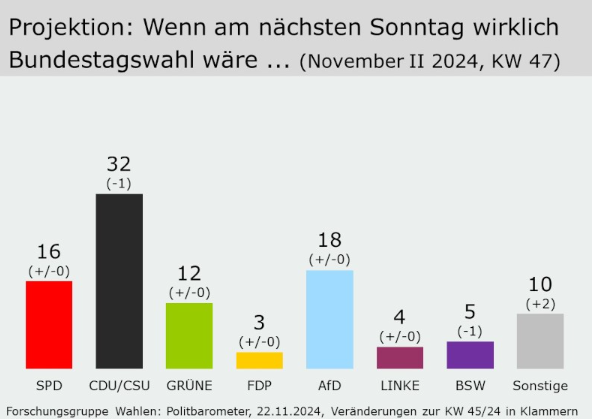
Public opinion polls show that the CDU/CSU leads with 32%, followed by the SPD at 16%, Greens at 12%, AfD at 18%, and the FDP at 3%. If the FDP fails to surpass the 5% threshold, they cannot participate in a coalition. A CDU-SPD (Black-Red) coalition or CDU-Greens (Black-Green) coalition appears likely.
In the preference survey for these two potential coalitions, the black-red alliance (a coalition between the CDU and SPD) emerged as the most favored, with 74% support. This is reminiscent of the coalition that lasted for 16 years under Chancellor Merkel, which many Germans regard as the most stable period in recent history.
However, in the case of a black-red alliance, Olaf Scholz, the SPD’s candidate for Chancellor, would compete for the position against Friedrich Merz, the CDU’s candidate. In this scenario, Merz is shown to have an advantage over Scholz. Meanwhile, in a separate survey measuring favorability for potential candidates for Chancellor, Boris Pistorius, the current Minister of Defense, scored significantly higher than both Scholz and Merz. Pistorius has, however, declared within the SPD’s internal primaries that he would not run for Chancellor in this election, pledging his support for Scholz instead.
Once a new chancellor is elected, they must address pressing issues, including preparing for Donald Trump’s likely presidency and restoring Germany’s faltering economy. Germany’s leadership is critical to overcoming challenges in the EU, requiring stronger leadership than seen under Scholz.
About the Author:
Choi Soo-jung Columnist
Soo-jung Choi is a columnist currently pursuing a doctorate in law with a specialization in maritime law at the University of Hamburg in Germany. She served as a senior researcher at the Korea Maritime Institute for 11 years. Her research focuses on marine environment, international fisheries regulations, and issues related to the United Nations Convention on the Law of the Sea, including territorial disputes over Dokdo.

댓글