

Korea-EU: A Strategic Pivot

- Limits of US-Centric Security and the EU Bypass Amid rising Korean Peninsula crises driven by the North Korea-China-Russia alignment, relying solely on the US for security intelligence restricts diplomatic autonomy. Establishing a Korea-EU Framework for the Protection of Classified Information is vital to forging a multilayered defense cooperation network.
- Sovereign AI Alliance Against US-China Tech Monopolies With the global AI market threatened by complete dependence on US and Chinese Big Tech, this Digital Trade Agreement (DTA) acts as a strategic convergence joining the regulatory powerhouse of the EU with South Korea’s advanced semiconductor and model-building capabilities.
- Survival Strategy to Escape Security and Digital Hostage Crises This Korea-EU partnership does not seek to replace existing alliances. Instead, it serves as a declaration of intent to escape the “security and digital hostage crises” orchestrated by the US and China, thereby maximizing South Korea’s geopolitical leverage and presenting a “Third Standard” in global hegemonies.
The Korea-EU Summit: Far More Than a Diplomatic Formality
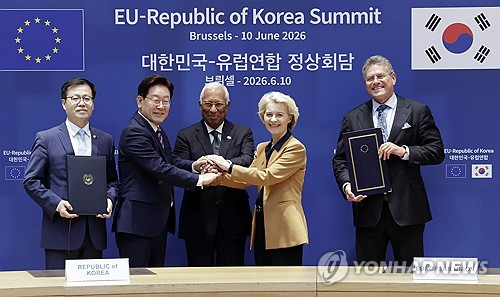
An analysis of the official reports regarding President Lee Jae-myung’s visit to the EU in Brussels on June 10 reveals that this bilateral cooperation extends far beyond mere diplomatic rhetoric. In particular, the agreements concerning Indo-Pacific security strategies and AI-digital cooperation carry profound implications for the future trajectory of South Korea’s foreign and defense policies.
The most critical takeaway from the joint statement of this 11th Korea-EU Summit is the formal acknowledgment by both parties that Indo-Pacific security and European security are intrinsically linked. Anchored by this shared recognition, South Korea and the EU agreed to launch formal negotiations on a bilateral Agreement on the Protection of Classified Information, while explicitly articulating their shared opposition to any unilateral attempts to alter the status quo in the Indo-Pacific.
This demonstrates that security challenges on the Korean Peninsula and East Asia are no longer confined to regional boundaries. Concurrently, it signals that Europe has officially begun to recognize geopolitical instability in the Indo-Pacific as a direct threat to its own continental security.
European Conflict Spills Over into an East Asian Crisis
The argument that Indo-Pacific and European security are interconnected has gained immense traction following North Korea’s overt intervention in the Russia-Ukraine war. Specifically, North Korea’s military assistance and strategic alignment with Russia serve as a prime example of how a European security crisis can directly spill over into East Asia.
Since North Korea and Russia signed the “Treaty on Comprehensive Strategic Partnership” in June 2024—formalizing mutual military assistance in the event of an emergency—the international community has continuously raised alarms over the contagion of transatlantic security threats into the Indo-Pacific.
Furthermore, the tightening strategic knot among North Korea, China, and Russia has taken center stage. If China, Russia, and North Korea consolidate a practical, albeit loose, strategic partnership tailored to their respective interests, the security architecture surrounding the Korean Peninsula will inevitably grow exponentially more volatile.
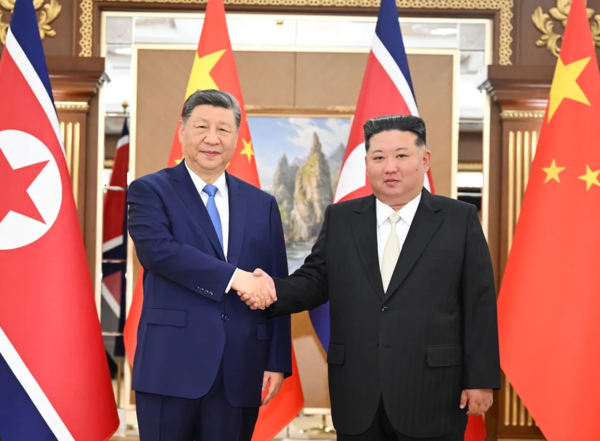
In particular, Chinese President Xi Jinping’s visit to North Korea on June 8 explicitly solidified the US-China gridlock in the Indo-Pacific. Given their moves to expand cross-border trade, reinforce military cooperation, and emphasize mutual respect for sovereignty and core interests, international deliberations on North Korea’s denuclearization are bound to enter a significantly more grueling phase.
Pyongyang will undoubtedly leverage backing from Beijing and Moscow to dilute the pressure of international sanctions, while Beijing may utilize North Korea as a strategic buffer zone. In this scenario, North Korea will cease to be a mere ally and instead transform into a highly potent diplomatic and security wildcard designed to constrain US strategic mobility amidst the Taiwan issue and the broader US-China hegemonic rivalry.
Simultaneous Crises: The Korean Peninsula and Taiwan
Consider a scenario where China intensifies its military coercion over Taiwan. If North Korea simultaneously manufactures security anxieties along the West Sea, the Demilitarized Zone (DMZ), or within the cyber and missile domains, Washington’s Indo-Pacific strategy would instantly be plunged into a catastrophic “dual-front crisis.”
In other words, the Indo-Pacific does not harbor isolated vulnerabilities. A crisis in the Taiwan Strait and a crisis on the Korean Peninsula can erupt concurrently. The probability of this nightmare scenario escalates in direct proportion to the tightening strategic alignment among Pyongyang, Beijing, and Moscow.
In such a volatile environment, South Korea’s legacy security architecture is no longer sufficient. While the ROK-US alliance remains the bedrock of South Korean defense, relying exclusively on the United States for total security capabilities introduces a profound strategic vulnerability. This is precisely where the EU emerges as a vital, non-traditional security partner for Seoul.
Limits of US-Centric Security and the Strategic Value of the EU
The recent friction surrounding intelligence-sharing protocols between Seoul and Washington highlights a glaring vulnerability in South Korea’s security matrix. Despite the South Korean government clarifying that the data in question was “open-source intelligence,” the US restricted the sharing of critical intelligence regarding North Korean troop movements, citing “sensitive information management” protocols. From Seoul’s perspective, this maneuver felt uncomfortably like a calculated effort to force compliance.
While Washington’s precision military intelligence and satellite surveillance assets cannot be replaced overnight, this friction underscores why South Korea must diversify its security cooperation channels. The more absolute Seoul’s reliance on American intelligence assets becomes, the more severely restricted its diplomatic and security autonomy will be.
The EU has steadily cultivated its own sovereign satellite intelligence frameworks and hybrid warfare intelligence capabilities. France’s military reconnaissance satellite networks, European-wide electronic intelligence assets, and continental defense-industrial technologies can offer an invaluable complementary buffer, even if they cannot fully replace US capabilities.
Hence, the Korea-EU Agreement on the Protection of Classified Information is far more than a routine bureaucratic document. It marks a foundational shift for South Korea to transcend a singular, US-centric intelligence dependency and build a resilient, multilayered security network. Furthermore, should Washington attempt to weaponize intelligence access as diplomatic leverage, this partnership provides Seoul with a vital “strategic bypass” to maintain negotiating power.
A Legal Bedrock for Defense and Military Technology Cooperation
Another critical dimension of the Korea-EU classified information agreement is that it establishes the definitive legal infrastructure required for advanced defense intelligence exchanges and military technology cooperation.
South Korea has already drastically expanded its footprint in the European theater via “K-Defense.” Defense procurement partnerships with European nations, such as Poland, have comprehensively validated the global competitiveness of South Korean weapon systems. However, to ensure future cooperation does not stagnate at the level of simple hardware exports, the relationship must evolve toward intelligence sharing, joint research and development (R&D), and cutting-edge military tech collaboration.
Achieving this requires a ironclad, mutually trusted classification protection framework. This agreement blueprint will serve as the institutional launchpad transforming South Korea and the EU from simple commercial partners into deep security, defense, and technological allies.
Ultimately, the very sight of South Korea diversifying its security architecture beyond an exclusively US-dependent model delivers a potent geopolitical message. It signals not an attempt to substitute core alliances, but a definitive declaration to enhance South Korea’s strategic autonomy and diplomatic leverage.
The DTA: Launchpad for a Sovereign AI Alliance
The second pivotal dimension to analyze is the deep policy implication of the Korea-EU Digital Trade Agreement (DTA). This pact can serve as the baseline for a Sovereign AI Alliance to counteract the artificial intelligence monopolies wielded by US and Chinese tech giants—a critical issue given the EU’s gradual loss of technological hegemony (as explored in my previous column, Europe Falling Behind in the Tech Hegemony Race).
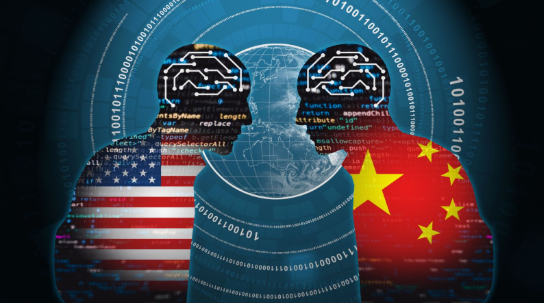
The global generative AI market is consolidating rapidly around American behemoths (OpenAI, Google, Meta, Amazon, Microsoft) and Chinese titans (Baidu, Alibaba, Tencent, DeepSeek). If this duopoly persists, South Korea and Europe face a grim future: becoming completely subjugated to US and Chinese AI ecosystems without ever developing indigenous AI frameworks that reflect their unique languages, cultures, legal structures, and value systems.
This transcends mere industrial competition. AI is poised to become the foundational operating system governing education, public administration, national defense, healthcare, finance, and culture. Ergo, surrendering AI sovereignty equates to the systemic erosion of data sovereignty, intellectual sovereignty, and ultimately, policy sovereignty.
The Convergence of “Regulatory Europe” and “Technological Korea”
The EU secured a pioneering position in the global AI governance race by codifying the world’s first comprehensive AI Act. However, Europe’s glaring vulnerability is its absolute lack of domestic Big Tech conglomerates and hyper-scale AI platforms. It possesses the rulebook, but lacks the corporate tech engines to deploy it.
Conversely, South Korea boasts proven experience developing proprietary LLMs (such as Naver’s HyperCLOVAX) and commands undisputed global dominance in next-generation AI semiconductors, particularly High Bandwidth Memory (HBM) spearheaded by Samsung Electronics and SK Hynix. While South Korea commands tech and manufacturing prowess, it requires partnership with the EU to shape global regulatory standards and scale its market reach.
Thus, the Korea-EU DTA represents a brilliant strategic intersection where “Regulatory Europe” meets “Technological Korea.” By marrying the EU’s gold-standard data protection metrics with South Korea’s cutting-edge AI and semiconductor architecture, the path opens to engineer an independent Sovereign AI ecosystem insulated from US-China models. This is not simple commercial cooperation; it is a grand strategic alliance for the digital age.
AI Sovereignty as the New Frontier of National Security
Much like military intelligence, over-relying on a specific foreign state or corporate entity for AI infrastructure introduces severe national security vulnerabilities. If a nation’s administrative, industrial, healthcare, and military data become tethered to US or Chinese cloud networks and AI platforms, that nation effectively surrenders sovereign control over its digital borders.
US cloud architectures—such as AWS, Microsoft Azure, and Google Cloud—already exercise a virtual monopoly over the global market. The efficiency and technical sophistication they offer are undeniably formidable. However, allowing a nation’s core data assets to remain structurally dependent on foreign corporate infrastructure over the long term poses a critical strategic risk.
Consequently, AI sovereignty is no longer a niche issue for tech sectors. It is a core pillar of national security sovereignty and a prerequisite for national survival. Much like diversifying military intelligence channels, Korea-EU digital cooperation is a definitive expression of intent: a refusal to be dragged along by the technological monopolies of competing superpowers.
Checkmating Superpower Monopolies via Trusted AI Standards
This Korea-EU partnership reportedly encompasses robust frameworks regarding AI ethics, data privacy, and data governance, alongside safe cross-border data transfers. This implies that South Korea and the EU are actively positioning themselves to co-author the global standard for “Trusted AI.”
While US and Chinese Big Tech firms utilize their colossal data pools and capital to monopolize the AI market, their predatory data harvesting and training methodologies have triggered severe blowback regarding privacy violations, copyright infringements, algorithmic bias, and cultural homogenization.
While the EU’s stringent AI regulations are frequently criticized for dampening internal commercial tech growth, they conversely serve as a powerful institutional shield designed to check the unchecked data extraction and market penetration of US and Chinese Big Tech. By infusing this regulatory shield with South Korea’s manufacturing and technological muscle, the Korea-EU coalition can offer a compelling “Third Standard” to the world. This will act as an institutional brake on superpower monopolies and a strategic mechanism to shelter regional AI industries.
Escaping the Geopolitical and Digital Hostage Crises
President Lee Jae-myung’s state visit to the EU and the resulting blueprints for military-security and digital alliances carry monumental strategic weight amidst the ongoing US-China hegemonic rivalry.
The United States remains South Korea’s indispensable ally, yet a US-centric security and technological order inherently threatens to restrict Seoul’s strategic autonomy. Conversely, while China remains an essential economic neighbor, its security posture applies severe pressure on South Korea’s strategic maneuvering room regarding the Korean Peninsula and Taiwan.
In this delicate environment, South Korea cannot afford submission to either camp. Instead, it must architect its foreign, security, and technology policies in a manner that maximizes its own strategic value. The partnership with the EU provides exactly that leverage.
This cooperation must never be misconstrued as an attempt to alienate the United States. On the contrary, it is a deliberate strategy to transform South Korea into a more formidable, highly leveraged ally. Nor is it designed to needlessly provoke Beijing; rather, the EU represents a pragmatic, realpolitik choice to expand South Korea’s survival space amid the tightening North Korea-China-Russia axis and superpower competition.
The core essence of this summit is clear: South Korea and the EU are indispensable partners. South Korea requires security and technological diversification; the EU requires a tangible, capable partner to operationalize its Indo-Pacific strategy and AI tech execution. The time has come for South Korea and the EU to unite their security and their future.
Choi Soo-jung Columnist
※ Columnist Choi Soo-jung is a Ph.D. candidate at the University of Hamburg, Germany, specializing in Maritime Security Law and Cyber Security Law. She previously served as a Senior Research Fellow at the Korea Maritime Institute (KMI) for 11 years. Her research focuses on the UN Convention on the Law of the Sea (UNCLOS), marine environments, international fisheries regulations, and the Dokdo territorial dispute. She has also served as a Visiting Researcher at the NATO Cooperative Cyber Defence Centre of Excellence (CCDCOE), a panelist at the NATO Maritime Security Centre of Excellence (MARSEC COE), and a Research Fellow at the NATO Defense College (NDC).

댓글