

Korean Youth Have Unmasked the Incompetence of Established Politics

- Political Incompetence Masked by Gender Strife While mainstream media and established politicians reduce the June 3rd local election results to a mere “gender polarization” among the youth, the true culprit lies in the political failure to address a structural crisis—namely, the 1.5-billion-won Seoul apartment barrier and a “systemic asset-based stratification” that has dumped nearly half (49.6%) of all household debt onto the younger generation.
- The Flawed Reality of Selective Welfare and Supply Rhetoric The political status quo stands exposed by both an adverse-selection welfare model—which screens beneficiaries purely by documented income rather than generational wealth, thereby alienating the truly vulnerable—and a short-sighted housing policy obsessed with temporary deregulation that fails to lower the barriers to entry for youth.
- The Cold Realization and Demands of “Conditional Supporters” Demonstrating high volatility in their voting patterns, the 2030 generation is not asking for populist cash handouts. Instead, they demand the restoration of a fair ladder for upward social mobility. Acutely aware that neither major party has an answer, they have issued a chilling warning through the ballot box.
The Trap of the “2030 Conservatization” Thesis
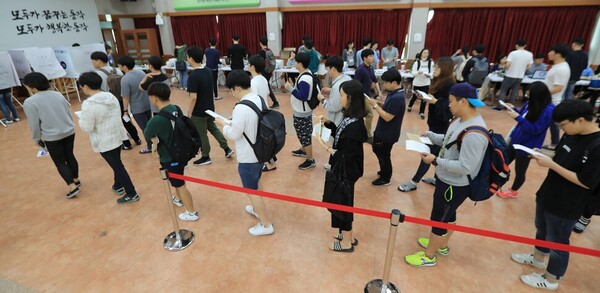
The June 3rd national concurrent local elections have come to a close. Alongside the final tallies, a single data point from the big three broadcasters’ exit polls has reignited a fierce debate. Among voters in their 20s, 55.8% of men backed the conservative People Power Party (PPP) candidates, while 66.4% of women supported the progressive Democratic Party of Korea (DPK) candidates. This identical schism manifested among voters in their 30s: 48.6% of men voted PPP versus 42.1% DPK, while 63.5% of women voted DPK versus 32.5% PPP.
Predictably, mainstream media outlets immediately blasted headlines proclaiming the “Reconfirmation of Gender Polarization in Youth Voting.” However, this interpretation is only half-correct. While the gender divide is a distinct and palpable reality, labeling it as the entirety of youth politics causes us to lose sight of a far more critical question.
The 2030 generation increasingly prioritizes a candidate’s competence and specific policies over blind partisan loyalty. In fact, in this election, the voter turnout intent among 18-to-29-year-olds hit 51.2%, a staggering 11.1 percentage point surge compared to the 2022 local elections.
The youth have not turned their backs on politics; on the contrary, they are marching into the political arena in greater numbers than ever before. To understand what they are truly demanding, we must dive beneath the surface—into the hard data and the underlying socio-economic structures.
The Political Topography Reshaped by the “Apartment Monster”
To comprehend the political choices of the 2030 generation, one must first confront the material conditions of their daily lives. On December 29, 2025, the average price of an apartment in Seoul crossed the historic threshold of 1.5 billion won ($1.1 million USD) for the first time.
According to data from the Korea Real Estate Board, Seoul apartment prices skyrocketed by a cumulative 8.98% over the course of 2025. This eclipses the 8.03% spike seen in 2018 during the Moon Jae-in administration, marking the highest annual surge since official record-keeping began in 2013.
Let us translate this staggering number into the lived reality of a young Korean. Suppose a young professional in their early 30s working in Seoul earns an annual salary of 40 million won. Even if they save every single won without spending a dime on food or clothing, it would take them over 37 years to purchase a 1.5-billion-won apartment. And that calculation relies on the impossible premise that apartment prices will remain frozen for nearly four decades. This is the stark reality confronting Seoul’s youth in 2026.
Living conditions have deteriorated accordingly. The proportion of young people relegated to precarious, sub-standard housing like Gosiwon (tiny, single-room residential facilities) more than doubled from 5.6% in 2010 to 11.5% in 2023. Furthermore, the share of youth living in spaces below the minimum statutory housing standard (14 square meters) ticked up from 6.1% in 2023 to 8.2% in 2024. While single-person households in the Seoul metropolitan area have exploded, the supply of small, non-apartment housing has dried up, putting immense inflationary pressure on the monthly rental market.
Housing costs are no longer just a basic living expense; they are a systemic drain. The ratio of actual housing expenditure to disposable income for the youth generation stands at roughly 9%—triple the 3% average across all other age demographics. Econometric estimates show that a mere 1% increase in housing costs triggers a 0.04% decline in total assets, and a 1 percentage point increase in the share of housing expenditure suffocates educational spending by 0.18 percentage points. This is a double-edged vice: exorbitant housing costs simultaneously cannibalize immediate asset formation and long-term human capital accumulation.
The debt landscape is even more alarming. According to reports from the Bank of Korea, the share of youth debt (ages 19–39) relative to the nation’s total debt portfolio skyrocketed from 23.5% in 2012 to an astonishing 49.6% in 2024. This doubling of debt share in just twelve years vividly illustrates how deeply the younger generation is being dragged into a structural quagmire of liabilities.
In Korean society, a residential property is never just a place to live. It is the bedrock of retirement security, the absolute material prerequisite for marriage and family formation, and the primary channel for intergenerational wealth transfer. The starting-line gap between a young person whose parents own a Seoul apartment and one whose parents do not already amounts to hundreds of millions of won. This chasm widens at a velocity that far outpaces the speed of any individual’s hard work.
In sociology, this is known as “asset-based stratification.” It is a rigid structure where inequality is dictated far more by wealth assets than by earned income.
Structural Distrust in the Welfare Apparatus
Within this framework, it is a logical inevitability that young people react with icy cynicism to traditional political “welfare rhetoric.” While conventional welfare temporarily alleviates immediate poverty, what this generation desperately craves is a visible, predictable path to asset formation.
This cynicism is born of a profound paradox: young people are not angry at the concept of welfare itself; they harbor a deep structural distrust toward the design of the current welfare system.
Consider the reality of the labor market. The proportion of youth whose transition from graduation to their first job takes more than a year climbed from 24.1% in 2004 to 31.3% in 2025. While macro-indicators like the headline youth employment rate show superficial improvement, the actual time required to land that crucial first job is lengthening. Meanwhile, the number of young individuals (ages 19–34) classified as “just resting” (economically inactive without seeking work) ballooned from the 200,000s in 2003 to over 400,000 in 2024.
Thus, even as employment statistics look polished on paper, the qualitative barriers to entry and the precariouness of work have intensified. Corporations’ aggressive preference for experienced hires and rolling recruitment has slammed the door on entry-level applicants, compounding the “scarring effect”—where early career delays leave permanent, negative marks on lifetime wages and career trajectories.
Against this backdrop, the design flaws of existing youth support policies become glaring. Programs like youth housing stipends, subsidized loans, and various regional youth allowances almost exclusively rely on income-tested targeting. While sorting by low income appears rational on paper, it fosters a malignant structural perversion in practice.
First, the disconnect between documented income and generational assets: A young person whose parents are multi-property landlords can qualify for government subsidies if their personal documented income falls below the threshold. Conversely, a youth from a provincial town working grueling hours at a part-time job in Seoul to scrape together 1.5 million won a month is disqualified for “exceeding the income cap.” It is an adverse-selection trap—what social policy experts call “the limitations of income-centric targeting.”
Second, the inequality of bureaucratic literacy: Complex application procedures and dense paperwork requirements inherently favor affluent, educated demographics. Metropolitian youth, individuals from families with administrative experience, and those fluent in navigating digital bureaucracy repeatedly siphon off the lion’s share of benefits. The pervasive sentiment that “the system rewards those who know how to play it rather than those who work honestly” is not a baseless grievance; it is an empirical observation.
Third, the hyper-visibility of intra-generational unfairness: In a digital ecosystem where peer benefits are scrutinized in real-time on social media and online communities, a single egregious case of unfair allocation instantly delegitimizes an entire policy portfolio. Regardless of the program’s actual statistical scale, its political fallout is explosive.
Why Youth Applaud Urban Redevelopment and Deregulation
This precise critique explains why aggressive supply-side housing policies—such as easing reconstruction and redevelopment regulations, lifting floor-area-ratio (FAR) caps near transit hubs, and accelerating urban renewal projects—garner substantial support among the youth. It is not an ideological shift toward conservatism.
It is a calculated, pragmatic alignment of self-interest: if the raw volume of housing increases, the statistical probability of me securing a home might finally rise above zero.
Indeed, in 2026, the Seoul Metropolitan Government is pushing through a policy to hike the legal upper limit of floor-area ratios for urban renewal projects by up to 1.2 times. To be sure, this cannot serve as an instantaneous panacea for youth housing. Due to bureaucratic bottlenecks, skyrocketing construction material costs, and steep financing rates, it typically takes five to ten years for new supply to materialize on the market.
Moreover, there is an inherent paradox: as redevelopment gains momentum, the asset value of existing property owners surges first, inadvertently raising the entry barrier for asset-poor youth. Yet, young people back this trajectory because it represents a willingness to smash the frozen, stagnant status quo.

Restoring the Ladder: A New Political Imperative
Let us re-examine the June 3rd local election exit polls. Beneath the superficial gender split lies a far more profound, systemic signal.
In the pivotal bellwether district of Pyeongtaek B, the proportion of voters who stated they were willing to switch candidates mid-campaign reached an overwhelming 53% among those aged 18–29, and 34% among those in their 30s—drastically eclipsing older demographics. The 2030 generation is not anchored to any political tribe. They are “conditional supporters.” They continuously calculate whether a candidate’s narrative and policy matrix genuinely answer their structural crisis.
Their demands have now crystallized. They are not begging for pity or cash handouts. They are saying: “Build a transparent, predictable pathway where honest labor can translate into asset formation.” They are not asking for unearned privileges; they want opportunities distributed via transparent, undeniable metrics of fairness. In a word, they demand the restoration of the social mobility ladder.
To answer this mandate, the paradigm of youth policy must be completely overhauled:
-Transition Welfare Metrics: Government must shift from crude income-centric screening to a sophisticated, integrated income-plus-asset matrix. Relying solely on National Health Insurance metrics while ignoring liquid financial assets and real estate holdings institutionalizes systemic adverse selection.
-Innovate Supply Structures: Housing policy must pivot away from short-term demand suppression toward structural innovation in mid-to-long-term supply. This requires a aggressive mix of expanded public rentals, high-density transit-oriented developments, and experimental equity-sharing housing models. Given the current squeeze on the rental market due to the drop in low-cost non-apartment builds, targeted policy intervention in the micro-housing supply chain is urgent.
-Bridge Labor and Housing: Macroeconomists at the Bank of Korea warn that youth employment and housing are not isolated personal hardships, but structural constraints strangling the nation’s potential growth. True asset pathways cannot open without structural labor reforms that dismantle the rigid dualism of the job market alongside housing supply expansion.
-Acknowledge Intra-Generation Diversity: A corporate employee in Seoul, a job-seeker in a provincial town, a young couple trying to wed without capital, and a freelance gig-worker living in a Gosiwon possess fundamentally conflicting economic interests. Treating them as a monolith ensures that benefits consolidate among the privileged few while the rest remain structurally alienated.
“Neither the Left Nor the Right Has an Answer”
Ultimately, the political arena of 2026 is moving past the traditional intergenerational warfare of old. It is transforming into a fierce conflict between those who possess assets and those who desperately need to build them. This is a question that neither the progressive Left nor the conservative Right has adequately answered.
Behind the surface-level reality of the June 3rd election gender divide lies a cold, clear consensus among the youth: neither side has an answer to our structural reality.
If the core values that anchored Korean democracy after the 1987 democratic uprising were “procedural liberty and equality,” the defining political imperative of 2026 has converged on “fair opportunity and a restored ladder.” Whichever political faction realizes this first—and addresses it with genuine structural solutions rather than theatrical gimmicks—will dictate the future landscape of Korean politics.
The youth have not abandoned politics. They simply know, with clinical precision, that no one has delivered a real answer yet.
Cho Sun-gyu IT Columnist
Sun-gyu Cho has spent over 35 years fostering human growth at the frontlines of education, corporate management, and regional community development. Driven by the core conviction that “every societal challenge is, ultimately, a human challenge,” he has dedicated his career to creating meaningful change through education and carving out new pathways through enterprise. Today, he continues to actively tackle diverse societal gridlocks across communities, dedicating his insights to sculpting a warmer, more equitable, and just future for all.




댓글