

South Korea and US Must Re-evaluate Russia
The Paradox of the Ukraine War’s End “We Must Not Hand Russia Over to China”

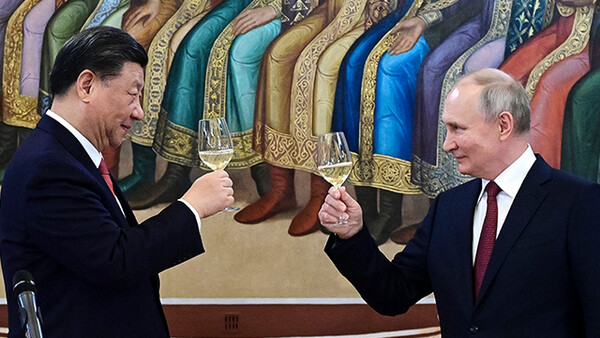
- Russia’s Growing Subordination to China Following the Ukraine War, a weakened Russia has grown deeply dependent on China economically and logistically, escalating the risk that Siberia, the Russian Far East, and the Northern Sea Route will be absorbed into China’s strategic sphere of influence.
- Threat to Northeast Asian Security Architecture If Vladivostok and the Russian Far East transform into an alternative maritime expansion route (a quasi-strategic stronghold) for China, South Korea will face a fatal security crisis, caught under Chinese strategic pressure from both the Yellow Sea and the East Sea (Sea of Japan).
- South Korea’s Two-Track Survival Strategy Seoul must uphold the “principles” of complying with international norms and aiding Ukraine while maintaining a “limited northern channel” to prevent Russia’s total absorption into China, thereby joining the United States to counter China’s monopoly over Eurasia.
The Post-Endgame Dilemma: The “Geopolitical Vacuum”
Sub-surface maneuvers are bustling within the international community regarding how the Ukraine War will end. While the United States applies pressure for a swift ceasefire based on “America First” policies, Europe is accelerating “Trump-Proofing”—preemptive defensive measures designed to shield government institutions, allies, and specific policies from the impacts of Trump’s decisions—to prepare for a so-called “security without America.”
However, domestic discussions remain insufficiently deep regarding the massive geopolitical tectonic shifts that will emerge once the gunfire ceases.
One of the realities we will face post-conflict is the fallout borne by a Russia that has managed to preserve a portion of its territory: the likelihood of Russia’s long-term “subordination to China” and its implications. Even if Russia withstands the war, it may find it difficult to avoid a structure of deeper economic, financial, technological, and logistical dependence on China.
The core dilemma lies precisely here. If Russia’s weakening and China’s strengthening occur simultaneously, can the West truly claim to have achieved a strategic victory?
The Limits of Russia Captured by the Kiel Report
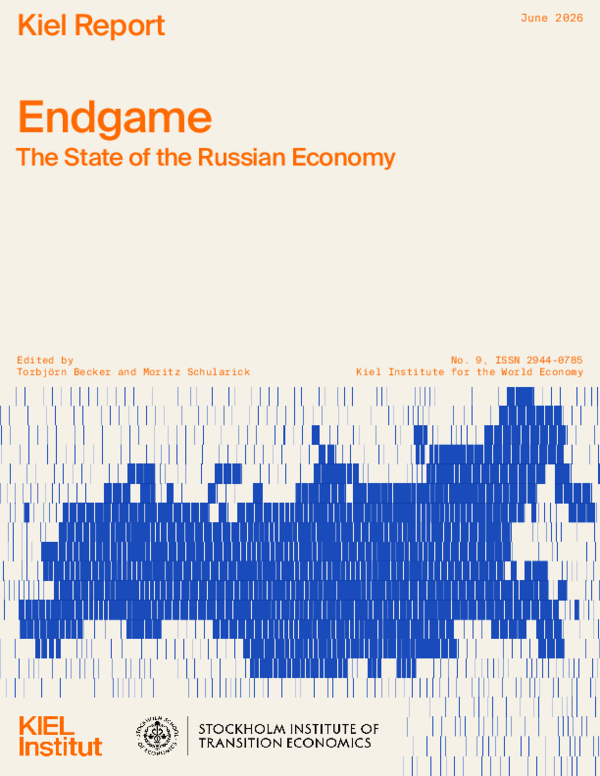
Indeed, authoritative Western think tanks are already capturing the limitations of the Russian economy in hard numbers. Kiel Report No. 9: “Endgame: The State of the Russian Economy” (June 2026), jointly published by Germany’s Kiel Institute for the World Economy and the Stockholm Institute of Transition Economics, diagnoses that while the Russian economy appeared to weather initial wartime shocks, it is rapidly approaching unsustainable thresholds in fiscal reserves, labor supply, and technology.
According to the report, Russia’s liquid National Wealth Fund assets plummeted from 6.5% of GDP at the war’s outset to 1.8% by April 2026, while oil and gas revenues in the first quarter of 2026 dropped 45% year-on-year.
Of particular note is Russia’s heavy reliance on China. The report points out that China accounts for approximately 35% of Russia’s total foreign trade, and roughly three-quarters of the increase in Russia’s sanctioned critical military component imports since 2022 have originated from China. In short, Putin’s war economy is becoming increasingly reliant on the financial, trade, and component supply chains provided by China amid Western sanctions.
The Strategic Void Between Data and Conclusions
However, it is also true that a significant strategic void exists between the report’s sophisticated data and its policy conclusions.
The report asserts that “Russia’s vulnerabilities must be leveraged by the West,” proposing a cutoff of energy imports and tighter enforcement of sanctions. This prescription is understandable in logic: making Russia pay a higher cost the longer it continues the war.
The trouble begins with what happens next. If China monopolizes the “geopolitical vacuum” created during the process of pressuring Russia, that pressure—while weakening Russia in the short term—may yield the counterproductive long-term effect of strengthening a China-centric Eurasian bloc.
China’s RMB (yuan) settlement network has already established itself as the rear financial infrastructure for Russia’s foreign economy. Over 90% to 95% of Sino-Russian trade is now settled in rubles and yuan, and the yuan’s share of Russia’s total foreign trade rose to about one-third by around 2024. As Russia is pushed out of the dollar and euro zones, it is sinking deeper into the yuan zone, allowing China to simultaneously expand its influence across energy, resources, logistics, and finance.
Ultimately, the central question is not “how to squeeze Russia further until it collapses.” The more fundamental core question is: “Does the West have a strategy to prevent China from monopolizing the vacant space while pressing Russia?”
Failing to answer this question risks driving the West—while attempting to manage a weakened Russia—to confront a more cohesive, China-centered Eurasian bloc that encompasses North Korea and Iran: the so-called CRINK (China, Russia, Iran, North Korea) axis.
South Korea’s Distinct Perspective on Russia
Amid these massive Eurasian tectonic shifts, South Korea must break free from the simplistic view of Russia solely as an aggressor in the Ukraine war. Of course, Russia’s illegal invasion must be severely criticized, and South Korea must responsibly join international efforts to aid Ukraine’s survival.
Yet within the architecture of South Korea’s security landscape, Russia simultaneously serves as virtually the sole northern variable capable of checking China’s expansion in Northeast Asia. Even if Europe looks unfavorably upon South Korea maintaining channels with Moscow, Seoul must preserve a minimal strategic point of contact with Russia from the standpoint of its own national survival strategy.
The true danger we must closely monitor is China’s push into Siberia and the Russian Far East at the end of North Korea-China-Russia alignment.
If prolonged war and sanctions force Russia into excessive dependence on China, Beijing may seek to bring not only Siberian energy, rare earths, and logistics networks into its sphere of influence, but also commercial and military strongpoints along the Northern Sea Route (NSR) and the Russian Far East.
China and Russia have already institutionalized a framework for Northern Sea Route cooperation, discussing navigation safety, cargo volume expansion, logistics development, and the sharing of ice and weather data.
The “Chokepoints” of Vladivostok and the Tumen River Estuary
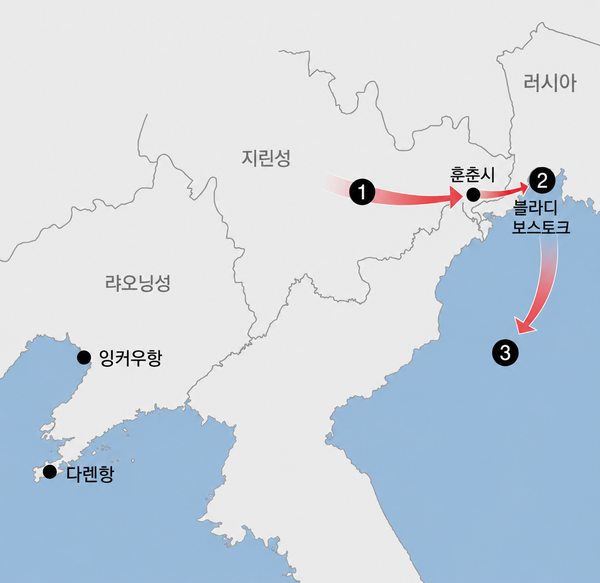
Vladivostok and the Tumen River estuary are the strategic chokepoints of the Siberian geography. Although China’s Jilin province lies within extremely close proximity to the East Sea, the final stretch is blocked by the borders of Russia and North Korea.
Under the 1991 Sino-Soviet Border Agreement, China is understood to hold navigation rights through the Tumen River; however, low railway bridges and shallow waters at the North Korea-Russia border have effectively restricted large vessels from accessing the East Sea directly. This physical constraint has functioned as a strategic barrier preventing China’s northeastern region from gaining a direct outlet to the East Sea.
What, then, is China’s realistic alternative? If large warships and merchant vessels cannot freely pass through the Tumen River mouth, Beijing is likely to expand commercial, logistical, and military access to existing ports in the Russian Far East—most notably Vladivostok.
While this does not immediately translate to territorial annexation or direct rule, if Chinese influence accumulates via long-term leases, port operational rights, logistics special zones, naval port-of-call rights, and joint exercises, Vladivostok could gradually transform into a Chinese quasi-strategic outpost.
Historical memory renders this issue even more sensitive. Prior to the 1860 Convention of Beijing, Vladivostok was within Qing China’s sphere of influence, and it is still remembered in China by its historical Chinese name, Haishenwai (海参崴).
In today’s international order, historical territorial claims cannot simply be transplanted directly into realpolitik. However, if China combines economic influence with strategic necessity to expand its voice in the Russian Far East, the symbolic and practical weight will be far from negligible.
When the East Sea Becomes China’s Northern Maritime Outlet
The moment Vladivostok transforms into a forward naval port or quasi-base for the Chinese Navy, the security landscape of Northeast Asia may fundamentally shift.
In July 2025, the Chinese Navy actually entered Russia’s naval port in Vladivostok to participate in the “Joint Sea-2025” drills, which included destroyers, supply ships, and submarine rescue vessels.
A single round of exercises cannot immediately be interpreted as permanent naval base establishment. Nevertheless, as Russia’s reliance on China deepens and cooperation on the Northern Sea Route and Far Eastern ports becomes institutionalized, the Chinese Navy’s access to the East Sea could evolve from temporary drills into a structural reality.
Up to now, China’s maritime expansion has been discussed primarily around the South China Sea, the Taiwan Strait, and the East China Sea. However, if China secures a detour connecting to the East Sea and the North Pacific via the Russian Far East and the Northern Sea Route, the pressure points of its Indo-Pacific strategy will expand unexpectedly northward.
Simultaneous Shocks for North Korea, Japan, and the United States
A watching North Korea will not be immune to these changes either.
Historically, the Pyongyang regime has balanced between reliance on and wariness of China. If the Russian Far East becomes deeply incorporated into China’s sphere of influence, North Korea will find itself pressured by China not only from the west along the Amnok (Yalu) River and north along the Tumen River, but also from the east along the Primorsky Krai direction. This implies that China’s intervention pathways in the event of a sudden contingency in North Korea or a peninsular crisis could multiply.
Japan will likewise shoulder grave strategic burdens.
For Japan, the East Sea has traditionally been a theater primarily for managing Russian naval and North Korean threats. Yet if Vladivostok functions as a routine port of call or operational support base for the Chinese Navy, Tokyo will feel the weight of Chinese maritime power far more acutely along its western coast and northern waters. This means substantial adjustments will be required for Japan’s defense lines and the U.S.-Japan alliance’s maritime strategy.
For the United States, this represents a critical challenge to its Indo-Pacific strategy.
U.S. containment of China has been architected primarily around the South China Sea, the Taiwan Strait, the East China Sea, and the First Island Chain. Yet if China broadens its operational radius into the East Sea and the North Pacific utilizing the Russian Far East and the Northern Sea Route, Washington’s Pacific defense blueprint will face fresh pressures from the north. The moment the northern outlet of the Eurasian continent is incorporated into China’s strategic options, the U.S. will be forced to confront a much wider and more complex front.
South Korea as the Ultimate Victim
The most direct victim will be South Korea.
Seoul is already subjected to Chinese maritime pressure in the Yellow Sea, and it is difficult to escape the fallout of a crisis in the Taiwan Strait to the south. If Chinese naval activity were structurally expanded further into the northeast via Vladivostok and the East Sea, the Korean Peninsula would find itself caught in a strategic pincer, squeezed by China from both the west and the east.
This alteration strikes at the foundational premises of South Korean security. This is precisely why Seoul must view the subordination of the Russian Far East and Siberia to China with the utmost gravity.
Consequently, South Korea’s outreach to Russia is not “pro-Russian.” It must be understood as an “anti-hegemonic containment strategy against China” and a “conditional engagement strategy” to prevent China’s monopoly over Eurasia. South Korea’s objective is not to unconditionally shield Moscow, but to “prevent Russia from being fully integrated as China’s junior partner, effectively handing over the strategic spaces of the Russian Far East and Siberia to Beijing.” This distinction must be kept clear.
South Korea’s Asymmetric Card
Historically, Russia has cooperated with China while simultaneously guarding against excessive Chinese influence. For the Russian elite, Siberia and the Far East are not merely borderlands, but core spaces of national identity and great-power status. A scenario where Chinese capital, population, and logistics networks overwhelm these regions is by no means a comfortable future for Moscow. Right within this structural fissure lies South Korea’s asymmetric card.
Seoul is one of the few nations capable of offering options that Beijing cannot provide. South Korea possesses the capabilities Russia requires across advanced manufacturing, shipbuilding, energy infrastructure, Northern Sea Route logistics, Far Eastern development, and digital-industrial technology. Prior to the Ukraine War, South Korean companies and technologies served as vital partners in modernizing Russia’s economy.
When Russia seeks to evade long-term, sole-source subordination to China, South Korea can serve as a “diplomatic lifeline”—if not a complete alternative—providing breathing room.
This approach must, of course, be pursued with caution. South Korea must not shake hands with Russia in a manner that undermines international norms or turns a blind eye to Ukraine’s suffering. Practical gains unaccompanied by moral duty amount to building a house on sand.
Seoul must actively pursue humanitarian aid, reconstruction assistance, winterization support, and indirect defense capability support to help Ukraine survive. Only then can South Korea’s northern strategy be recognized not as mere “opportunism,” but as a “responsible strategy.”
The Northern Strategy Europe and America Must Understand
Simultaneously, Europe needs to understand South Korea’s geopolitical conditions. To Europe, Russia is primarily an aggressor to the east; however, to South Korea, Russia is also a northern variable capable of checking China’s expansion in Northeast Asia.
Just because Europe’s moral outrage is justified does not mean South Korea’s security reality vanishes. Seoul must aid Ukraine while leaving room to prevent Russia from being entirely handed over to China.
The United States needs to strategically tacitly condone and leverage this dynamic. If Washington genuinely seeks to block China’s Eurasian expansion, South Korea’s “limited channels with Russia” can function not as an inconvenient exception, but as a useful auxiliary axis.
Maintaining Russia as a northern point of contact managed at a controllable level by South Korea, Japan, and the United States is wiser in the long run than transforming Russia entirely into China’s rear logistics base.
Ultimately, South Korea’s strategy must operate on a two-track system of principles and pragmatism. Pragmatism without principles appears as vulgar opportunism, while principles without pragmatism risk reducing themselves to moral self-indulgence that ignores security realities.
It is imperative for South Korea to prove its qualification as a nation of dignity through responsible solidarity with Ukraine. Simultaneously, by maintaining minimal strategic channels with Russia, Seoul must secure macroeconomic leverage to block China’s monopolization of Siberia, Primorsky Krai, and the Northern Sea Route.
Post-Ukraine War, South Korea’s northern strategy is not a matter of helping Russia. It is a “survival strategy” to prevent China from swallowing Siberia and the East Sea. Only through this meticulous two-track strategy can Seoul protect its alliance, uphold international norms, and safeguard South Korea’s security within the grand chess match of Eurasia.
Choi Soo-jung Columnist
Columnist Choi Su-jung is currently majoring in Maritime Security Law and Cyber Security Law in the Ph.D. program at the University of Hamburg, Germany. She served as a Senior Researcher at the Korea Maritime Institute for 11 years, conducting research on the UN Convention on the Law of the Sea, including the marine environment, international fisheries norms, and the Dokdo territorial dispute. She has completed visiting researcher programs at the NATO CCDCOE, served as a panelist at the NATO MARSEC COE, and completed the Research Fellowship at the NATO Defense College.)


댓글