

Progressive Slogans, Militaristic Memes: The Two Faces of Starbucks

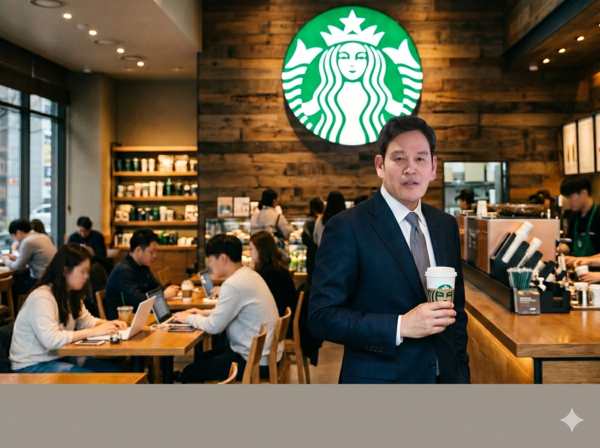
- The Contamination of the ‘Third Space’ By allowing itself to be hijacked as an “our-side brand” through the ostentatious, far-right political performances of Shinsegae Group Chairman Chung Yong-jin and online “Ilbe-esque” subcultures, Starbucks Korea has forfeited its identity as a neutral, inclusive space.
- The Hypocrisy of Global HQ’s ESG Management While capitalizing on a progressive image in the U.S. by championing diversity and human rights, Starbucks Corporation turns a blind eye to militaristic marketing and political controversies in Korea, revealing a deeply hypocritical approach to ESG.
- The Call for a Breakup with Chung Yong-jin The only way for Starbucks to prove its authenticity and sever ties with the chronic ills of Korean chaebol culture—where an individual owner’s political ambitions cannibalize an entire brand—is to sever its relationship with Chairman Chung.
The Two Faces of Starbucks
The recent controversy surrounding Starbucks Korea is not merely a matter of an isolated, inappropriate marketing event. It is a symbolic case study showing a glaring contradiction: how a brand that built its empire on progressive, inclusive slogans in the West can so easily compromise with toxic, militaristic memes in the Korean market. This incident lays bare how a global brand becomes politicized, and how a corporate tycoon’s personal worldview can destabilize an entire culture of consumption.
What makes this issue particularly problematic is that it lies at the intersection of Chairman Chung Yong-jin’s repetitive political grandstanding, Starbucks Korea’s tone-deaf marketing, and Starbucks Corporation’s selective ethical consciousness at the global headquarters.
Starbucks has long been recognized as a “Third Space” where anyone can pause and stay. Yet, the current iteration of Starbucks Korea increasingly reads as a space that projects a specific cultural and political sensibility. At the core of this shift lies Chung Yong-jin’s excessive personal branding, a marketing culture that mistakes controversy for buzz, an uncomfortable alignment with far-right online male subcultures, and a hypocritical ESG strategy from a global headquarters that fails to govern these excesses.
Originally, Starbucks was never just a coffee brand. It branded itself as an emblem of urban sophistication, global sensibility, diversity, and inclusion. For years, the U.S. headquarters aggressively promoted its commitment to ESG (Environmental, Social, and Governance) management.
Here, “Environmental” signifies eco-friendly operations and carbon reduction; “Social” stands for diversity, labor rights, and community responsibility; and “Governance” implies corporate transparency and ethics. Simply put, the company crafted an image of a “socially responsible enterprise” rather than a mere profit-driven machine.
The problem is that these values crumbled far too easily in the Korean market. Marketing events that consume tanks, militarism, and a masculine combat mindset as mere play clash directly with the brand philosophy Starbucks has historically championed.
While preaching human rights and diversity in the United States, Starbucks in Korea has mindlessly capitalized on tropes that provoke political polarization and gender conflict. Naturally, consumers are left to ask: Is Starbucks’ ESG a genuine philosophy, or is it merely marketing jargon deployed selectively across different markets?
The Flippancy and Danger of Chung Yong-jin
The involvement of Chung Yong-jin has exacerbated the gravity of the situation. For a long time, he has treated political messaging on his social media as a form of recreational consumption. His controversies over anti-communist rhetoric (myeol-gong), expressions associated with specific political factions, and exaggerated performances of masculinity have not been isolated gaffes; they have been repeated as a deliberate branding strategy.
The critical issue is that the personal preferences of the corporate patriarch have begun to cannibalize the identity of the entire enterprise. Consumers no longer view Starbucks as a neutral ground. Instead of a coffee brand, they begin to read it as a corporation aligned with a specific political sensibility.
This reflects the unique pathology of Korean chaebol culture. When CEOs of global corporations in the U.S. or Europe make political statements, they operate within strict corporate governance and brand risk management systems. The culture surrounding Korean conglomerates, however, frequently fails to separate the corporation from the individual.
Chung Yong-jin appears indifferent to the fact that his personal tastes, moods, and political instincts dictate the image of the entire group. This is precisely why his social media politics are dangerous. It is not a matter of a private account; it fundamentally alters the semiotic framework of the entire Shinsegae Group and, by extension, the Starbucks brand.
Starbucks Events That Galvanize “Ilbe” Culture
This dynamic inevitably invokes what is known as the “Ilbe Storehouse (Ilbe) culture.” To be clear, one cannot definitively conclude that Starbucks or Chung Yong-jin directly endorses Ilbe—a notorious far-right online community widely known for hate speech, misogyny, and political trolling. What matters here, however, is not intent, but cultural context.
In South Korean society, militaristic play, aggressive masculinity, anti-PC (political correctness) sentiment, and a mockery-centered humor culture have long been consumed in tandem with far-right male online spaces. Ilbe is not just an internet forum; it has become a cultural signifier of hate, derision, cynicism, and weaponized political aggression enjoyed as entertainment. The real issue is that Starbucks has begun to function as an extension of that political performance.
Consumers no longer experience Starbucks as a politically neutral coffee shop. The act of purchasing a coffee has begun to feel tethered to a specific cultural and political stance. At this exact juncture, certain far-right male communities, particularly those steeped in Ilbe-esque culture, began to aggressively appropriate the Starbucks brand.
Indeed, following the anti-communist controversies, posts repeatedly surfaced in Ilbe-like forums consuming Starbucks as a political badge of honor. Users uploaded photos of Starbucks drinks and merchandise as a form of “patriotic consumption” or utilized the brand as a meme to mock opposing political stances.
These cultural codes are far too easily legitimized under the guise of “fun” or “memes.” Starbucks is no longer consumed as a simple coffee provider, but as an “our-side brand.” This phenomenon is not a fleeting episode; it is a pattern of accumulation.
Global Brands Carry Responsibility for Symbolic Consumption
When a global brand turns military imagery like tanks into a marketing event, it is entirely natural for consumers to trace its cultural lineage. Yet, a global brand cannot behave like a rogue internet forum.
Starbucks should not be a brand that generates viral buzz by pandering to the sensibilities of specific male-dominated online spaces; it ought to be a public space shared and consumed across diverse demographics, generations, and genders. Recently, however, Starbucks Korea has steadily lost that sense of equilibrium.
While one cannot claim that Starbucks directly supports Ilbe, intention is irrelevant in the contemporary politics of branding. What matters is which group is consuming the brand, and in what manner. A global brand has a fundamental responsibility to manage where its symbolic consumption drifts. Starbucks Korea has effectively abdicated that responsibility.
Frankly, looking at the trajectory so far, Starbucks Korea appears to have relished the controversy rather than managing the risk. It has suffered from a reckless internet-style marketing mindset where any buzz is equated with success, a dangerous flippancy that fails to distinguish politics from memes, and the ostentatious social media grandstanding of its corporate owner. Starbucks is morphing from an inclusive space where anyone can relax into a venue that broadcasts a specific cultural bias.
For a brand with a traditionally high proportion of female consumers, this cultural alignment is particularly fatal. In Korean society, militarism and aggressive masculinity are frequently consumed in connection with misogyny, anti-PC sentiments, and a culture of systemic mockery.
In this regard, the responsibility of Starbucks Corporation’s global headquarters is immense. A global brand does not merely lease the rights to a logo; it retains the duty to police and uphold its brand philosophy and ethical standards.
Global HQ Must Read the ‘Chung Yong-jin Risk’
If Starbucks truly wishes to demonstrate that it has no affiliation with Ilbe-esque culture, what is required now is not a superficial press release.
First, it must completely halt all marketing tactics that rely on militaristic or hyper-masculine codes. Second, it must actively demonstrate its brand philosophy of diversity and inclusion through concrete actions within Korea. Third, it must establish a clear, institutional firewall between Chung Yong-jin’s personal political performances and the Starbucks brand. Fourth, it must state a clear principle and maintain a strict distance from the phenomenon of specific far-right communities treating Starbucks as a political mascot.
The core of the discomfort consumers felt during the “Tank Day” controversy is simple. Citizens do not merely dislike the image of a tank. They are repulsed by the performative masculinity behind it, the culture of political derision, the toxic playfulness of far-right online subcultures, and the utter irresponsibility of a conglomerate power that fails to restrain it.
At that moment, Starbucks ceases to be a coffee brand. It becomes a lightning rod revealing the political and cultural fissures of an era. Ultimately, Starbucks must part ways with Chung Yong-jin.
Park Mi-sook Scholar of Popular Culture
Park Mi-sook, Independent Scholar of Popular Culture who has researched popular culture across South Korea and the United Kingdom. She holds a Ph.D. in Korean Studies with a focus on Hallyu (the Korean Wave) from a UK institution, specializing in East Asian Studies. She currently resides in Jeju Island with her five dogs.





댓글