

0%PGR, Breaking Down the ‘Asset Cliff’ for Korea’s Youth

In 2026, the specter of a 0% potential growth rate for South Korea is shifting from a distant fear to a looming reality. While export indicators suggest a technical recovery, the economic sentiment felt by ordinary citizens remains in sub-zero territory. The “2026 World Inequality Report” by Professor Thomas Piketty points a painful finger at extreme polarization as the fundamental cause of our chronic low growth. We are at a critical juncture where policy alternatives must urgently break the vicious cycle of “human capital depletion” and “declining potential growth.”
The year 2026 has begun. Major institutions, including the OECD, the Bank of Korea, and the KDI, project this year’s economic growth to be in the high 1% to low 2% range. This analysis suggests that a base effect from last year’s sluggishness, combined with fiscal stimulus, will lead to a modest recovery centered on domestic demand.
However, a recovery in statistical indicators does not necessarily equate to economic vitality. The KDI and IMF have identified three pivotal keywords for the Korean economy in 2026: ▲Economic security and tariff barriers, ▲Hyper-gap investment in AI and semiconductors, and ▲The “asset gap and potential growth crisis”—the most deep-seated malady of our economy. While these factors are interconnected, the most fundamental threat is undoubtedly asset polarization. Inequality is no longer just a source of social conflict; it has become a structural barrier that stifles the output of the South Korean economic engine itself.
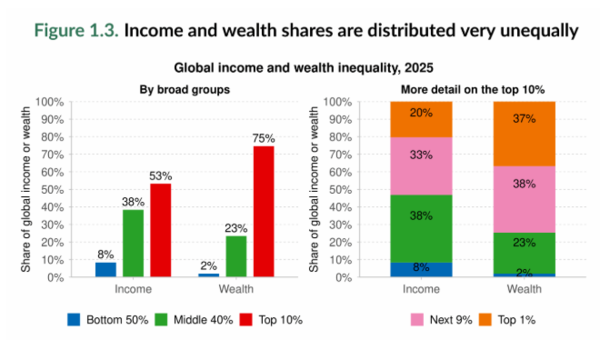
The “2026 World Inequality Report,” released in December 2025, provides empirical evidence that the warnings issued by Professor Thomas Piketty a decade ago have become a global reality. According to the report, the world’s richest 0.001%—approximately 60,000 individuals—hold an average of 1 billion euros (approx. 1.7 trillion KRW) each, while the average assets of the bottom 50% (4 billion people) amount to a mere 6,500 euros (approx. 11 million KRW). While the top 10% monopolize 75% of global wealth, the bottom 50% are left to share a meager 2%.
The report’s researchers noted, “While a tiny elite amasses unprecedented wealth, billions are denied even basic stability,” highlighting that this chasm has become a “global wealth trap” that restricts opportunity and institutionalizes hereditary inequality.
The reality for South Korea’s younger generation is even more severe. Recent statistics reveal that the asset gap within the 2030 demographic has reached a staggering 64-fold. While the top 20% hold assets averaging nearly 1 billion KRW, the bottom 20% possess only about 15 million KRW. This gap, which stood at approximately 30-fold a decade ago, has more than doubled in less than a single generation.
In the past, there was a prevailing belief that “effort leads to advancement.” Today’s youth, however, are confronted by a massive wall at the very starting line. When the point of departure is determined entirely by parental economic power, both the opportunity to invest in human capital and the dynamism to take risks are rendered powerless before this “64-fold cliff.” Amidst a tightening job market and skyrocketing housing costs, South Korea is becoming a “list of things to give up” rather than a land of opportunity for those without inherited assets.
The OECD warns that Korea’s potential growth rate will plummet to 0.8% in the 2030s and enter the 0% range by the 2040s—a permanent trap of low growth. Economists attribute the dampening effect of polarization on potential growth to two primary factors:
First is the deficit in human capital investment. As analyzed by economists Galor and Zeira, deepening asset inequality prevents talented individuals from accessing education and innovation. For the nation, this represents the loss of human resources that should be utilized most efficiently, leading directly to a decline in productivity.
Second is the extinction of economic dynamism. When the asset gap crosses a critical threshold, the social ladder breaks. For those without a safety net, “challenge” becomes synonymous with “gambling.” When a society becomes preoccupied with stability or rent-seeking instead of innovation, its growth engine inevitably loses steam.

We must now shift the paradigm of asset formation support. This should not be viewed as “charitable welfare” but as a national “investment” to restart a stalled economic engine.
Spain’s innovative welfare experiments are worth noting. Spain has been a pioneer in bold social policies, such as “Universal Basic Income.” Recently, the discourse on “Universal Inheritance” (Youth Basic Assets) has moved beyond simple cash transfers to a broader social agenda of “social inheritance” provided by the state.
The core of this policy, proposed by Spanish Deputy Prime Minister Yolanda Díaz, involves granting 20,000 euros (approx. 30 million KRW) to every 18-year-old, regardless of socio-economic background. These funds are restricted to higher education, vocational training, or startup capital, focusing strictly on enhancing the future competitiveness of youth. This declaration of restoring “future self-determination” to youth who had abandoned their ambitions due to asset barriers offers a valuable blueprint for universal opportunity infrastructure in Korea.
While basic assets guarantee a fair starting line, it is the responsibility of national finance to expand the “field of opportunity” where innovation can flourish.
In this context, the reorganization and split of the Ministry of Economy and Finance on January 2, 2026, is a significant milestone. It signals a shift from mere management of tax revenue and macroeconomic indicators toward a “strategic budget planning” function that decides where to prioritize the nation’s limited resources.
The role of the newly empowered Ministry of Planning and Budget in setting national priorities is paramount. The “Startups for All Project,” featured in the Ministry of SMEs and Startups’ year-end report, exemplifies the direction fiscal policy should take. This system—where the state supports investment and incubation for any viable idea regardless of collateral or background—serves as an innovative model of budget utilization that provides a practical “ladder of challenge.”
Upon receiving this report, President Lee Jae-myung expressed full resonance, stating, “This is a remarkable result of thinking from the user’s perspective,” and called for a dynamic growth engine that operates effectively on the ground. The responsibility to fuel this spark of innovation now falls to Lee Hye-hoon, the nominee for the first head of the newly established Ministry of Planning and Budget. If opportunities for human capital accumulation through jobs and education are severed for the younger generation, our nation will remain permanently mired in the swamp of low growth.

Whether the South Korean economy in 2026 settles into stagnation or secures a springboard for a second leap depends on our approach to the “wall of assets.” The process of securing funding and reaching social consensus will undoubtedly be arduous. However, we cannot expect sustainable growth while leaving a broken ladder in place. Technological innovation alone cannot guarantee broad-based prosperity. Only when we address structural inequality and dismantle the barriers facing our youth can we restore a ladder where effort is fairly rewarded.
Nominee Lee Hye-hoon must move beyond conventional budget allocation and demonstrate a bold fiscal role for the “expansion of opportunity,” fulfilling the mandate of the new Ministry. What Nominee Lee must prove during her confirmation hearing is not merely her administrative skill, but a resolute strategy to redirect the flow of the national budget toward breaking the “64-fold wall” and building a ladder of innovation and basic assets. I strongly urge the Ministry of Planning and Budget to move beyond the role of a “vault keeper” and become a “future architect” that elevates South Korea’s potential growth. This is the most certain key to revitalizing the Korean economy.
About the Author: Hong Jung-min is a politician, lawyer, and entrepreneur holding a Ph.D. in Economics from Seoul National University. She previously served as a senior researcher at the Samsung Economic Research Institute and founded AIT Inc. before entering politics as the 6th recruit for the Democratic Party of Korea. As a member of the 21st National Assembly, she served as a floor spokesperson and was active in committees focused on industry, SMEs, and science and technology. She is currently a managing partner at a law firm and an adjunct professor at Sejong University.




댓글