

Establish a ‘Korean-style Economic Security Policy’
Two World-Historical Transitions and South Korea’s Tasks (2) “Democracy is our vital interest, and the foundation for prosperity. We believe it blooms on peace” South Korea must now highlight its geopolitical strategic significence and internally, focus on ‘manufacturing innovation Begin by drafting a ‘Comprehensive Manufacturing Status Report.’

2. South Korea’s Tasks
Tailored Response to Trump-style Protectionism
Even though South Korea’s presidential diplomatic attempts have stalled, the next Trump administration is anticipated to propose many bills against Korea in a hub-spoke fashion. Let us carefully investigate bills that may be raised against other countries before Korea to prepare for what is to come. Protectionism is nothing new, but Trump-style protectionism is different.
First and foremost, a customized strategy is required, particularly given the Trump administration’s duality, which includes both JD Vance and Elon Musk. At times, South Korea needs to highlight its strategic importance to the US by showcasing its contributions as a military ally and manufacturing powerhouse. For example, with $21.5 billion and 90 greenfield investment-based projects, South Korea led the U.S. in FDI in 2023. With the highest 14% rate, this made a substantial contribution to job creation in the US through FDI and reshoring. The possible boomerang effect of high tariffs, which could harm the United States itself, must be brought to the attention of others.
Farrell & Newman (2019) warn that in asymmetrical interdependent relations, if a state in a hub position excessively wields the “weaponization of interdependence” against a spoke, the latter might attempt to exit the relations entirely (Henry Farrell, Abraham L. Newman, 2019, “Weaponized Interdependence: How Global Economic Networks Shape State Coercion,” International Security 44(1)). Several instances of diplomatic tensions between governments have prompted Japan to diminish its dependence on Chinese rare earth elements and South Korea to seek alternatives to Japanese semiconductor supplies. We must also remind you of the 1930 Smoot-Hawley Tariff Act, which initiated a cycle of retaliatory tariffs that resulted in losses for all parties concerned.
Restoring Democracy: A Commitment to Flourishing Societies
The primacy of democracy precedes economic considerations. This issue is fundamentally connected to essential human rights. Simultaneously, democracy serves as the essential foundation for fostering enduring prosperity. The extended duration of political upheaval surrounding impeachment has undoubtedly inflicted economic harm, and it is troubling that we are inadequately preparing for the potential return of Trump. The significance of the economy cannot be overstated. Nevertheless, we should exercise caution against a myopic, economically motivated viewpoint. This crisis represents a distressing consequence stemming from the gradual decline of democratic principles. Given that the water has already been spilled, we ought to appreciate the significant insight that democracy is not merely valuable but also serves to “put food on the table.” Let us transform this setback into a chance for rejuvenation.
Plus, peace is the soil in which democracies grow. The North-South Korean division is the root cause of the current political divisiveness and suppression of democracy in the country. Yoon Seok-yeol invoked the assertions of “Protecting free South Korea from the threat of communist North Korea” and “Eradicating the shameless pro-North anti-state forces” to justify the imposition of martial law and the succession of conspiracies to overthrow the governance. That it stopped here is a godsend. It was a tremendous relief when the president’s arrest was finally resolved during Biden’s term. Unless anything unexpected happens after Trump’s inauguration on January 20, 2025, then nobody can say what will happen.
Today, South Korea is part of the West. Positioned at a key geopolitical fault line, it has become a stronghold of a free market economy with democracy. South Korea’s weakening democracy is a risk to Western security. It should highlight its importance and look for strong foreign support and solidarity for democracy. South Korea has become a powerful culture leader after becoming industrialized and democratized. It offers hope and inspiration for emerging countries.

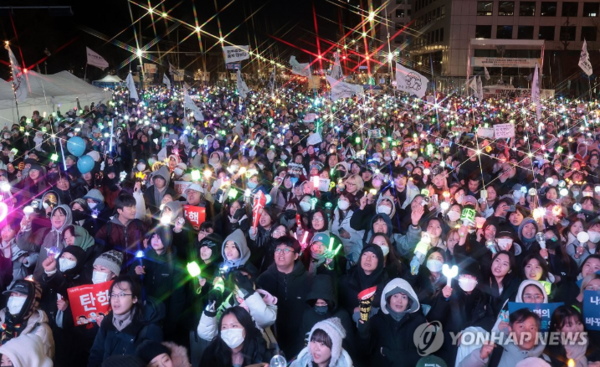
South Korea can’t compete with nearby powerful countries in military or economic strength, but it has soft power. This is not just about the Korean Wave; it’s also about the attractiveness of democracy that allows it to happen. South Korea showed K-pop, light sticks, and different foods paid for by people who couldn’t join in the freezing squares demonstration. The world, disappointed by the president’s unconstitutional martial law, applauded the ‘K-protests.’ Democracy is a vital interest to South Korea. It is an advance payment for prosperity.
Economic Security Policy 2.0 – Establishing a Korea Economic Security Policy
Establish a ‘Korean-style Economic Security’ policy now. Economic security is not just about stabilizing supply chains. Inappropriate usage of ‘security’ is dangerous and limits our options. Given our economic security environment, economic security should be limited to places where the economy and security interweave like a fabric. Every external shock should not cause fragmented replies. We also consider international cooperation. To rebuild the “Korea’s Economic Security” strategy, we need a refined approach to economic and security challenges that utilizes all available methods and has a holistic perspective. (Note- Economic Security has become a buzzword, although differentiating it from similar notions like economic statecraft and economic coercion is difficult. For a discussion related to this in practice, see Yanghee Kim (2024), “Economic security vs economic coercion and data protection vs data protectionism: consequences and implications of the LINE Issue for Korea and middle powers,” Elcano Institute.)
Democracy and peace underpin Korea’s economic security policy of retaining its industrial innovation leadership and progressing. Advanced manufacturing’s strategic value was revealed by the pandemic. Thus, South Korea is the only partner that can cooperate across manufacturing sectors like semiconductors, batteries, shipbuilding, defense, and others under the U.S.’s radar, and Western countries must de-risk China. This is good news. If Trump continues to restrain China, the world’s factory, it will present an opportunity for a manufacturing nation.
The US White House released the 2021-2024 Quadrennial Supply Chain Review, on December 19, 2024, summarizing the Biden administration’s cross-sectoral efforts to reshape global supply chains. This initiative aims to strengthen the resilience of the global supply chains for critical items essential to economic and traditional security. It represents Biden’s blocification of protectionism strategy and the creation of a Trust Value Chain. (For detailed discussions, refer to Yang-hee Kim(2022), ‘The Transformation of 21st Century Protectionism, ‘Blocification of protectionism’ and ‘Trust Value Chain (TVC)’, Korea National Diplomatic Academy; Yang-hee Kim(2023), ‘Can the U.S.-led ‘Trust Value Chain’ Function? Focusing on Electric Vehicle Batteries,’ Trends and Outlook, No. 119). The review asserts that the core of strengthening the global supply chain lies in a robust U.S. manufacturing sector, and Korea is seen as a key partner for this. For instance, the first manufacturing investment example cited in the review is the joint battery venture between South Korea’s LG Energy Solution and U.S. automaker GM.
South Korea should issue an annual manufacturing report to enhance its manufacturing innovation ecosystem. This would enable regular policy implementation evaluations. Since 2016, the National Institute of Standards and Technology has published U.S. yearly reports. The report assesses U.S. manufacturing production, employment, wages, productivity, innovation, waste, and even occupational injuries to international standards.
We must also address difficult problems like large-small business interactions, industrial innovation decentralization between the capital region and the provinces, and carbon neutrality. This should help us clearly and calmly analyze the critical home circumstances that threaten our powerhouse manufacturing position and start a protracted rehabilitation process. Let’s get back to basics in an emergency, even when time is tight.
Antonio Gramsci’s idea of “interregnum,” in which the old have passed away but the new has not yet emerged, may be used by some to explain the world of today. To be honest, though, I hardly agree with this. As of January 2025, rather than the breakdown of the old order, Korea and the rest of the world are still rife with reactionary forces and regression. First, let’s make sure the old system finally collapses.
Author:
Kim Yang-hee Professor
Yang-hee Kim holds a Ph.D. in Economics from the University of Tokyo. Having worked at Samsung Economic Research Institute and the Korea Institute for International Economic Policy, she is currently a member of faculty of Economics, Finance, and Trade at Daegu University. She has served as a trade commissioner for the Ministry of Trade, Industry, and Energy and as the head of the Research Department at the Korea National Diplomatic Academy. Her recent books include The Returns of Economicsts (2022, co-authored), 2024 Korean Economy Outlook (2023, co-authored), and papers such as “Interactions between Japan's ‘weaponized interdependence’ and Korea's responses: decoupling from Japan vs. decoupling from Japanese firms” (2021), “Can the U.S.-led ‘Trust Value Chain’ Function?” (2023), and reports like “Economic security vs economic coercion and data protection vs data protectionism” (2024).




댓글