

Trump’s Return, South Korea Crisis: two world-historical events linked
]Two World-Historical Transitions and South Korea’s Tasks(1)] What’s the connection between Trump’s return and the riots in Korea? U.S. protectionism is neither new nor likely to succeed. Biden’s approach to China differs from Trump’s... It could loosen. Why it’s too early for South Korea to despair.

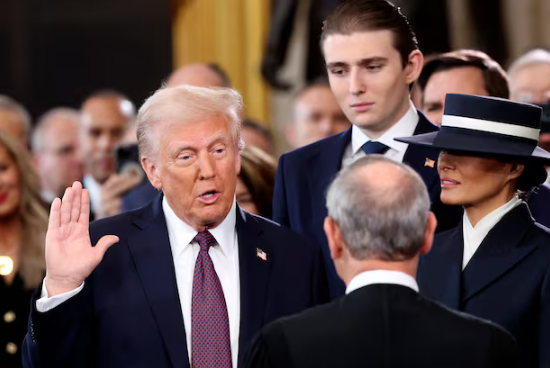
We are today facing two world-historical transitions. Donald Trump is back as the 47th President of the United States. The other is the problem of democracy in South Korea, which is going through a political impeachment crisis. As global democracy is in decline, South Korea needs to understand the significant geopolitical implications of whether it can recover its democracy, which is a remarkable achievement in the history of democracy.
These two transitions are closely related. Furthermore, a terrible rerun of the riot in the U.S. Capitol four years prior took place in South Korea on January 19, only one day before Trump’s inauguration. The tragic events of January 6, 2021, in the U.S. Capitol were reenacted by the Seoul Western District Court on January 19, 2025. Consequently, the connection between these two global historical shifts has become much more robust. The main mid-to long-term issues facing South Korea will be discussed in this article along with an analysis of these closely related incidents.
1. Diagnosis and Outlook
Trump’s Return
Donald Trump has returned as the 47th President of the United States. His return is the result of the extreme “polarization” that has spread across the political, economic, and social-cultural landscape of the U.S. Issues such as inflation and immigration have shaken the election, and Trump’s “America First” rhetoric has had a strong appeal, elevating him from a political heresy to a mainstream leader in American politics.
John Ikenberry, a professor at Princeton University, states that Trump is poised to contest “almost every element of the liberal international order, trade, alliances, migration, multilateralism, solidarity between democracies, human rights (Gideon Rachman, Dec 28 2024, “How America First will transform the world in 2025, Financial Times (https://www.ft.com/content/d11fa816-0c8f-4c79-abb0-8523dd2ecfe4))”. Gideon Rachman, a columnist for the Financial Times, refers to Trump as a revisionist seeking to alter the world order alongside Xi Jinping and Vladimir Putin at the above newspaper. British political philosopher John Gray marks his back “the definitive end of a liberal world order” (Note- John Gray, 13 Nov 2024, “Trump and the triumph of illiberal democracy, The New Stateman (https://www.newstatesman.com/international-politics/2024/11/donald-trump-triumph-of-illiberal-democracy). The world is wondering whether the ‘public goods’ the U.S. provided to the world after World War II could turn into ‘public bads’. The uncertainty that the U.S. brings has become a constant.
Nevertheless, it is biased to view America First as the end of neoliberalism (Note-Yang-hee Kim, November 19, 2024, “‘Nobus Ordo Seclorum’ For Whom?”, Hankyoreh). This is because it reinforces neoliberalism with deregulation and tax cuts at home while simultaneously encouraging exclusionary nationalism and protectionism abroad. The United States employs a “two-track” approach, with free-market policies in its still-dominant financial sector and protectionism in the real economy, where its competitiveness has decreased. In line with this, Trump’s administration has already displayed indications of internal strife between individuals like Vice President JD Vance, who supports protectionism, and Treasury Secretary Scott Bessent, who comes from the hedge fund industry, and Elon Musk, who leads the so-called Department of Government Efficiency and supports deregulation. We could have an opportunity when we acknowledge this duality.
When entering an unknown world, wisdom from the past is essential. In fact, economics textbooks often promote free trade, but protectionism has been the dominant force in world trade history since the 16th century. The spread of free trade in the 19th century and after World War II is a relatively recent phenomenon, and even then, advanced countries still protected agriculture and high-tech industries, while developing nations practiced protectionism for infant industries (Note- For more on Friedrich List’s protectionist theory and the history of protectionism, see Yang-hee Kim, 2021, “Friedrich List,” in the Korean Social Science Research Association’s “Returns of Economics,” Park Young-ryul Publishing). Of course, many economists, including the eminent trade historian Douglas Irwin, emphasize that protectionism has played a secondary role in America’s economic and technological progress(Note – Douglas A. Irwin, 2020, “Trade Policy in American Economic History,” Annual Review of Economics Vol. 12). The historical lesson here is that Trump’s protectionism is not entirely new, and its success is uncertain, offering a hope-filled outlook.
What are the similarities and differences between Biden’s and Trump’s protectionism? Both administrations have the same goal: to firmly contain China. However, there are three key differences. First, the frontlines of protectionism differ. The former (Biden) diversified the frontlines from ‘a point’s (U.S.) to ‘lines’ (bilateral) to ‘areas’ (mini-lateral), finding value in alliances amid America’s declining hegemony. In contrast, the latter (Trump) prefers ‘lines’ only or hub-spoke relationship, viewing all matters through a transactional lens, as he believes this maximizes the U.S.’s negotiating power. But this isn’t because Trump undervalues his allies—he is simply more desperate. The second difference is the tools used for protectionism. The former (Biden) used both carrots (subsidies for industry policies like the CHIPS Act and Inflation Reduction Act) and sticks (high tariffs) to revive advanced manufacturing, whereas the latter (Trump) only wields the stick. The final difference is that, unlike Biden, Trump, being a master of negotiations, may abruptly strike a big deal with China, loosening the pressure on the containment of China. This possibility should not be dismissed.
Economists widely criticize Trump’s high- tariff strategy, but a particularly sharp critique also applies to not only Trump but also Biden. One comes from Professor Simon, founder of Global Trade Alert. He has raised doubts about the effectiveness of protectionist measures under both Trump’s first and Biden’s terms. He claims that, since the U.S.-China trade war began in 2018, foreign direct investment (FDI) has neither increased as expected, nor substituted the hoped-for import. Compared to the period before the trade war (2012-2017), FDI in total manufacturing rose in 2023, but the imports that were supposed to be replaced also rose. Only two industries (transportation equipment; electrical equipment, appliances, and components) saw a positive FDI effect on import substitution among 8 industries. Employment also disappointed The Financial Times found that uncertainty after Trump’s presidency delayed or canceled, 40% of planned IRA-related investments(Note – Financial Times, August 11, “Delays hit 40% of Biden’s major IRA manufacturing projects”). High tariffs, along with a skilled worker scarcity, a weak supply chain, and infrastructure deficiencies, are expected to further undermine FDI profitability.
This analysis makes economic sense intuitively. FDI to evade tariff barriers may not necessarily lead to import substitution, even if it takes the form of greenfield investments rather than M&As. Despite FDI replacing the imports of finished goods, it could potentially lead to the import of more intermediate goods in the short and medium run. This is due to poor local procurement conditions for those goods. South Korean companies’ main customers for intermediate goods exported to China and Southeast Asia are South Korean companies or affiliates operating there. Of course, in the long term, FDI can contribute to import substitutions, job creation, and technology transfer. However, Simon’s research raises concerns about the protectionist experiment, particularly given Trump’s second-term preference for hub-spoke relations and stick use.
The Crisis and Opportunity of Korean Democracy
“All the law in the world has been obtained by strife. Every principle of law which obtains had first to be wrung by force from those who denied it; and every legal right—the legal rights of a whole nation as well as those of individuals—supposes a continual readiness to assert it and defend it.” (Rudolf von Jhering, The Struggle for Law(1872))
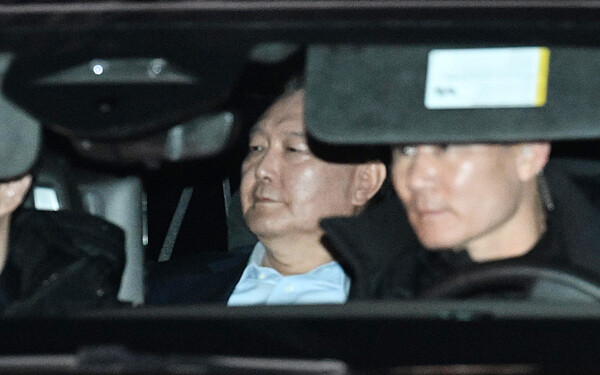
South Korea became the first constitutional nation to restrain an incumbent president after 47 days on allegations of unconstitutional martial law and treason on January 19, 2025. I purposefully wrote this line in the active voice about South Korea. Like Rudolf von Jhering’s obvious aphorism, it was hard to get but worth fighting for. A president, a former prosecutor-general, recklessly demolished Article 11 of the South Korean Constitution, “All citizens shall be equal before the law,” causing a constitutional crisis. Democracy was saved by the people’s loyalty, civic resistance, and disobedience.
In truth, Yoon Suk-yeol is the reverse of the liberal democracy advocate he depicted. In its March 2024 “Democracy Report 2024” (https://www.v-dem.net/documents/43/v-dem_dr2024_lowres.pdf), the world-renowned Varieties of Democracy (V-Dem) Institute stated that Yoon had spearheaded the decline of Korean democracy. The world has 91 democracies (liberal, electoral) and 88 autocracies (electoral, closed) as of 2023. Only 29% (2.3 billion people) are in the former, while 71% (5.7 billion) are in the latter. South Korea is one of 9% of East Asia’s liberal democracies, along with Australia, Taiwan, Japan, and Bhutan. South Korea is the only nation to industrialize and democratize after colonial rule and war.
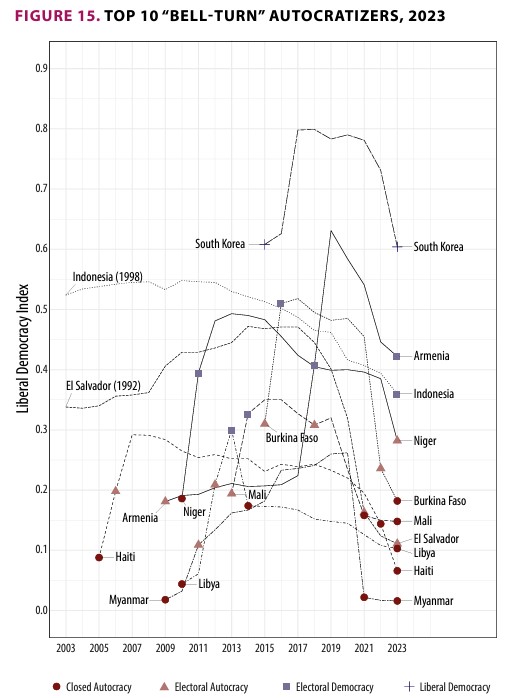
South Korea was shamed in 2023 for leading the global downfall of democracy, drawing it back to 1985 (population) or 1973 (economic power). South Korea’s Liberal Democracy Index (LDI) dropped during the Park Geun-hye scandal in 2015 but rose after the candlelight protests to 17th place in 2021. Unfortunately, after Yoon Suk-yeol took power, it sank to 47th in 2023, back to 2015. South Korea joins eight other countries that have rapidly retreated into dictatorship, forming a “Bell-turn” shape. South Korea was the only former liberal democracy that has become authoritarian among those 10. How much will its standing deteriorate after December 3rd martial law and judicial uprising?
Luckily, hope is still alive. Between 1900 and 2022, 48% of autocratic countries followed up with “democratic turnarounds,” which can be divided into three subtypes: J-turn, U-turn, and L-turn. Over the past 30 years, this type of regime transformation has increased to 70%(Source - Marina Nord, Fabio Angiolillo, Martin Lundstedt, Felix Wiebrecht, and Staffan I. Lindberg, January 2024, “When Autocratization is Reversed: Episodes of Democratic Turnarounds since 1900”, Working Paper SERIES 2024:147, V-Dem Institute). Additionally, 93% of these countries restored or improved their democracy after democratic turnarounds. The study found that South Korea pioneered the “democratic turnaround” that ended the autocracy regime from 1961 to 1964 and made an amazing leap toward democracy in 1987, flourishing into the 21st century. After Lee Myung-bak and Park Geun-hye, South Korea declined until 2016 and then recovered, displaying “U-turn” democratic turnarounds till 2017.
Thus, we are at a historical crossroads, nearing a third democratic turnaround. Whether this impeachment ends or starts a new journey is world historical. The world is watching us because of this.
Author:
Kim Yang-hee Professor
Yang-hee Kim holds a Ph.D. in Economics from the University of Tokyo. Having worked at Samsung Economic Research Institute and the Korea Institute for International Economic Policy, she is currently a member of faculty of Economics, Finance, and Trade at Daegu University. She has served as a trade commissioner for the Ministry of Trade, Industry, and Energy and as the head of the Research Department at the Korea National Diplomatic Academy. Her recent books include The Returns of Economicsts (2022, co-authored), 2024 Korean Economy Outlook (2023, co-authored), and papers such as “Interactions between Japan's ‘weaponized interdependence’ and Korea's responses: decoupling from Japan vs. decoupling from Japanese firms” (2021), “Can the U.S.-led ‘Trust Value Chain’ Function?” (2023), and reports like “Economic security vs economic coercion and data protection vs data protectionism” (2024).





댓글