

Russian Genre Painting: Into the Lives and Pain of the People
[Kim Heeeun’s Resonant Stories of Russian Art] 19C Russian intellectuals awakened to the mission of saving their homeland and its people. they created a new artistic language: genre painting. boldly exposed the absurdities of the Russian aristocracy. This movement laid the foundation for the “Peredvizhniki” and heralded Russia’s artistic revolution.

Russian painters became the voices for the suffering masses.
Paintings that resonate with the times, telling stories of people and their lives. Russian artists of the 19th century proclaimed, “Art that doesn’t reflect reality is worthless,” and became the eyes and ears of the people, capturing the grim realities of their era on canvas.
Russia is the first nation where a people’s revolution succeeded. Quietly holding their breath, the Russian people have a latent power that erupts with great force. While many factors propelled Russia toward revolution, 19th-century Russian genre painting, alongside literature, became the “spirit of the age” by serving as the language of the people. Realist genre painting, which blossomed explosively in the 19th century, became a distinctive “artistic revolution” unparalleled in global art history.
The history of Russian painting is shorter than that of Western Europe. It was only after the establishment of the Russian Academy of Arts in Saint Petersburg in 1757 that the formal training of painters began. Before this, Russian art was limited to religious iconography, and even in the 18th century, it primarily comprised portraits for aristocrats or academic historical works.
The 19th century brought significant changes to Russia. Experiencing the Napoleonic Wars of 1812 deeply instilled patriotism in Russians and a sense of national unity. This aspiration, combined with the modernization dreams of war heroes who had witnessed a changing Europe, culminated in the “Decembrist Revolt” of 1825, Russia’s first modern revolution. Although the revolt failed, Russian intellectuals began to grapple with their societal responsibilities, awakening to their roles as the “intelligentsia” with a mission to save both the nation and its people. The “Second Renaissance” — a cultural revolution in 19th-century Russia — was a historical product of this intellectual awakening.
The Beginnings of Russian Genre Painting: Alexei Venetsianov
In response to these societal needs, the Russian art scene broke away from academic styles and birthed a unique artistic language: “Realist Genre Painting.” This movement was pioneered by Alexei Venetsianov(1780–1847), regarded as the “father of Russian genre painting.” A nobleman himself, Venetsianov was the first to depict rural life in Russia, portraying the dignity and humanity of the often-despised peasant class. He redirected the gaze of artists from the aristocracy to the common people, becoming the first genre painter in Russian history.
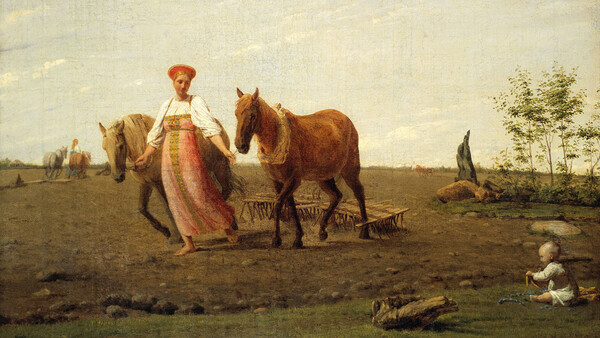
In Venetsianov’s seminal work Spring Plowing, his warm regard for peasants is immediately evident. A woman, dressed in traditional Russian attire, gracefully walks as if she were heading to a picnic, even while plowing a field. As she works, her child plays cheerfully on the grass, while golden sunlight bathes the scene as if to celebrate their lives. Though somewhat idealized, the painting elevates the sanctity of peasant labor and suggests that the harsh lives of Russian peasants deserve to be blessed.
Venetsianov also challenged the Russian Academy of Arts’ discriminatory policies against peasant students, who were expelled simply for their lack of noble status. In response, he established Russia’s first art school for the common people on his Tver estate. Graduates of this school later formed the “Venetsianov School”, which became a cornerstone of Russian genre painting.
Under Venetsianov’s influence, Russian realist genre painting evolved to include satirical and critical realism, bearing fruit in works that exposed societal absurdities. This realism would later provide the foundation for 20th-century Soviet Socialist Realism.
Russian Humor in ‘Satirical’ Genre Painting
‘Satirical’ genre paintings uniquely critiqued Russia’s societal absurdities with humor. Pavel Fedotov and Vasily Pukirev were notable artists in this style, using biting wit to elicit bitter laughs.
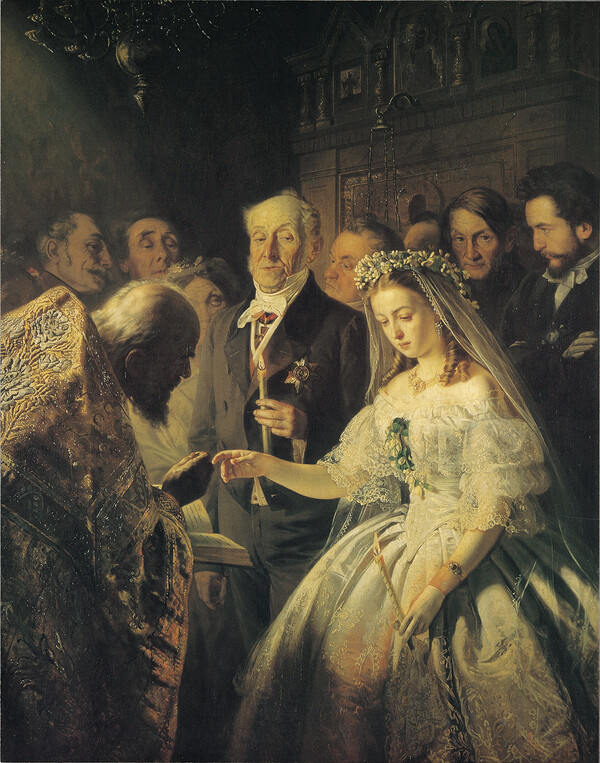
Pukirev’s The Unequal Marriage is a satirical depiction of the absurd reality of 19th-century Russia, where even the sacred institution of marriage was commodified and driven by money. The main characters of this wedding scene are a pair that would seem more fitting as a grandfather and granddaughter. The young girl, as delicate as a single flower, appears to have been sold off to repay tenant debts. Her swollen, reddened eyes—perhaps from crying all night—painfully convey her anguish. The priest, hastily officiating the ceremony, seems complicit in this grim reality, while the rest of the scene lays bare the grotesque hypocrisy of the Russian aristocracy, who gloss over this injustice with their wealth.
Particularly striking are the expressions of the four elderly guests surrounding the groom like a human backdrop. Their faces, etched with petty envy and disdain, suggest they are unimpressed or even resentful of their friend’s late-life windfall. Their twisted gazes lend a dry, bitter tone to the painting, as their layered wrinkles seem to echo the heavy sighs of despair that the artwork evokes.
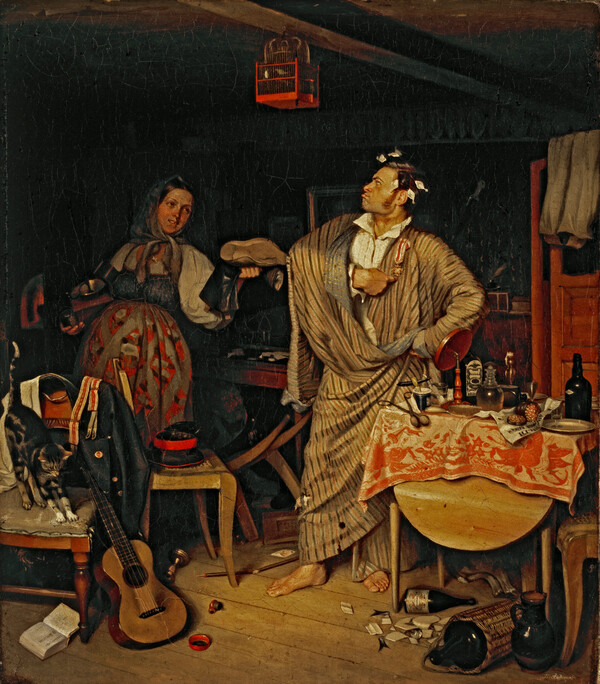
Was corruption in 19th-century Russia confined to marriage? Hardly. The decadence and laziness of the Russian aristocracy were a grave societal blight, eroding the very fabric of the era. For impoverished nobles, life’s primary ambition became entering social circles to seduce wealthy women and secure a fortune.
In the painting, the male subject appears unable to pay even his rent, yet continues to live extravagantly. The landlord is ready to seize valuable belongings as collateral. Meanwhile, the man, with paper curlers in his hair, busily prepares for an upcoming party. He pouts, pointing to a medal—a symbol of his nobility—boasting, “Just wait a little longer, and I’ll pay it all at once!” The scene mercilessly exposes the vanity of Russian aristocrats, who remained immersed in frivolous pleasures, utterly blind to the harsh realities surrounding them.
Critical Realism: The Rise of Vasily Perov
This brief interlude of humor and satire gave way to a grim reality: by the mid-19th century, Russia was plummeting into an inescapable abyss. The devastating effects of serfdom and the decadence of the imperial aristocracy left the entire nation groaning under the weight of its suffering.
By the mid-19th century, Russia’s dire social conditions—marked by the abuse of serfs and the decadence of the aristocracy—called for more direct critique. Critical realism emerged as artists sought to expose injustices with powerful visual language. Vasily Perov led this movement.
In this bleak context, Russian Realist painters, who sought to become the eyes and ears of the people and the voice of the times, could no longer remain silent. They endeavored to expose the world’s injustices and uncover its absurdities through the potent language of painting. It was in this period of societal crisis that critical realist genre painting emerged. At the forefront of this movement was Vasily Perov.
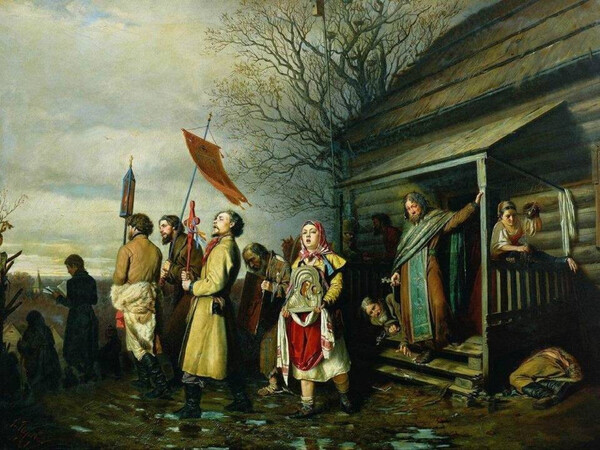
The pinnacle of critical realist genre painting, Vasily Perov, was a remarkable figure from the very beginning. While studying at the Russian Academy of Arts, Perov boldly depicted the harsh reality of Greek Orthodox priests, who were meant to guide and uplift society but were instead sprawled drunk in his painting Easter Procession in a Village. This work earned him an award at an art exhibition and even the privilege of studying abroad. However, he was stripped of all these honors on accusations of mocking the clergy. Later, this piece would be recognized as the first work to critique the establishment, marking the genesis of Russian critical realist genre painting.
Exploring Vasily Perov’s works, which sought to reveal the world and empower the people through the two-dimensional canvas, one cannot help but quietly acknowledge, “No wonder a revolution was inevitable.” His hyper-realistic paintings are striking in their brutal honesty.
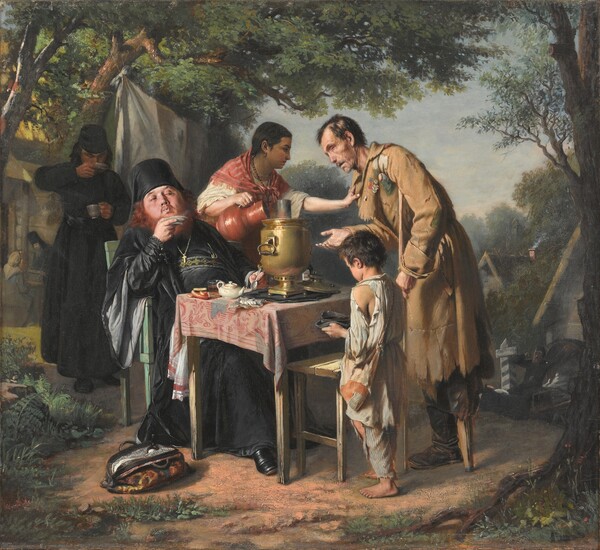
Rotten power dripping with greed and the peasants left to beg for their daily bread. A donation bag peeks out beside the priest, who, slightly tipsy, feigns aloofness and pretension. Perov poignantly captures the plight of the impoverished peasants, who, despite recognizing the priest’s hypocrisy, must bow their heads to escape their present hunger. The painting evokes deep sympathy for these withered souls.
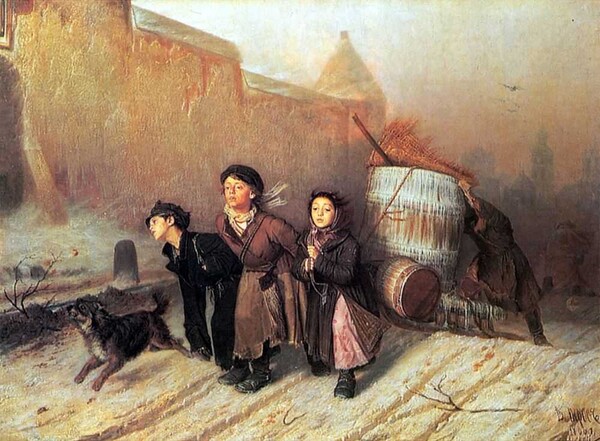
The 1800s in Russia saw both adults and children drowning in misery. The emancipation of serfs in 1861 offered little more than a hollow promise, freeing them in name only, without granting them land to sustain their lives. Unable to support themselves, many serfs were forced to send their children into labor to secure a meager meal.
In The Troika, children, no older than ten, pull a cart that should be drawn by horses. The scene appears to take place at dawn, with icicles hanging from the water barrels, underscoring the bitter cold. One wonders if their grueling labor will even earn them a crust of bread. The children’s pale, exhausted faces and weary demeanor reflect lives already burdened with unimaginable suffering.
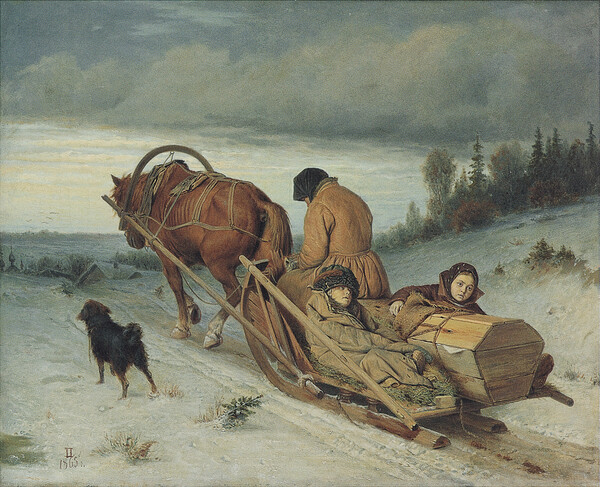
What is a person’s final journey in life? Surely, it is the trip to their burial site. In this painting, the absence of a father figure suggests that the owner of the humble wooden coffin is the family’s patriarch. The daughter’s face, hollow with grief, shows the exhaustion of endless weeping, while the son, wearing what appears to be his father’s coat, looks equally frail and sickly. The mother, slumped over as she drives the cart, carries the weight of despair on her shoulders. Even the emaciated horse pulling the coffin, with its protruding ribs, reflects the family’s destitution. The harsh Russian winter mirrors the suffering of the impoverished.
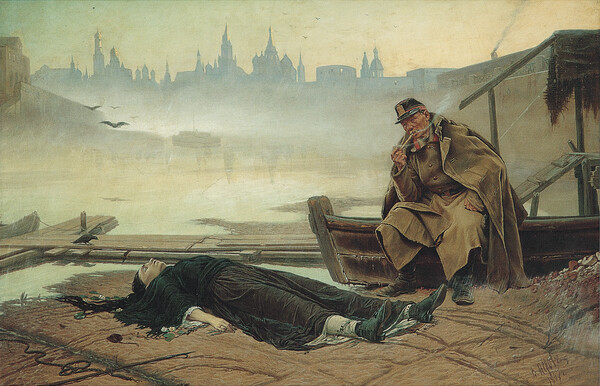
Another life lost. The absence of a crowd suggests such incidents were all too common. A weathered old man, smoking his pipe, seems to mutter, “Ah, this wretched world—another one gone.” This painting captures mid-19th century Russia, where death was often the only escape for those crushed by a life of relentless hardship.
For Russian genre painters, the two-dimensional canvas became a vessel for revealing life’s harsh truths. Their brushstrokes, imbued with raw honesty, narrated stories of humanity and survival.
As the great Russian writer Ivan Turgenev (1818–1883) famously said, “There is no art that transcends its people.” Russian genre painters positioned themselves closest to the common folk, acting as their eyes and ears to speak for the times. Their sincere voices would eventually flow into the Peredvizhniki movement of the 1870s, fueling the energy for a revolution in Russian art and laying the foundation for Russian modernist painting.
Kim Hee-eun Director of Gallery Kartina
Kim Hee-Eun has been an art dealer, exhibition planner, and curator for nearly 20 years. She runs Gallery Kartina[희김2] , specializing in Russian art, in Seoul and Moscow. An enthusiastic docent, she is affiliated with the Tretyakov State Gallery and the Pushkin Museum. She is the author of Whispering Stories of Russian Art and Russian Art Beyond the Museum. Through her YouTube channel, Gallery Kartina,[희김3] she strives to popularize Russian art in South Korea.


댓글