

Korea: Those Who Uphold Truth Also Protect the Nation
[The Vichy Regime: A Chronicle of Collaboration and Betrayal] “Citizens who believed that ‘Dreyfus is innocent’ continue to protect France to this day. The Catholic Church, the military, and the press, which claimed to represent France’s interests, ironically endangered the nation instead.”

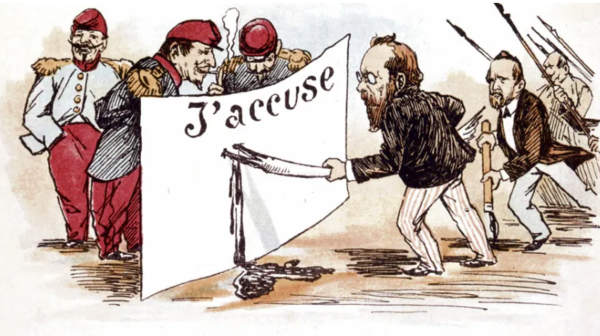
- 진실을 지키는 이들이 나라도 지킨다 translation of a Korean column originally published on December 30, 2024, titled 진실을 지키는 이들이 나라도 지킨다
Since the French Revolution in 1789, France has not always maintained the same system of governance. There were periods of monarchy and empire. However, the France of today is a republic, self-defined in its constitution as a nation inheriting the Declaration of the Rights of Man (1789) and the preamble of the 1946 Constitution. The republic’s foundation rests upon the proud legacy of the Revolution. Yet, preserving the spirit of the republic has not been easy. The Catholic Church, opposing the Revolution’s legacy, and elites like the military and bureaucrats, prioritized their own interests at critical moments under the guise of “national interest.” When they ignored truth for selfish gain, the French Republic was imperiled. It was citizens who believed that upholding truth and justice aligned with France’s best interests who ultimately safeguarded the republic.
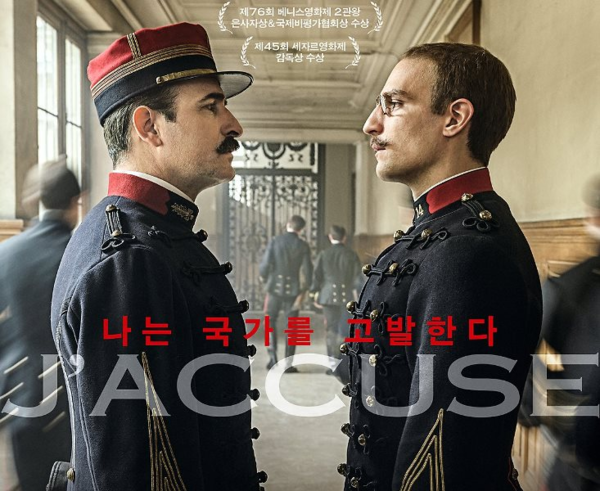
“Dreyfus is innocent. That’s why we stood up for the truth.”
The Dreyfus Affair (L’Affaire Dreyfus), which began in 1894, just before the dawn of the 20th century, vividly demonstrates the unique French tradition of citizens, led by intellectuals, defending truth and the republic.
When a document containing French military secrets was discovered at the German Imperial Embassy in Paris, the French government launched an investigation. Captain Alfred Dreyfus, a Jewish officer, was accused based on handwriting analysis purportedly matching the document to his own. However, his true “crime” was his Jewish identity. Despite a shoddy investigation, Dreyfus was quickly tried in a climate of anti-Semitism, sentenced to exile, and dishonorably discharged from the military.
Two years later, in 1896, Lieutenant Colonel Georges Picquart, head of the military’s intelligence department, uncovered evidence pointing to the real culprit: Major Esterhazy, who had been selling information to Germany for money to fund his lavish lifestyle. The handwriting on the documents was unmistakably Esterhazy’s. Picquart reported these findings to his superiors, only to be met with resistance. For the French General Staff, preserving anti-Semitic propaganda that claimed “Jews threaten France” was more important than revealing the truth.
Despite retaliation that included his reassignment to a remote desert post in Tunisia, Picquart refused to compromise. His persistence in exposing the truth earned the ire of powerful institutions: the Catholic Church, anti-Semitic media, and the military establishment, which sought to protect its reputation after the humiliation of defeat in the Franco-Prussian War (1870–71).
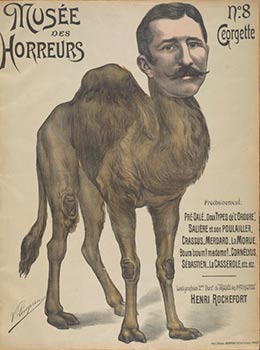
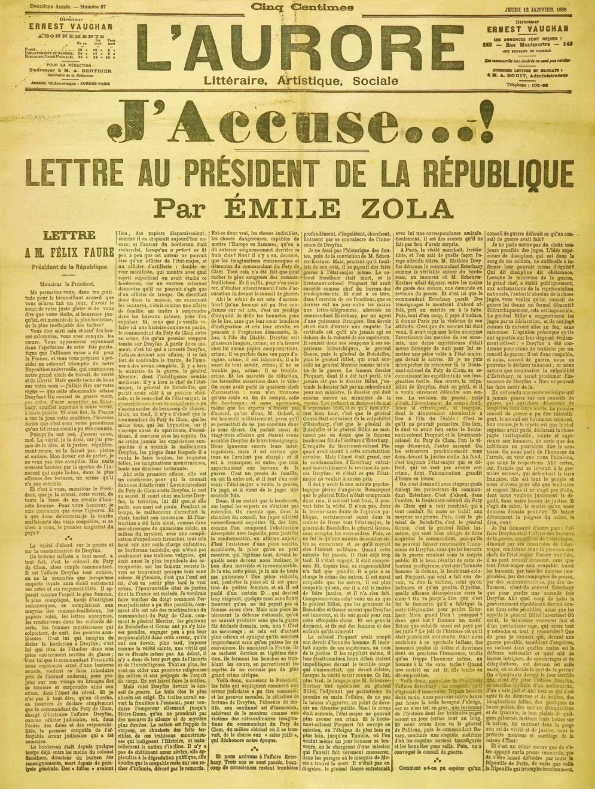
Émile Zola and “J’accuse”
In 1898, the renowned novelist Émile Zola penned his famous open letter, “J’accuse” (“I Accuse”), published in the newspaper L’Aurore. Zola publicly denounced the military and other figures who had obscured the truth in the Dreyfus Affair. Already an established literary figure, Zola could have avoided controversy by remaining silent. Instead, he boldly voiced his conviction, shaking French society to its core.
The Catholic Church, military, bureaucrats, and anti-Semitic press joined forces to vilify Zola, accusing him of tarnishing France’s honor and betraying the nation. Meanwhile, supporters of Zola argued that exposing the truth was not contrary to France’s interests but essential for its security. This polarized France, dividing the nation into pro- and anti-Dreyfus factions.
The prolonged controversy led the General Staff to seek a compromise by pardoning Dreyfus in exchange for his acceptance of guilt. Exhausted from years of exile, Dreyfus accepted the pardon. However, intellectuals and citizens who believed in his innocence continued to demand his exoneration, and in time, he was formally acquitted. This victory spurred the passage of the 1905 Law on the Separation of Church and State, ensuring that the Catholic Church could no longer meddle in national affairs.
The Legacy of Those Who Condemned Dreyfus
The individuals and institutions that condemned Dreyfus did not fade from influence. Their misplaced pride in France’s colonial empire bolstered French imperialism, supported by the Catholic Church, military, far-right fascists, and sympathetic media. These same factions had proclaimed Dreyfus guilty. During the economic depression of the 1930s, they gained further momentum, culminating in the establishment of the collaborationist Vichy regime after Nazi Germany’s 1940 invasion of France.
The Vichy regime’s complicity with Nazi Germany betrayed the core values of the French Republic. Catholic leaders sought to restore their privileged status from the days of the monarchy, while the military blamed foreigners and socialist politicians for France’s woes, even sending prominent left-wing figures like Léon Blum to concentration camps. Fascist writers and thinkers aligned with the Nazis, arguing that emulating the German model was essential for France’s survival.
This betrayal of the republic extended to everyday citizens. Nazi demands escalated after Germany’s defeat at Stalingrad in 1943, yet Vichy officials failed to protect French interests. Innocent civilians were executed for trivial offenses, and the collaborationist forces crushed resistance movements. The same factions that had wrongfully accused Dreyfus trampled the republic under Nazi occupation, but their crimes could not be hidden.
Citizens Who Upheld Truth and Defended the Republic
The Vichy regime propagated the image of Marshal Philippe Pétain as a national savior, but it was ordinary citizens—resistance fighters—who truly defended France’s honor. These individuals disrupted railways, rescued Jews from concentration camps, and maintained contact with Allied forces. Neither the Catholic hierarchy, military leaders, nor fascist writers and journalists played any role in saving France. Instead, those who vilified critics as “enemies of the nation” were the ones who endangered it.
The privileged elites who claimed to protect the republic acted solely in their own interests. By framing Dreyfus as the villain, they sought to showcase their “patriotism” while secretly endangering France’s security. They collaborated with Nazi Germany to suppress dissent and eliminate political rivals, showing no genuine regard for the nation.
In contrast, the intellectuals and citizens who declared “Dreyfus is innocent” resisted authoritarian forces and defended republican values. They believed that protecting their friends and fighting against totalitarianism was essential for safeguarding the French Republic. Despite setbacks, they persevered, leaving their struggles as a record to inspire future generations.
Thus, the history of modern France stands as a testament to its citizens’ determination to learn from past mistakes, resist present abuses of power, and foster hope for the future. Inspired by Émile Zola’s words, “Truth is on the march, and nothing will stop it,” they have shown that the pursuit of truth aligns with the nation’s highest ideals.
Author:
CHOO SUNG MOK, is an ordinary office worker who considers himself a person who listens, reads, and writes. He majored in Chinese at Hankuk University of Foreign Studies and began his career after graduation. However, driven by a long-standing desire to properly learn French, he enrolled in the French Language and Culture program at Korea National Open University and earned a “second bachelor’s degree.” His goals include studying the Vichy regime, the Resistance, and the Shoah to write about them, as well as translating and introducing French-language books and materials that address regions such as China, Central Eurasia, and the Middle East. He continues his studies with these two aspirations close to his heart.





댓글