

To Chairman Chung Yong-jin, Who Fails to Comprehend the Essence of Democracy
- [Executive Summary]
- The Hypocrisy of Value Relativism Chairman Chung Yong-jin’s apology—claiming that “even if our thoughts differ, our desire to build a better world is the same”—is a dangerous form of value relativism. It is a calculated historical whitewashing that attempts to sanitize constitutional subversion and far-right distortion as mere “differing opinions.” Liberty cannot grant the enemies of liberty the freedom to destroy it.
- The Constitutional Legitimacy of May 18 and Anti-Authoritarianism The history of the May 18 Democratization Movement and the resistance against dictatorship cannot be subsumed under the banner of “diversity of preference.” It was a fierce, constitutional resistance born of “militant democracy,” where citizens put their lives on the line against anti-constitutional violence that sought to annihilate the democratic basic order.
- The CEO’s Signaling and the Inevitable Catastrophe Chairman Chung’s warped historical perspective—evidenced by his past “crush communism” (Myeol-gong) crusades and mockery of the Sewol ferry victims—acted as a corporate signal that fostered an organizational culture tolerating derogatory rhetoric. The recent Starbucks “Tank Day” scandal is the inevitable byproduct of this deeply embedded historical insensitivity.
‘Differing Thoughts, But the Same Heart’? A Flawed Premise
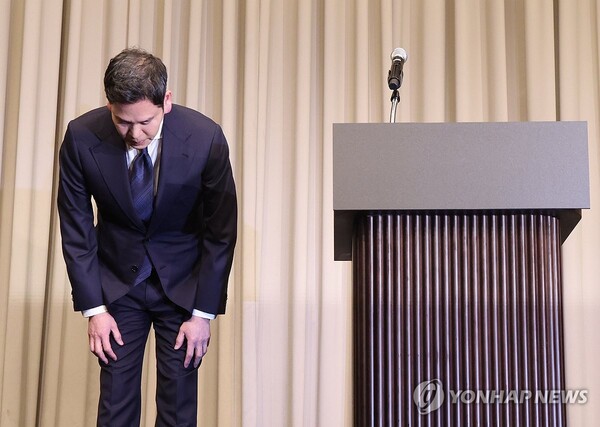
Given the nature of this apology, Shinsegae Group Chairman Chung Yong-jin stands in dire need of a stark reality check. While he bowed his head repeatedly and offered profuse apologies, his remarks betrayed a complete lack of introspection regarding the core ideology firmly rooted in his mind.
To expose the reality of this unrepentant mindset, I must ask Chairman Chung a fundamental question: “Would it be acceptable if I were to arbitrarily confiscate your personal fortune?”
Chairman Chung would undoubtedly offer a resounding “No.” He would argue that the freedom to plunder another’s property does not constitute true liberty. Indeed, the very market economy and private property rights he so fervently worships are liberties that can only exist and be protected within the protective fences of our Constitution.
Yet, during his public apology today, Chairman Chung articulated a view on “liberty” that reveals the root cause of this entire catastrophe, laying his distorted worldview bare.
Chung remarked, “This is a time when we need greater effort to understand one another and move forward together,” adding, “While our individual thoughts may differ, I believe we all share the same heart in wanting to build a better Republic of Korea and hand down a superior world to future generations.”
While this may sound plausible on the surface, it is a fundamentally errant notion. It bears the unmistakable hallmark of a sophisticated “historical whitewashing,” an attempt to grant absolution to far-right extremist values under the pretext that “only the methodology differed, while the devotion to the nation was identical.”
Thoughts on Constitutional Liberty Cannot Be Subject to Relativism
While there are countless domains where our thoughts can and should differ, there are sacred boundaries where divergence is strictly impermissible. Divergence of thought must occur within the boundaries of the Constitution. One cannot hold a “differing opinion” that violates constitutional values or seeks the destruction of the constitutional order itself. This is a threshold that no corporate leader in South Korean society should ever cross, lest they degenerate into an “anti-constitutional figure.”
The history of the May 18 Democratization Movement—which stood against the brutal violence of the military junta—and the sacrifices of those who resisted dictatorial regimes are not merely “one of many alternative opinions” to be tolerated under the guise of diversity. It was a desperate, constitutional resistance of a “militant democracy,” where citizens weaponized their own bodies to defend the democratic basic order against anti-constitutional violence. Our Constitution provides an unequivocal, uncompromising standard on this matter.
Therefore, to dismiss a crisis where historical tragedy was openly mocked on the anniversary of May 18 through slogans like “Tank Day” or “banging on the desk” (Tak) by casually lumping it into the phrase “differing thoughts, but the same heart” is inherently synonymous with desecrating the martyrs of the anti-authoritarian struggle and the very history of constitutional defense.
There Is No Freedom to Destroy Democracy
As a former student of Western History at Seoul National University, Chairman Chung should be well aware of how the German Third Reich came to be.
Following its defeat in World War I, the Weimar Republic embraced a flawed form of “relativism,” operating on the premise that “the state must accommodate anything the majority desires.” In the 1930s, Adolf Hitler and the Nazi Party exploited this legalistic, majoritarian voting system to seize power, subsequently dismantling the democratic system from within.
In the aftermath of World War II, modern Germany embedded a pivotal countermeasure into its Basic Law. It established the principle that a democratic system must never extend its “tolerance” to encompass dictatorial or totalitarian factions bent on self-destruction.
This marked the birth of “Militant Democracy” (Defensive Democracy)—the conceptual framework dictating that democracy must be equipped with both a combative spirit and defensive capabilities. It can be summarized in a single axiom: “The enemies of liberty cannot be granted the liberty to destroy liberty.”
The Constitution of the Republic of Korea fully integrated this doctrine of militant democracy by establishing the system for the unconstitutional dissolution of political parties—a legal hammer that ultimately brought down the Unified Progressive Party. Germany goes a step further, maintaining not only party dissolution mechanisms but also the “forfeiture of fundamental rights” (Grundrechtsverwirkung), which strips individuals of their basic rights if they abuse them to subvert the democratic order.
The Perils of an Anti-Constitutional CEO
Chairman Chung’s public displays of ideological hostility toward North Korea and China under the banner of “crush communism” (Myeol-gong)—flatly contradicting our constitutional mandate to pursue peaceful coexistence—combined with his past mockery of the social consensus surrounding the Sewol ferry victims, run completely counter to the democratic values championed by our Constitution. Appallingly, Chairman Chung failed to recognize this even during his apology today.
Had he harbored such ignorance during his university days, it would have been a negligible issue; the toxic ripple effects of an individual’s anti-social or anti-democratic tendencies are relatively contained. However, once an individual becomes a chief executive—particularly the chairman of a massive conglomerate like Shinsegae Group, which commands a vast workforce of executives and employees—harboring such anti-social and anti-constitutional thoughts becomes an existential hazard.
This is precisely the toxic worldview that was transcribed directly into the recent Starbucks “Tank Day” marketing event. The chief executive’s warped values and historical insensitivity acted as an institutional signal within the enterprise, establishing an organizational culture that normalized derogatory rhetoric. This systemic failure effectively paralyzed the internal compliance and approval lines of the working-level staff. In short, this scandal was an absolute inevitability.
Let us be entirely clear: we do not grant the enemies of liberty the liberty to destroy liberty.


댓글