

Korea: Finding “Hope of the Era” at the Namtaeryeong Protest
Jeon Bong-jun’s Struggle Group enters Seoul Solidarity with citizens resolves a 130-year-old grievance Farmers and citizens offers hope for our time
This text is a translation of a column(남태령 시위에서 ‘시대 희망’을 쏘다) originally published on December 24.
A Feeling of Guilt
“Mom, are you going to another protest?”
“Yes, I have to go. The farmers must have driven their precious tractors all the way here, shivering in the cold for days. Last night, they were blocked by police barricades and couldn’t move, stuck on the streets. I heard citizens stood by them, shivering through the night to protect them. I’m worried they might get frostbite. Someone has to step in so those who stayed up all night can rest.”
“Why does it have to be you, Mom? Why you?”
“Well... ordinary people like me need to step up because the police won’t use excessive force against us. If it’s just the farmers, the crackdown can get brutal.”
This was last Sunday afternoon, December 22. My second child, sensing my unease, tried to dissuade me from joining the protest, but I couldn’t ignore the call.
Since the previous day, I had been following the news on YouTube about the Jeon Bong-jun Struggle Group, organized by the Korean Peasants League (KPL). The group had embarked on a five-day tractor march to Seoul, only to be blocked by police barricades at Namtaeryeong Pass.
I couldn’t shake the thought of farmers and citizens spending the freezing night together, trying to change the situation. Reports of people collapsing from hypothermia and being rushed to the hospital only heightened my sense of urgency. With wind chills dropping below -10°C, I couldn’t help but feel both sympathy and guilt for those enduring the cold.
Standing with Farmers in the Cold
The Jeon Bong-jun Struggle Group began their march on December 16, departing from Jinju in South Gyeongsang Province and Muan in South Jeolla Province. With 30 tractors and 50 trucks, they aimed to reach the presidential residence, demanding President Yoon Suk-yeol’s impeachment. However, they were stopped at Namtaeryeong Pass by police barricades. Reports of farmers and citizens collapsing from the cold filled me with worry.
As someone who owes so much to the farmers who safeguard our land, I felt compelled to join them. But having just returned from a trip outside Seoul, it was already Sunday afternoon, and I was still recovering from the journey. The freezing temperatures made it even harder to muster the energy. Nevertheless, I resolved to go and stand with them.
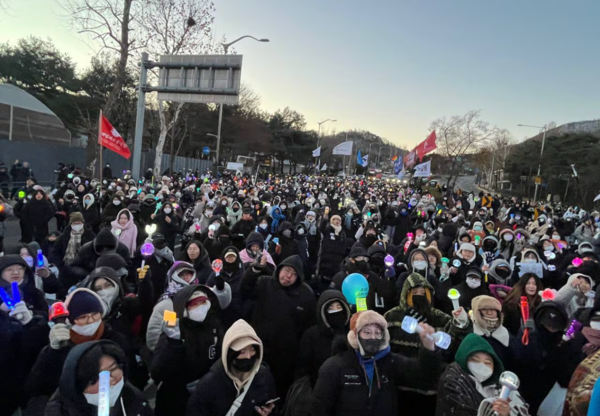
When I arrived at Namtaeryeong Station, I wasn’t sure exactly where the standoff was taking place. But as soon as I stepped off the subway, I saw a massive crowd of tens of thousands gathered nearby. The sight of delivery motorcycles passing by with pizzas and hot dogs, sent by supportive citizens, warmed my heart. Food and hot packs were being handed out to those who had braved the cold all night, a testament to the spirit of solidarity and care.
The March of Solidarity
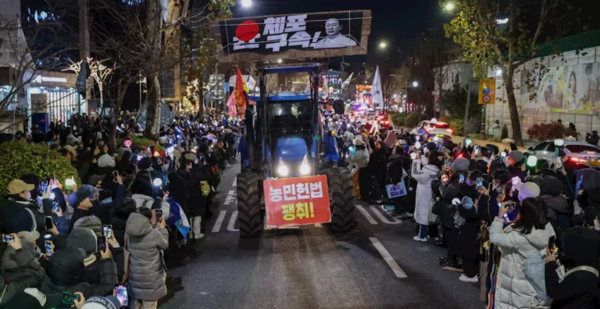
After hours of negotiations, opposition lawmakers announced that the barricades would be lifted, and the march could resume. The news brought cheers from the crowd. As the march began, the tractors—previously hidden by the crowd—came into view, lined up alongside the road. Farmers led the way, followed by citizens of all ages, particularly young women in their twenties, whose bright cheers filled the air.
As I watched the procession, tears welled up in my eyes, and I wasn’t alone. Many around me were moved to tears, including the farmers standing next to their tractors. These farmers, who had endured 28 hours of freezing cold at the barricades, are the guardians of our land and the heroes of food security. Their sacrifices struck a deep chord, and I couldn’t hold back my emotions.
A New Hope for the Era
The Jeon Bong-jun Struggle Group’s successful march into Seoul felt like a moment of historic significance. It was as if the spirit of the Donghak Peasant Revolution, which failed to overcome the Ugeumchi Pass 130 years ago, had finally found resolution. This time, the “farmer-citizen alliance” had crossed Namtaeryeong Pass and entered Seoul, a symbolic victory achieved through unity and determination.
For ordinary citizens like me, this moment affirmed the power of collective action. The
farmers’ resilience and the citizens’ solidarity reminded me that change is possible when we come together. As I stood there among the crowd, I felt a renewed sense of hope for our future.
About the Author:
Young-Hwa Jeong , in her mid-40s, is a former journalist for MoneyToday. After transitioning to writing and meditation, she now teaches mindfulness at Dongguk University’s Center for Future Convergence. She is also a mother of two.

댓글