

Korea: the First Natives of the Democratic Republic!
Solidarity with Glow Sticks and Hand Warmers Born as citizens of the democratic republic, The “Kisses” protestors in Hannam-dong, braving winter nights, Thwarted Yoon’s ambitions with civic virtue and experience. Leaders must empower these individuals to be the backbone of society.

Protestors with Rolling Suitcases
January 4, 2025, 4 p.m. Just four days into the new year, a “Yoon Suk-yeol Impeachment Rally” was held in front of Gyeongbokgung Station in Seoul. This was my first time attending a protest in eight years, since the “Park Geun-hye Scandal” protests near Gwanghwamun Square in December 2016.
Returning to the protest scene after eight years, I noticed how much the atmosphere had changed. During the rally outside the National Assembly on December 14, where the Speaker announced, “The impeachment motion against President Yoon Suk-yeol has passed,” I didn’t fully grasp the changed vibe. However, two weeks later, at the Gyeongbokgung rally, I finally witnessed the brilliance of glow sticks I had only read about in various reports.
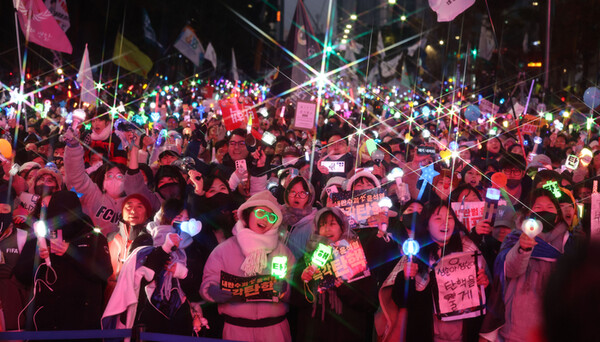
Having not attended a protest in so long, I had come completely unprepared — no cushion, no hand warmers, and, most crucially, no glow stick. While looking for a spot to sit on the bare asphalt, a young woman seated on a mint-green mat called out softly, “Excuse me, ma’am!” When I looked her way, she patted the spot next to her, saying, “Please sit here.” She also invited another participant standing behind me to join us, offering her mat generously.
In front of her lay a large mint-green suitcase, matching the color of her mat. Attached to the suitcase handle was a cute glow stick labeled “Impeach Yoon Suk-yeol.” It seemed she had packed the suitcase with protest essentials. She pulled out hand warmers, tearing them open and shaking them to activate the heat. After a while, she handed out the warmers to me and others nearby.
It appeared that the participants seated with her weren’t previously acquainted. Likely, she had arrived early, set up her mat, and offered her spot to those who hadn’t brought cushions.
For the first time since the emergency martial law declaration on December 3, I personally experienced the “warm protest atmosphere” I had heard about, with prepaid orders, food trucks, and shared hand warmers. I couldn’t help but wonder: What motivated this young woman, likely in her early twenties, to bring such a large suitcase filled with warmers and snacks to share?
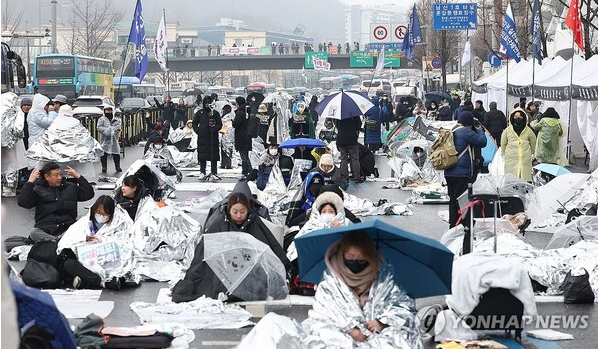
“Natives” and “Immigrants” of the Democratic Republic
The answer became clear soon after the rally began. A YouTube live stream team, noticing her suitcase and mat, approached her for an interview, which she willingly gave. Sitting nearby, I overheard her story. She had come all the way from Paju.
“What’s in this big suitcase?”
“Some mats, hand warmers, and snacks to share with other participants.”
“It must’ve been hard carrying this from so far. Why go to such lengths?”
“Seven years ago, I attended the protests calling for Park Geun-hye’s impeachment. It was my first protest, and I hadn’t brought anything. But strangers around me gave me cushions, hand warmers, and even kimbap. That memory left a strong impression, so now I want to do the same for others.”
And there it was—experience. Experience proved more powerful than I had imagined. Her generosity, rooted in “experience” and “selfless sharing,” spoke volumes.
This young woman likely belongs to what I call the “natives of the democratic republic.” True natives, born after 1987—the year South Korea transitioned to a full democratic constitutional system—have never known the trauma of dictatorship. Those born earlier, like myself, are “immigrants” to this democratic republic, having lived through authoritarian regimes we never chose.
The freedom, camaraderie, and magnanimity she demonstrated likely stem from the innate virtues of natives who have never experienced dictatorship. These are the democratic virtues—essential for the success of democracy—that are now becoming the foundation of our society.
Since 1987, South Korea’s democratic progress has occasionally faltered. Yet each time, citizens have exercised their constitutional rights to resistance and peaceful protest, demonstrating remarkable patience, restraint, and adherence to the rule of law. By removing corrupt officials and holding elected leaders accountable, they have steadily built a fully democratic nation.
The virtue and experience of these democratic republic natives have now thwarted President Yoon’s “loyalist coup” and written a new chapter in our history.
What We Overlooked: The Civic Instincts of the Natives
At 10:33 a.m. on January 15, the arrest warrant for President Yoon Suk-yeol was executed, marking a turning point in the “December 3rd Insurrection Crisis.” The judicial process for Yoon, who proclaimed an unconstitutional state of emergency to attack Korea’s democratic constitutional order, and his co-conspirators, will now proceed according to legal protocol. Similarly, the Constitutional Court’s ruling on his impeachment will follow due process. Given that the Court is a “child of the 1987 Constitution” and a symbol of democracy and constitutional integrity, it is implausible that it would reject the impeachment motion, barring a complete repudiation of its own raison d’être. Likely, the peaceful and lawful impeachment of Park Geun-hye from eight years ago will repeat itself.
While initially drafting this article, I intended to explore what citizens should prepare for in the aftermath of Yoon’s arrest. However, reflecting on the past 40 days, I realized that my assumption was arrogant and misplaced. The citizens have already demonstrated—without guidance or instruction—that they instinctively, and through experience (or what might be colloquially called “a gut feeling”), understood the situation and acted courageously.
Therefore, the Democratic Party, the National Assembly, and interim leaders like Sang-mok Choi, who have been at the forefront of this battle to defend democracy, must prioritize these democratic republic natives. Their governance, policies, and decisions must respect and reflect the will of these citizens.
Never Forget Gratitude Toward the People
The greatest blunder and downfall of Yoon Suk-yeol and the December 3rd insurrectionists was their ignorance, disregard, and underestimation of the democratic republic’s citizens. Future leaders of Korea must learn from this failure. Moreover, the political establishment should focus on ensuring that the civic virtues and instincts displayed during the December 3rd martial law crisis are not undermined but instead nurtured, allowing these citizens to grow as the foundation of our society.
The National Assembly, which passed the “Declaration of Gratitude to the People for Rescinding Yoon Suk-yeol’s Martial Law” during a committee session at the end of last year, must go beyond mere rhetoric. It should institutionalize its gratitude, transforming it into tangible actions. This is the true meaning of a national acknowledgment and the proper way to honor the citizens who flocked to the National Assembly on the night of December 3.
The Assembly’s declaration captures this sentiment:
“The National Assembly of the Republic of Korea pledges before the people to fully uncover the details of the December 3rd Yoon Suk-yeol Insurrection and hold those responsible accountable under the Constitution and the law. Until the state of emergency and the insurrection are completely eradicated, the National Assembly will stand with the people.
We express our profound gratitude, infinite respect, and trust in the wisdom and greatness of the Korean people, who have risen time and again to safeguard democracy and the constitutional order. It is an honor to stand with the citizens of the Republic of Korea during these challenging times.”
About the Author:
Hyunjung Kim, Ph.D., is a full-time researcher at the Party Law Research Center of Korea University, specializing in constitutional law, human rights law, party law, constitutional history, and media-related legislation. She earned her doctorate from Korea University with a dissertation on “A study on the party protection function in the political party Dissolution System.” A Journalist to DDANZI Ilbo, she is also a member of the Roh Moo-hyun Foundation’s “Democracy and Leadership Research Association.” Dr. Kim has worked as a journalist for various outlets, including the Catholic Peace Broadcasting Corporation.


댓글