

Korea: The Meaning Behind K-Pop Fandoms Wielding ‘Impeachment’ Light Sticks
Defying a Coup and Achieving Impeachment K-Pop fandom culture: “Resistance, solidarity, and sharing” Teenagers gain experience in “small yet joyous victories” Candles turn into light sticks—not just a superficial shift Youth shaping the future, growing as the protagonists of change
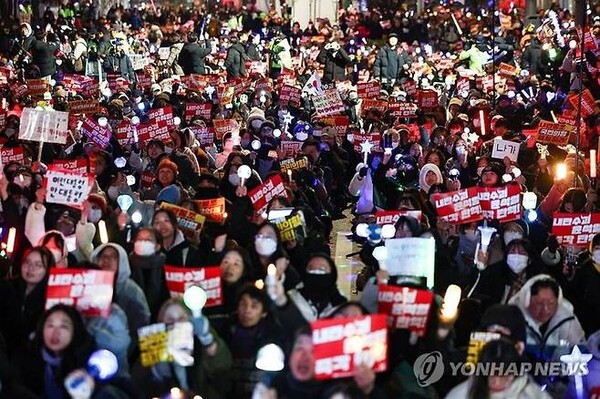
On Saturday, December 14, South Koreans mobilized a massive peaceful protest to pressure the National Assembly, successfully leading to the impeachment of the President. However, this marks just the beginning of a prolonged impeachment process. Finalizing the impeachment requires the Constitutional Court’s ruling, an early presidential election, and managing the year-end parliamentary schedule, all under the looming tensions with prosecutors and judiciary systems widely suspected of sympathizing with President Yoon Seok-yeol’s alleged insurrection.
This article reflects on the impeachment crisis triggered by Yoon’s actions and was presented at a public forum hosted by students and professors at Seoul National University. It focuses on the “activism of young women,” who have emerged as the driving force behind the citizen movement observed during the December 7 protest at Yeouido Plaza in Seoul. The article was written for a proxy reader as the author was attending an international academic conference abroad. As a written record, it captures South Korea’s collective emotions in December 2024, making it a valuable document for sharing and remembering.
===================
K-Pop Fans Resisting Authoritarianism Worldwide
Hello, I’m Hong Seok-kyung from the Department of Media and Communications. During last week’s first forum, I sat among the audience, listening to my colleagues and responding to questions from students who filled the venue, even up the stairs. Though I’m currently at an overseas conference, my spirit and fury are with you, far greater than last week’s.
Today, I want to talk about what I witnessed on Saturday, December 7, at Yeouido Plaza in Seoul. Having studied “Hallyu” for years, and more recently delving into BTS fandom over the past five years, I’ve been amazed by the explosive energy of “K-Pop fandom culture.” This has led me to explore its political potential.
Across the globe, K-Pop fans have challenged authoritarian governments, racist politicians, and bigoted intellectuals, from the United States to Chile, Hong Kong, and the Middle East. These efforts have become more visible through news reports. However, less attention has been given to the political energy of K-Pop fandoms within Korea itself. Perhaps this neglect stems from the fact that the global K-Pop market is over ten times larger than the domestic one, or because we tend to focus more on how we’re perceived externally than on internal developments.
Yet even in Korea, K-Pop fandoms have been quietly making their mark. The transition from candlelight protests to demonstrations using light sticks signifies more than just a change in appearance.
“Solidarity and Sharing” Learned Through Messing around, Not Studying
The defining features of K-pop fandom are solidarity and sharing within its community. This culture did not emerge overnight. It traces its roots back to the rise of fangirls visible during Seo Taiji’s debut in 1992 and the birth of the first generation of K-pop fandom in the mid-90s. Korean teenage girls developed this culture despite being scolded by their parents for “wasting time” instead of studying.
The global K-pop fandom culture is an extension of this movement born in Korea. Their power doesn’t stem from a few explosive moments but from repeated and reinforced “joyful experiences of solidarity” through their teens and twenties.
K-pop fans gather far in advance, sometimes days earlier in foreign countries, for concerts where seats are pre-assigned, practicing the spirit of sharing. In an era of hyper-competition and individualism driven by late capitalism, they willingly invest their precious time, money, and effort to create something and share it within their community, finding joy in the process. They find happiness in supporting their favorite group’s new album and witnessing its success on domestic and international charts like Billboard.
This “experience of small yet joyful victories” is an immense source of strength. As these fans move from their teens and twenties into their thirties, they’ve shown their capability to handle even massive moments of mourning, such as in the aftermath of the Gangnam Station murder, with order and composure. The skills of braving cold mornings in long lines for live broadcasts and enduring waiting with cheerful camaraderie have been passed down across 30 years of fandom generations.
On Saturday, December 7, the persistence and exuberance displayed by young people occupying the space in front of the National Assembly was cultivated through such experiences. Only now is it drawing nationwide attention.
The Chorus of Young Women and Middle-Aged Men
Data emerging over the past week confirms this reality. The December 7 protest at Yeouido saw the highest participation among women aged 20-35 and men aged 45-59. On-site, middle-aged men wielding colorful light sticks were struck by the energy of the 20s and 30s women who confidently dominated the square with their chants and speeches. Social media has since been flooded with confessions from these men, saying they “regret scolding these young people without understanding their power,” and messages acknowledging that “the freedoms we enjoy are the result of our parents’ sacrifices.” They also pledged, “We’ll do better from now on.”
In an effort not to stifle the younger generation’s enthusiasm, some middle-aged participants are learning to share K-pop protest playlists. Meanwhile, young protesters are requesting a mix of K-pop tracks and traditional protest anthems. Protest sites are now seeing the likes of Girls’ Generation’s <Into the New World>, G-Dragon’s <Crooked>, <Whiplash>, and <Apartment> blending with <March for the Beloved>, <In the Wilderness>, and <Amor Fati>. A surreal coup attempt by a reckless president has, against all odds, brought about generational unity in civil society!
The relocation of protests from Gwanghwamun to Yeouido also marks a significant shift. Unlike Gwanghwamun, where the sheer mass of candlelight protests created wave-like displays, Yeouido’s intersecting roads, parks, and central avenues fostered smaller hubs of activity. These hubs thrived with endless speeches and spirited gatherings. Throughout the square, the commanding voices of young women leading chants for “Yoon Seok-yeol’s Impeachment” were particularly memorable.
Young men also made a notable appearance, though less so than young women. The lack of a symbolic “banner” to rally behind seemed to be a challenge for them. Unlike labor unions and political parties with their high-flying flags, young men seem to lack the collective experience of occupying public spaces in analog, face-to-face settings. Whether future protests in front of the National Assembly succeed may depend on how many of these young men join in and what shared cause they rally under.
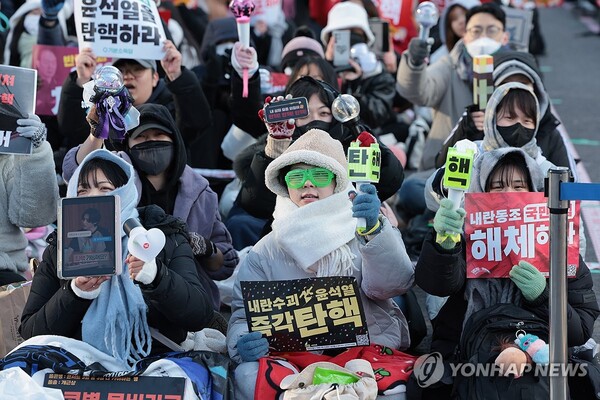
The French march, and We take control
I have spent many years as a professor in France, a country renowned for its culture of protest. As someone who specializes in popular culture, I have always been attentive to the dynamics of crowds and movements in public spaces. In France, protests involve marching through streets; in Korea, we take over the squares.
While French protests often attract external agitators or those exploiting the demonstrations to incite violence—leading local shopkeepers to shutter their stores—we do things differently. In Korea, protest participants pre-order drinks and snacks from nearby businesses to offset their losses, showing solidarity even with those who cannot participate directly. Afterward, we even clean up the waste left behind.
Most strikingly, while French protests rarely go beyond the Internationale when it comes to collective singing, Korean demonstrations resonate with a multitude of songs that unite and empower participants.
This ability to endure and resist through collective joy is an old Korean tradition. It reflects the resilience that has sustained us through periods of physical threat and enabled us to achieve democratization. This strength forms the foundation of the “Korean Wave” (Hallyu), the global phenomenon of cultural exports that encapsulates Korea’s success story of democratization and economic growth. Our history of overcoming adversity makes Korea unique, and now, we are writing a new chapter in that story.
The Past Saves the Present, the Dead Save the Living
History repeats itself when it remains incomplete. How, then, can the past save the present, as writer Han Kang(Nobel Prize in Literature) once asked? In many ways, the challenge we face now is even more daunting than in 2016. Korea’s task of resolving a military coup disguised as a declaration of martial law through democratic processes is unprecedented, and the world is watching closely.
At the heart of this movement, a generation of young people is emerging as the protagonists who will rewrite the future.
In the world you will shape, there will be no place for those who march with flags of Korea, the U.S., and Israel held together, nor for lawmakers of the People Power Party who believe that within a year, people will forget and vote for them again. Instead, we celebrate a generation of young people who sing songs to remember the names of the 105 heroes, refusing to let their sacrifices fade from memory.
It pains me deeply that I cannot be present tomorrow at Yeouido. Thank you for listening to this long story.
(This is a transcript of the speech delivered by Professor Hong Seok-kyung on December 12 during the second political forum organized by the Department of Political Science and International Relations at Seoul National University.)
Author:
Born in 1963, Hong Seok-kyung studied French Literature and Mass Communication at Seoul National University and earned her Ph.D. in Media and Communication Studies in France. After serving as a senior researcher at the Broadcasting Commission in Korea, she taught at Bordeaux University in France for 12 years before joining Seoul National University’s Department of Communication in 2013.
Since her graduate studies, she has focused on popular culture, particularly its sociocultural and political roles, inspired by her interest in the role of song movements in people’s culture. This academic pursuit culminated in works like The Korean Wave in the Era of Globalization and Digital Culture (2013). Her extensive field research on the sociocultural and political potential of large fandoms, particularly in On the Road with BTS, remains a significant contribution to the field.



댓글