

Outlook on Trump’s Energy Policy: Part 1
[Jay Kwon’s “Understanding Energy”] Pushing Support for the Fossil Fuel Industry U.S. Energy Industry Holds Top Global Competitiveness No Significant Production Increase Likely in Trump’s Second Term Environmental Groups Oppose, Energy Companies Show Tepid Interest
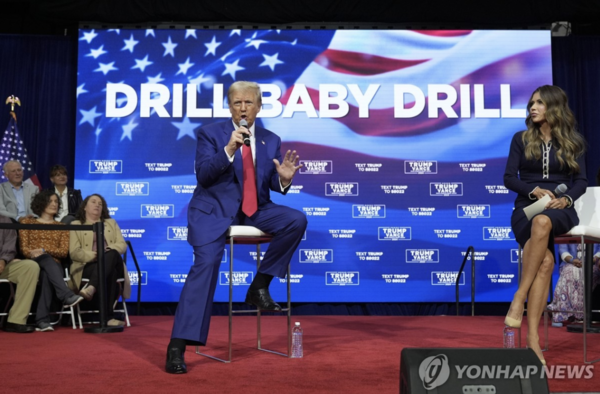
- 트럼프 2기 美에너지정책 어떻게 될까① anslation of a Korean column originally published on December 17, 2024, titled 트럼프 2기 美에너지정책 어떻게 될까①
The United States is gearing up for the inauguration of the second Trump administration on January 20. There is increasing interest in the direction of U.S. energy policy during his second term. Historically, Trump’s energy policy has focused on supporting the fossil fuel industry while also affecting the renewable energy sector. In this article, we will explore the expected changes and implications of energy policies under the upcoming Trump administration. (Due to space constraints, Part 1 will cover the fossil fuel industry, while Part 2 will address the renewable energy sector and climate policy.)
1. The U.S. Transformed into an Oil and LNG Superpower
During President Trump’s first term, the U.S. oil and gas industry experienced significant growth. Policies aimed at easing regulations, stimulating investment in shale oil and gas, and expanding drilling on federal lands proved to be effective. As a result, the U.S. addressed issues related to foreign oil imports and domestic natural gas depletion, leading to a stabilization of energy prices. Key consumer energy prices, including gasoline, natural gas, and electricity, showed a downward trend.
In addition to meeting domestic demand, the U.S. expanded its oil and natural gas exports, transforming from an energy importer to an energy exporter. This shift reduced dependence on Middle Eastern oil and facilitated changes in the global order as the U.S. gradually reduced its involvement in the region. This phenomenon, collectively referred to as the “Shale Revolution,” represents the culmination of a process that began in 2008. Trump’s first term is regarded as the period when this revolution reached its peak.
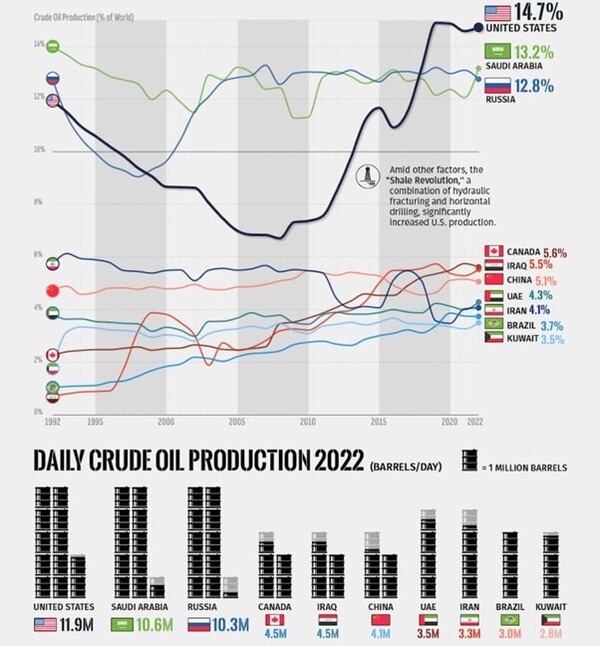
In 2008, the U.S. represented 7% of global oil production, but by 2020, this figure had increased to 15%. The U.S. is now the world’s largest oil producer, and the growth in domestic oil and natural gas production has significantly improved the international competitiveness of the U.S. fossil fuel industry. As a result, U.S. crude oil exports surged from 600,000 barrels per day (b/d) in 2016 to 3.2 million b/d in 2020. This increase in domestic production and crude oil exports is primarily due to the expansion of shale oil production.
Shale oil production also results in the extraction of substantial amounts of natural gas alongside crude oil, which has naturally increased domestic natural gas production and liquefied natural gas (LNG) exports. LNG exports grew from approximately 5.7 million tons in 2016 to about 68.4 million tons in 2020. The U.S. has become one of the top three LNG exporters globally, alongside Australia and Qatar, each exporting roughly 80 million tons annually.
2. U.S. Fossil Fuel Industry Remains Competitive During the Biden Administration
Despite the Inflation Reduction Act (IRA) and a focus on renewable energy support under the Biden administration, the U.S. fossil fuel industry has become even more competitive. Recent data reveals that U.S. LNG (liquefied natural gas) exports reached approximately 91.2 million tons in 2023, allowing the U.S. to surpass Australia and Qatar to become the world’s leading LNG exporter. Additionally, crude oil exports saw significant growth, averaging 4.058 million barrels per day (b/d) in 2023, which represents a 13% increase from the previous year.
Why have oil and gas production and exports continued to increase under the Biden administration? The answer lies in the strong competitiveness of the U.S. fossil fuel industry. Since becoming the first country to commercialize shale oil and shale gas in 2008, the United States has consistently lowered the breakeven point for developing oil and gas fields through rapid technological innovation and significant capital investment.
The three major producers in the global oil market are the United States, Saudi Arabia, and Russia. In late 2014, in response to the rapid growth of U.S. oil production and exports, Saudi Arabia and Russia entered into a significant competition by increasing their own production to protect their market share. This aggressive strategy by Saudi Arabia led to a sharp decline in international oil prices starting in 2015. Consequently, the U.S. shale oil and gas industries experienced temporary setbacks, with noticeable production declines in 2015 and 2016, as illustrated in Figure 2.
At that time, many experts believed that Russia, relying on Soviet-era infrastructure, was the only producer capable of competing with Saudi Arabia’s ultra-low-cost oil fields. They speculated that the United States, facing higher production costs, would struggle to remain competitive. However, through relentless technological advancements and innovations, the production costs of U.S. shale oil were reduced to levels comparable to those of Saudi Arabia and Russia. Ultimately, this intense two-year oil production war concluded with a victory for the United States.
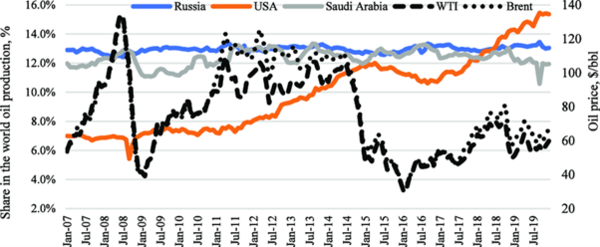
The estimated production cost of U.S. shale oil is around $40 per barrel (bbl), while shale gas costs approximately $3 per MMBtu. As long as international oil prices remain above these levels, the U.S. can maintain a daily production rate of 14 million barrels, with natural gas co-produced at competitively low prices. In summary, although the Biden administration’s policies have not been particularly favorable to the fossil fuel industry, the industry’s innovations and international competitiveness have secured its position. This has allowed the U.S. to maintain its competitiveness in oil and natural gas at the highest global level.
3. The Intricacies of the Shale Revolution
The anticipated second Trump administration is likely to shift energy policy away from the Biden administration’s focus on renewable energy and revert to a strategy centered around fossil fuels. During his campaign, President Trump frequently used the phrase “Drill, baby, drill,” indicating plans to further expand shale oil and gas drilling. This rhetoric highlights the complex dynamics involved in the U.S. shale revolution.
Shale oil and gas are hydrocarbons that are trapped in sandstone layers formed from hardened clay. These resources are extracted through a process known as fracking, which involves creating fractures in the rock to access oil and gas located deep within these layers. During fracking, horizontal wells are drilled, and artificial earthquakes are induced to crack the sandstone. These fractures enable oil and gas to rise to the surface due to pressure differences.
While fracking has allowed for the commercial development of extensive shale oil and gas reserves, it has also resulted in several negative side effects. The artificial fractures can lead to oil leaking into groundwater and surface areas, causing pollution. While producers aim to capture as much oil and gas as possible, unprofitable natural gas is often flared or vented directly into the atmosphere. This process releases significant amounts of CO₂ when burned, or, even more concerning, allows methane—a gas with a much greater impact on climate change—to escape.
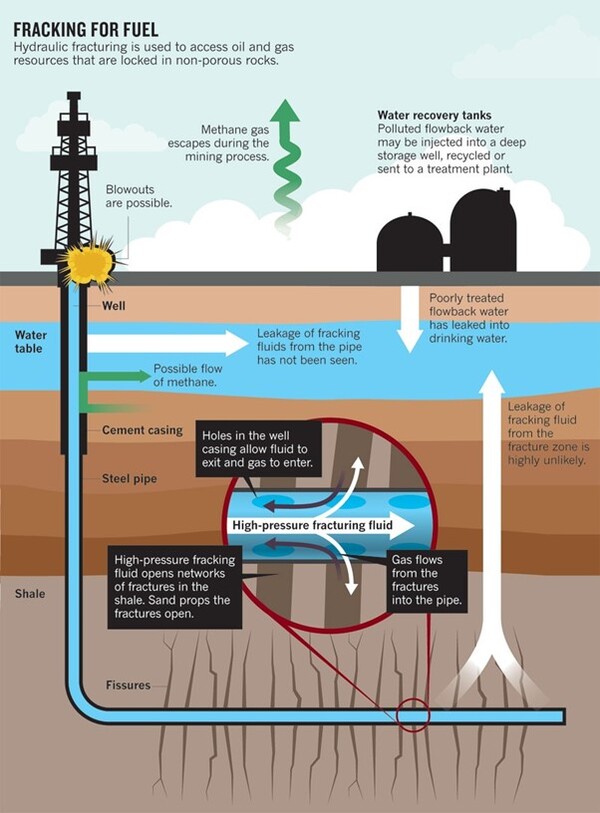
The primary component of shale gas is methane, which is a greenhouse gas that is much more potent than carbon dioxide (CO₂). Once released into the atmosphere, methane takes approximately 100 years to break down naturally. During this time, its greenhouse effect is 20 to 100 times stronger than that of an equivalent mass of CO₂. Consequently, the expansion of shale oil and gas production not only continues our reliance on fossil fuels but also significantly accelerates climate change and global warming. This is why the Biden administration has pursued stricter regulations on fracking and has banned it on federal lands as part of its response to the climate crisis.
In the United States, unlike in many other countries where underground resource rights are owned by the government, these rights belong to individual landowners. Many fracking operations use production-sharing agreements, which allow landowners to receive a portion of the profits. Since the shale revolution, the value of privately owned land with potential shale resources has significantly increased, making production-sharing agreements more favorable for landowners. This trend has also led drilling companies to seek opportunities for fracking on federal lands.
4. Limited Potential for Rapid Oil and Gas Production Growth in Trump’s Second Term**
The second Trump administration is likely to implement policies that expand shale oil and gas drilling sites and increase production to lower domestic energy prices. Despite opposition from environmental groups, fracking and drilling activities on federal lands—primarily in western regions and Alaska—are expected to rise. A particular concern is oil drilling in the Arctic Ocean off Alaska’s northern coast, which contains significant oil and gas reserves. Since the 1980s, further drilling and development in this area have been prohibited due to the near impossibility of natural cleanup after an oil spill. Nonetheless, the Trump administration is advocating for development in this region, arguing that it will enhance U.S. energy security.
The Biden administration had halted approvals for new LNG (liquefied natural gas) export projects, citing conflicts with the climate goal. While LNG produces fewer greenhouse gases than other fossil fuels, it is still a fossil fuel, and large-scale LNG production contradicts climate goals. However, under pressure from the domestic energy industry and to enhance dominance in the global energy market, the second Trump administration is expected to swiftly resume the approval processes that were previously halted. If these approvals move forward, U.S. LNG production, currently around 100 million tons annually, could increase by 60 million tons, reaching a total of 160 million tons within four years.
Despite efforts to boost shale oil and gas production on federal lands and to relax environmental regulations, significant growth in production is unlikely. The U.S. is already the world’s largest oil producer, and any increase in production directly impacts international oil prices. Current prices stand at about $70 per barrel, and U.S. producers are aware, from past experiences, that overproduction can lead to unprofitable price drops. When prices fall, higher-cost production fields are typically idled. Consequently, U.S. oil and gas production is largely influenced by market demand and prices rather than government policy.
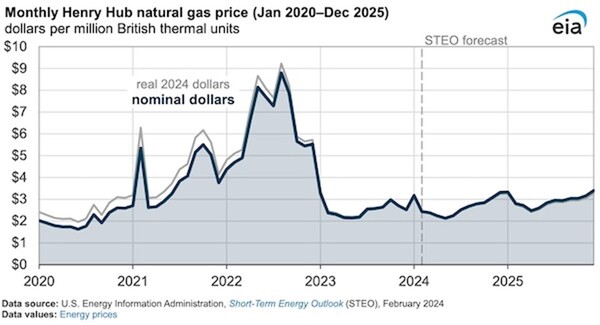
If large-scale drilling on low-rent federal lands increases production, it is anticipated that production on private lands will decrease. While an increase in LNG exports from 100 million to 160 million tons annually is expected, it is unlikely to have a significant impact on domestic natural gas production. At this level, LNG export volumes would represent about 20% of U.S. domestic demand. However, with current natural gas prices at $3 per MMBtu, there is insufficient incentive for new shale gas development. The U.S. Energy Information Administration (EIA) projects that natural gas prices will remain between $2.50 and $3.50 per MMBtu through late 2025, a price range that is inadequate to encourage new shale gas projects.
Nonetheless, the Trump administration is likely to streamline the approval processes for LNG exports, expand tax benefits for investments in oil and gas pipeline networks connecting various states, and increase the strategic petroleum reserve (SPR). These actions may offer some assistance in boosting oil and natural gas production.
5. Limitations of One-Term Administration
A second Trump administration would aim to enhance energy security and dominance by increasing domestic fossil fuel production. This approach contradicts the principles of the Paris Agreement and could lead to significant environmental challenges. The increased reliance on fossil fuels is likely to result in higher greenhouse gas emissions, undermining global efforts to combat climate change. Beyond concerns about the climate crisis, expanding drilling on public lands and waters may encounter strong opposition from environmentally conscious groups due to the potential negative impacts on ecosystems.
President Trump is expected to disregard concerns regarding his policies and make a strong push for their implementation. However, environmental organizations and civil society are likely to voice their opposition. This opposition could lead to legal and political challenges during the implementation of these policies. Additionally, a second Trump administration would be characterized by non-renewable energy initiatives. Major oil companies, such as ExxonMobil, have already expressed worries about the fossil fuel-centric energy policies anticipated under a second Trump administration and have openly opposed the withdrawal from the Paris Agreement.
If large energy companies continue with pro-fossil fuel policies, they may encounter backlash from consumers both domestically and internationally. Furthermore, the recent decline in crude oil and natural gas prices, driven by excessive production, is not likely to enhance profitability for these companies. It’s also important to note that developing new oil and gas wells typically takes two to four years, making it difficult to predict future policies if there is a change in the presidency in four years.
6. Conclusion
Trump’s energy policy for a second term will focus on enhancing the competitiveness of the domestic fossil fuel industry and increasing production. This is expected to be achieved through deregulation and the simplification of permitting processes. However, it remains uncertain how effectively companies will respond to these changes.
The United States is already the world’s leading producer of crude oil and natural gas, with natural gas being the cheapest and most abundant energy source available. This success can be attributed to the advancements and competitiveness brought about by the shale revolution. Nevertheless, current production levels and prices limit further expansion.
In the short term, Trump’s second-term energy policy is likely to stimulate U.S. economic growth, increase energy production, and reinforce U.S. energy dominance. In the long term, however, it may encounter opposition from environmental advocates and those pushing for the development of renewable energy sources. The effectiveness of Trump’s policies during his second term will depend on the specifics of the measures taken and their implementation.
About the Author:
Jay Kwon is the leader of the Facebook knowledge group COR Energy Insight. He is dedicated to exploring better alternatives for sustainable energy. Jay organizes and shares research with experts in the energy industry to inform the public while also debunking fake news and misconceptions. Currently, he works as an executive in the energy business sector.



댓글