

No difference between ‘Gold’ and ‘Soil’ in semiconductors
[Yeonsub Jung’s Science and Philosophy] How to solve a supply shortage with innovation
[Yeonsup Jung, author of “Crow’s Science Hunting”]
Why is there a shortage of semiconductors for vehicles?
Complaints that it is difficult to find semiconductors for vehicles will continue for a year. Predicting a decrease in the purchase of Korona cars, manufacturers have reduced production of semiconductors for vehicles and increased their weight to state-of-the-art semiconductors in preparation for the conversion of self-driving cars. The outlook was wrong, and consumers were relieving the frustration of corona by car, so semiconductors for vehicles with long production processes could not keep up with demand. To make matters worse, droughts, fires and power outages stopped semiconductor manufacturing plants, while the U.S. blocked exports of semiconductor technology to China.
Due to the lack of semiconductors for vehicles, automobile workers have been unable to work, which has also led to a decline in car sales worldwide. Korea also saw its auto production index fall 5 percent in October. The South Korean government and the White House have taken care of semiconductors, but manufacturers are constantly filming semiconductors for vehicles as orders for finished cars are pouring in. If this trend continues, supply and demand of automotive semiconductors will not be released until the second half of next year.
There are five companies that supply automotive semiconductors. They are NPX of the Netherlands, Infineon of Germany, Renesas of Japan, Texas Instruments of the United States and ST Micro of Switzerland. But if you listen deeply to the production line, the five suppliers design automotive semiconductors and manufacture only part of them, leaving most of them to Taiwan’s TSMC. A company that only manufactures semiconductors based on design is called a foundry company, and TSMC is a foundry company that supplies 70% of semiconductors for vehicles in the world. Although there are five companies, it is not wrong to argue that TSMC controls supply and demand of semiconductors for vehicles.
Why didn’t you make Samsung SK?
Korea is also a semiconductor powerhouse. Because automotive semiconductors only supply 3% of semiconductors, they are ‘drugs’ for automotive semiconductors. Why don’t car semiconductor designers leave their production to Samsung and SK Hynix? Semiconductor officials say Samsung and Hynix have refused to win orders due to low yields on manufacturing semiconductors for vehicles. However, it is hard to believe what they say as the NPX is bouncing back by offering a huge amount of 70 trillion won, even though Samsung is eyeing to acquire and merge NPX. Vehicle semiconductor designers may prefer TSMC, which has manufacturing technology only, to Samsung, which has both design/manufacture technology, for fear of technology leakage.
The reason why Samsung or SK Hynix cannot manufacture automotive semiconductors is due to the characteristics of automotive semiconductors. Semiconductor for vehicles requires toughness and reliability as much as its functions. Unlike home appliances, cars travel rough mountain roads, bump into rocks, are exposed to freezing temperatures of minus 40 degrees Celsius in winter and submerged while crossing road pools. To withstand pressure, temperature, and moisture, it must be made strong. In the 1990s, Daewoo Electronics insisted on “tankism” of electronic products, but tankism applies to automobiles. Moreover, since the 10,000 won semiconductor has been discontinued and the 10 million won car cannot be replaced, the manufacturer must keep the spare amount of the vehicle semiconductor for more than 20 years.
Samsung and SK Hynix do not make semiconductors based on tankism. South Korea’s semiconductor industry is more about household semiconductors than automotive semiconductors. The memory that goes into home appliances and computers works in a ‘warm’ environment. Samsung and TSMC have been competing for thickness of gate circuits to obtain high-capacity memory. The gate circuit, which stood at 50 nanometers 15 years ago, has become as thin as 5 nanometers these days. Thin new circuitry increases capacity and consumes less power, but reduces toughness and reliability. In extreme environments, new semiconductors are prone to malfunction, and older semiconductors are more durable. TSMC makes automotive semiconductors with 50 nanometers and memory semiconductors with 5 nanometers, but South Korea has abandoned 50-nanometer technology.
We need to break through ‘innovative thinking’
Although supply and demand of semiconductors for vehicles will be normalized in the future, similar problems could arise again. No matter how strong the old-fashioned method is, the company cannot trust its fate with technology and products from 20 years ago. While applying new technology, ‘strong’ automotive semiconductors can emerge. To get out of fear, you have to think about innovation.
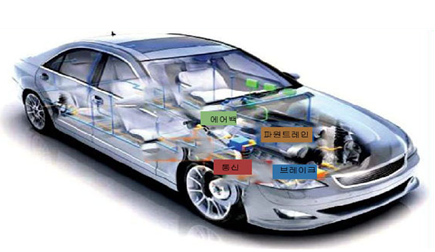
It is hard to say that the current electronic control structure of automobiles is optimized. A representative part of automotive semiconductors is MCU (Micro Control Unit), which will be used for about 100 internal combustion cars and 1,000 for electric vehicles and self-driving cars in the future. As the number of MCU types increases, it is difficult to supply and demand and to maintain parts.
The way to reduce MCU types is ‘integration of functions’. Three or four integrated MCUs in the center can absorb hundreds of MCU functions that have been dispersed. Central and distributed controls are not only applicable to vehicles, but also to all electronic controls, including power plants, factories, and power grids. The ruling power can also be divided into central power and decentralization. The feudal society of the Middle Ages was in the era of decentralization. However, as roads were built and exchanges were active, feudal society collapsed and a centralized absolute monarch appeared. When communication technology develops, distributed and central control find the right balance. Tesla was less affected by the shortage of semiconductors in its vehicles because it switched MCU from distributed MCU to integrated MCU.
Let’s take a closer look at MCU’s capabilities to develop an integrated MCU. MCU for vehicles is a small chip installed in brakes, engines, and handles to help drive safely. MCU’s function is also to detect objects and alert them when reversing. It is no problem to understand MCU as a central processing unit (CPU) for personal computers. Electronic engineers call small chips CPU in personal computers, but MCU in cars. Similar chips are included in mobile phones, which are called AP (Application Processor). CPU is powerful but consumes a lot of power, and AP consumes less power despite its powerful functions. MCU is simple in function but durable.
It’s time to develop “High Trust MCU”
Considering the similarity between MCU and AP, it is possible to infer that Samsung, which has AP design and production capability, can develop MCU. However, considering MCU’s toughness, it is possible to argue that the two can never be combined. Therefore, the integrated MCU has no choice but to develop into two directions: High-performance MCU with mobile phone function and High-trust MCU with tank function. High-function MCU is used to show the driving path of vehicles, and High-trust MCU is used to control brakes and engines. You can think of an electronic control structure so that a future car can have one High-performance MCU and one High-trust MCU.
Samsung has already released Exynos Auto, a High-function MCU, so only the task of developing a High-trust MCU remains in Korea. Instead of going back to the previous 50-nanometer fabrication technology, the latest 5-nanometer fabrication technology should increase reliability. You can make thin circuits through extreme ultraviolet (EUV), but you don’t have to insist on thick circuits. Instead of relying on technology in the 2000s, it can change semiconductor materials or optimize gate three-dimensional geometry to make tough semi-conductors. In engineering, ‘Stronger design’ is a state-of-the-art technology and can never be called an old-fashioned technology, only High-function semiconductors can be “Gold” and high-trust semiconductors cannot be “Soil”. ‘Stronger design’ is used not only in automobiles but also in defense, robots, satellites and nuclear power.
Korea is trying to produce a highly reliable integrated MCU by acquiring one of the five designers, but this attempt seems difficult to make. They already have a symbiotic relationship between design and production with TSMC, making it difficult to squeeze in. I hope you will once again use the power of designing High-capacity memory to High-trust semiconductors as you have no choice but to become independent in Korea.
[This article is an automatic translation by Naver Korea’s automatic translation system “Papago” using artificial intelligence (AI).]
Yeonsup Jung
Yeonsup Jung, author of 'Science Hunting of Crow, is a researcher at the Korea Hydro & Nuclear Power. After his master's degree in chemistry at Seoul National University, he went through the LG Chem Institute and the Korea Electric Power Corp. About 50 published papers and 10 patents were registered. It received the technical award from the Korea Atomic Energy Association and the Ministry of Commerce for its design and export of nuclear power plants.

댓글