

Why did North Korean defector appear in ‘Squid Game’?
[Geechan Park’s sweet and savory North Korea stories] The reason why North Korean story is always with K-contents

The K-contents’ secret to success and the reason for the existence of North Korean material
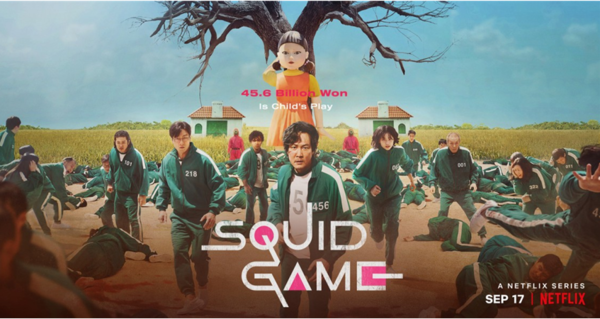
Following the success of Parasite and BTS, ‘Squid Game’ received explosive love from people around the world. It can no longer be explained in terms of ‘accident’ or ‘the consideration of the cultural imperialist country’. So people came to call them by bigger and better names such as K-Contents, K-Soft Power, and K-Culture. What is the reason for its success? Not only domestically, but also abroad, they are unable to explain the secret clearly.
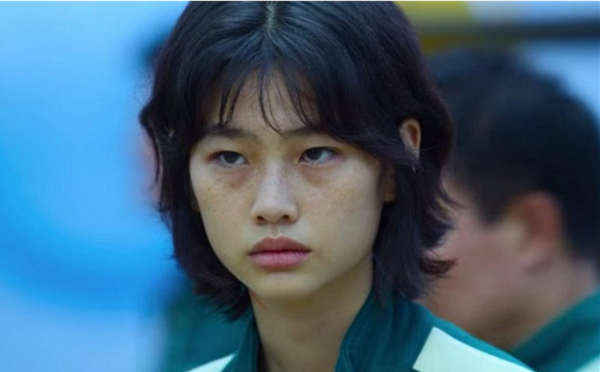
In ‘Squid Game’, Kang Sae-byeok, a North Korean defector, received worldwide attention as one of the five most important characters (Seong Gi-hun, Cho Sang-woo, Oh Il-nam, Kang Sae-byeok, and Ali). Actor HoYeon Jung, who played Kang Sae-byeok, got 20 million Instagram followers additionally and became a global star, and she was selected as a Louis Vuitton’s global ambassador.
Two years ago, the melodrama “Crash Landing on You,” set in North Korea itself, hit the global market. In the movie ‘Parasite’, one of the key devices of the story, the underground bunker, is a housing structure that came out of the feeling of danger among the wealthy in Seoul, who live in danger of war.
Why the North Korean story elements have positioned in K-contents without missing out? One answer that penetrates the two questions on both the secret of K-contents’ success and the reason for the existence of North Korean elements could come from ‘Theory of a Cultural Powerhouse’, written by Kim Gu.(Kim Gu is one of the most respected Korean independence leaders.)
A paradoxical clue in Kim Gu’s ‘Theory of a Cultural Powerhouse’
“I want my country to be the most beautiful country in the world, not to be the richest country. Because we have been heartbroken by other people’s aggression, I do not want my country to invade others. Our wealth is sufficient to make our lives abundant, and our strength is sufficient to prevent the invasion of others. The only thing I want infinitely is the power of high culture. This is because the power of culture makes us happy, and furthermore gives happiness to others.
(omitted)... I want our country not to become a country that imitates others, but to become a source, a target, and an example of high and new culture. That is why we want world’s true peace to be realized in our country and in the world through our country.”
Remembering the resurgent article these days, many people say: “How could such optimism be expressed in a situation when independence was finally achieved after all kinds of hardship and contempt but the country was being split in two by great powers?”
This is how I understand Baekbeom(the nickname of Kim Gu)’s words. “Since we have suffered all kinds of pain and sorrow as a poor, weak and invaded country, we can rather set the most universal standard for a beautiful culture and world peace in the process of overcoming and surmounting the difficulties.” Paradoxically, our country can become a more beautiful and global cultural powerhouse because it is a nation which is divided as well as weak politically, militarily and economically. But only if we wisely overcome them.
Where else is there any people in the world who have been more concerned and put into action to overcome the overall weaknesses of a poor country, a weak country, and a divided country in the shortest possible time than the people of our country? I believe that a more beautiful and peaceful new world culture can emerge through these fierce and beautiful processes that are still ongoing.
The charm of K-contents story structure
Yujung Kang, a cultural critic and professor at Kangnam University, analyzed the secret of K-contents’ success very convincingly.
“The style that the Korean public likes is realism. In Korea, it is difficult to be recognized and loved by the public as a good work without showing a social point of view. You can recognize that just by looking into the Korean movies with 10 million viewers like ‘Masquerade(Gwanghae)’, ‘Assassination’, and ‘Inside Men’. (omitted)... Most popular films, especially American popular films, aim for happy endings or fantasies, even if unrealistic, but such cheap compromises don’t work well on Korean. It is because they have known through many years of experience that reality problems cannot be solved by compromises in a movie.” (Kyunghyang Shinmun, 2021.10.22.)
Korean content has always been realistic and fierce, but honest and fun, dealing with the ‘social structural problems’ that occur in reality. And through the form of an ‘open ending’(which overseas critics call a ‘K-ending’) rather than a clumsy compromise or an artificial happy ending, the current structural task and its weight are thrown back to the audiences.
Why has this style of storytelling been established in Korea? It is said that culture and art are reflections of reality. Koreans have faced a variety of serious social problems while achieving the so-called “compressed growth” in the most vulnerable and poorest country. In world history since the 20th century, it is difficult to find people who have suffered more, agonized more, and struggled more than Koreans with these problems. The unique fruit of ‘Korean narrative structure’ has ripened in the fierce pain of grappling with numerous social and structural problems in process.

The same root of pains that Kang Sae-byeok and D.P.‘s An Jun-ho sufferd from
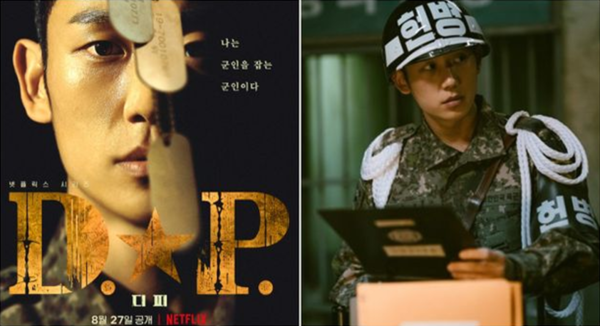
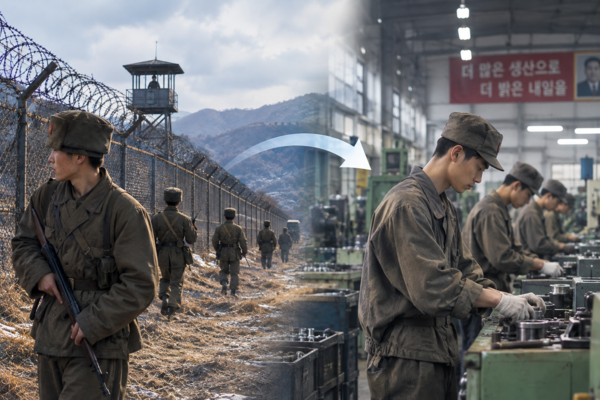
If we look more carefully at the materials of North Korea, we could realize that they are current reality issues that stems from the structure of divided nation. In addition to the problems that Kang Sae-byeok encountered in ‘Squid Game’, the pains that Ri Jeong-hyeok and Yoon Se-ri faced in ‘Crash Landing on You’, Lim Yong-su and Han Shin-seong confronted in ‘Escape from Mogadishu’, and An Jun-ho and Han Ho-yeol troubled with in ‘D.P.’ are based on the common somethings contradictory that come out of a reality in which Korea is divided into hostile two countries.
The pain of Kang Sae-byeok in ‘Squid Game’ as well as the pain of ‘D.P.’‘s Jun-ho An is rooted in our divided reality that cannot be seen anywhere else in the world. The popular drama ‘D.P.’ starts with the opening credits ‘All Korean men must go to the military’. Our reality is that any exception is not permitted to BTS members, who are the best evangelists of K-culture.
K-contents cultural powerhouse is in progress
Therefore, movies, dramas, and webtoons with themes or materials about division or North Korea will continue to appear in the future. The reason is not only because such stories throw a different charm to the global market and audience when they are uploaded on a global platform. More fundamentally, it is because the subjects and materials are the real problems and tasks for survival that we cannot give up to confront.
The road to the ‘cultural powerhouse’ that Baekbeom spoke of is currently in progress. Maybe it’s just starting. The division issue of Korea is our more serious issue than the issue of class polarization. The issues are very old and entrenched, requiring more pain and trial and error.
Paradoxically, I believe that the our contents could be more attractive and beautiful, and further blossom greatly into the world.
Geechan Park
The author, Geechan Park, is a financial man who completed an MBA from Washington University in St. Louis after graduating from Seoul National University in Economics and is a North Korean researcher who approaches the issues on the Korean Peninsula based on a global and future-oriented perspective. He is working as a member of the development cooperation committee at the Korean Sharing Movement, and obtained his Ph.D. in the University of North Korean Studies.



댓글