

The presidential candidate who maintains his identity wins
[Korean presidential election trends and prospects as seen by a linguist] “The middle class is fictional...there is only a floating class” Which candidate was self-centered and impressed his supporters?
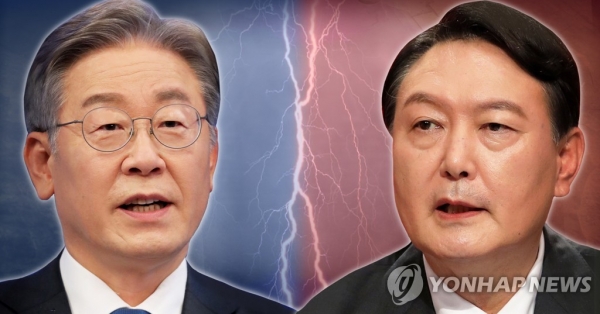
[Lee Chang-bong, Professor of English Language and Literature, Catholic University of Korea] The presidential race between Democratic Party candidate Jae-myung Lee and People’s Power candidate Seok-yeol Yoon is fierce. Just a week ago, most opinion polls showed that candidate Seok-yeol Yoon was ahead of candidate Jae-myung Lee outside the margin of error. The situation has suddenly turned around, and recent public opinion polls suggest that the approval rating between the two candidates is thin or that Lee is ahead. How could such a sudden reversal happen in just one week?
Seok-yeol Yoon’s minus Vs Jae-myung Lee’s plus
The politician and the media seem to be paying attention to the overlapping of the negative factors of Yoon’s side and the positive factors of Candidate Lee as the main cause. In the case of Candidate Yoon, above all else, he made many mistakes in the evaluation of his qualifications and abilities due to his reckless attitude and lack of language skills at every important event. In addition, the conflict and division in the composition of the camp and the predecessor team raises serious questions about the reality of his leadership and political power.
On the other hand, in order to turn the crisis of declining approval ratings into an opportunity for reversal, Candidate Lee is strengthening the Democratic Party’s innovation, that is, internal faithfulness, by promoting the “Democratic Party of Lee Jae-myung” rather than “Lee Jae-myung of the Democratic Party.” Reform is continuing with the formation of an agile squadron, centered on the reformers necessary to realize the candidate’s own political vision.
These comments from the politician and media are all valid points of view. Behind all phenomena, complex factors are bound to act. In this article, I try to find the fundamental factors that can explain the phenomenon by borrowing the political insight of a linguist and opening a window to insight into the inner side of the phenomenon.
“Everyone has both progressive-conservative identities.”
Professor George Lakoff, a master of cognitive linguistics and one of America’s representative conscientious intellectuals, has presented the direction for progressive politics in American politics through several influential books. What he consistently insists is that it is ‘framing’ that governs voters’ actions and thoughts, while the conservative camps in American society have successfully propagated their political identity and worldview in a frame and led the way. The progressive camp pointed out that the conservative camp’s framing showed that they were being dragged around without helplessness.
In particular, he pointed out that it is a fatal mistake to easily give up the values they believe are right, compromise, and right-click in the vague expectation that the progressive camp will get more middle-class votes.
In the book ‘Thinking Points’(2006), Professor Lakoff rejected the concepts of ‘ideological center’ and ‘centrism’ and introduced the concept of ‘biconceptuals’. According to him, we humans are all ‘conceptually dual’. The dominant identity of the conservatives is the “strict father model” and the dominant identity of the progressives is the “benevolent parental model”, in which no one sees the world through one model. Although these two models are fundamentally exclusive, it means that both exist in our brains and culturally both. In other words, people flexibly apply the model frame of these two ideas according to individual cases.
As a concrete example, it is possible to support a very conservative foreign policy that is progressive in economic terms but conservative in social terms and supports progressive domestic policy, but prioritizes national interest in foreign policy approach.
“You cannot succeed if you activate the value of your competitor”
Professor Lakoff’s point of view suggests significant implications for Korea’s progressive politicians. South Korea’s progressive camp used to vaguely come up with a strategy of embracing the middle class, citing the tilted playground environment. it can be said Professor Lakoff stresses that such a right shift will not succeed because it will activate the values of the other side, not yours, and will also alienate native supporters by giving up intrinsic values.
He argued that progressives should continue to appeal to displaced voters with the same messages in the same vein, with the same values and political principles they originally preached to their supporters.
It is unknown whether Candidate Jae-myung Lee planned a major change in the election campaign with Professor Lakoff’s comments in mind. However, it can be seen that the recent trend of Candidate Lee and his camp has been a trend that reinforces the candidate’s self-identity faithful to his own progressive values and promotion of social innovation. Candidate Lee’s act of inner faithfulness not only mobilized his supporters, but also seems to have acted as a force to induce biconceptuals to move to support him, seeing the discriminatory excellence in individual issues and policies advocated by the candidate. .
In other words, it is not that Lee has moved to the right, but rather people with a double mindset approached him by keeping his position stronger.
However, it seems that it is not a wise decision to take the most recent incident, Lee’s apology regarding the case of Professor Cho Kuk, and his inability to show decisive action in the face of unreasonable attacks on the privacy of the person he appointed during the personnel decision process in his camp. It seems that the candidate’s inability to firmly maintain the political identity of the candidate and show a shaky appearance is having a negative effect because he cannot consistently maintain his inner faithfulness.
Seok-yeol Yoon, who escaped from his self-political identity
Professor Lakoff’s point is, of course, meaningful political advice for the conservative camp. Candidate Seok-Yeol Yoon’s actions were the opposite of the directions preached by Professor Lakoff. He has been on a path that seems to sell his soul if he can get his vote. A typical example is that he was unable to keep the center of his religious identity at all by making contact with all religions and denominations, attending religious events indiscriminately, and making popular comments each time. Rather than showing an open mind that embraces all religions, his moves can only be seen as a shallow number of attempts to win votes using all religions. And as he toured each province, he did not hesitate to say that he was the son of that region, giving the impression that he was obscuring his own background identity.
The most serious error and lameness of Candidate Yoon is that it is difficult to become a team without carefully considering the harmony with his political identity in the process of forming a senior captain led by the so-called ‘Jong-in Kim, Han-gil Kim, Byeong-jun Kim’ 3 Kim line considering the scalability of the middle. Even people who seemed to have a problem with harmony were forced into it, causing continuous disputes and conflicts. In the end, he and Jun-seok Lee, the leader of the People’s Power, who should play the most important role, almost ended up in a conflict with the breakup and closed it up dramatically, and his damage is, in a word, ‘disastrous’.
Candidate Yoon’s move greatly deviated from the basic lesson of protecting one’s own political identity, as pointed out by Professor Lakoff. As a result, party members and supporters within the power of the people opposed it, and it seems that the majority of the dual-conceptualists who were disappointed by the policies suggested by the Yun camp did not reach out to specific issues, moved toward candidate Lee Jae-myung.
Candidate must protect his identity and get voters to approach him
I think this overall change explains the recent reversal of approval ratings. In light of the points and discussions so far, the lessons for both candidates are self-evident. Politicians need to keep their own center more firmly, solidify the support of their native supporters, develop and recruit wise policies on a case-by-case basis, and lead the bi-conceptualists to come to their side.
You have to get people to come, not the candidate himself. The middle class is fiction. There is only a floating layer. In order to obtain floating votes, it is not the politicians themselves who move, but people who move when they hold the center more firmly and show differentiated competitiveness in the center.
In conclusion, upright politics is about moving people’s hearts by moving people’s hearts with politics that keeps the center of one’s political identity and maintains loyalty.
[This article was translated from Korean into English through Google’s artificial intelligence (AI) automatic translator.]
Chang-bong Lee
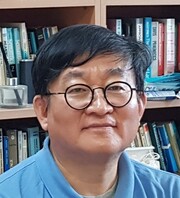
Professor Changbong Lee, Department of English Language and Literature, Catholic University of Korea, is a Ph.D. in Linguistics (Pragmatics major) from the University of Pennsylvania, USA. He mainly studies topics related to the closeness of language and culture, and is also active in writing English textbooks, study materials, and general liberal arts books. Recently published a book <About English in the Country of America> (published by people). As a linguist on Facebook, he is also actively writing articles to analyze and criticize Korean society and culture through language.
댓글